
Key Takeaways
A founder’s guide to startup MVP development that ships in a 3-week sprint instead of a 6-month build that quietly kills the company.
- Long builds are the risk, not the safety. 43% of startups fail from poor product-market fit (CB Insights), and every extra month before real users raises that risk.
- A well-scoped MVP takes weeks, not quarters. If your build runs past 1–3 months, the scope is not minimal enough.
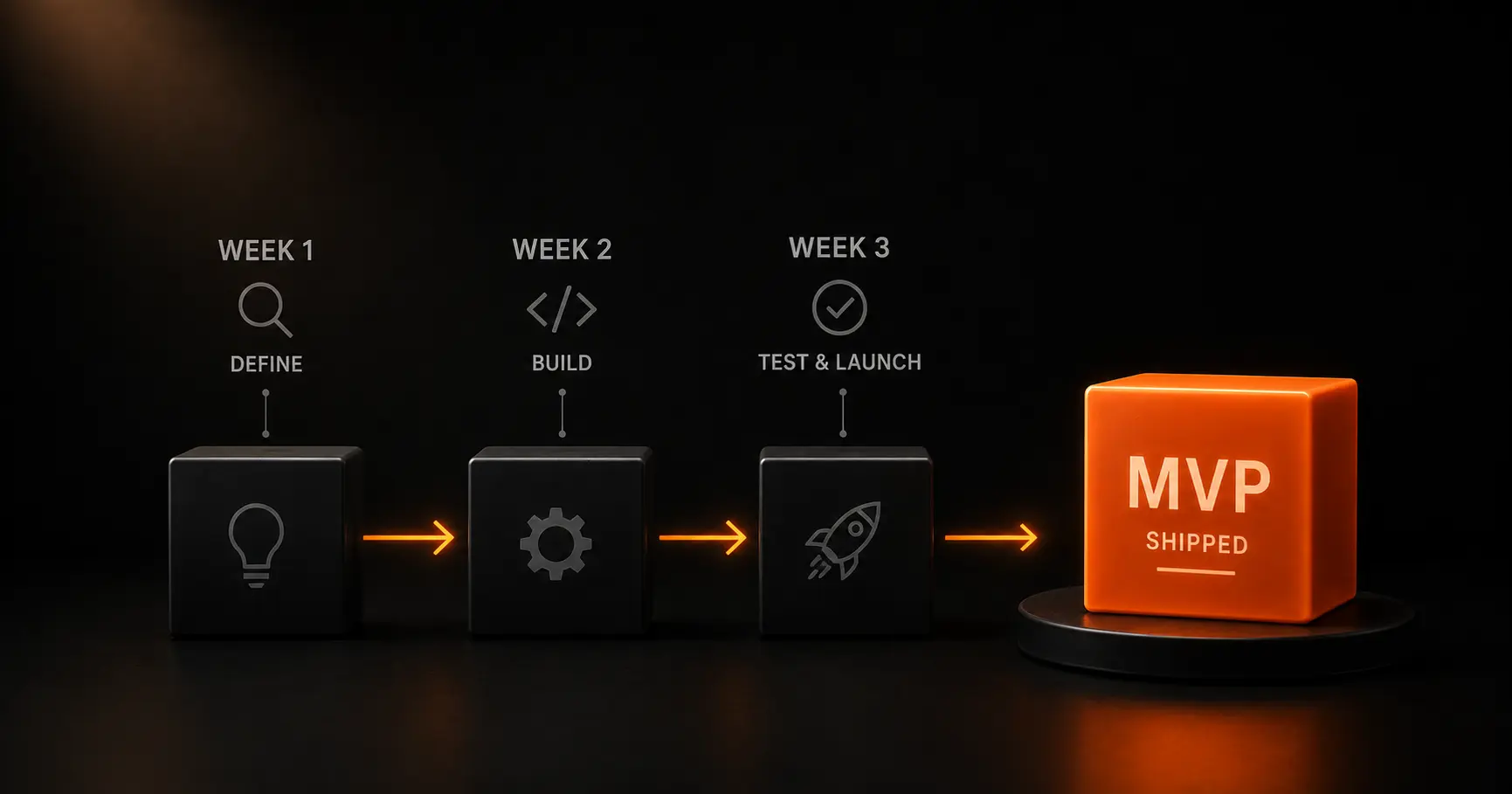
- The 3-week sprint has three phases: week one scopes and designs, week two builds, week three tests with real users and ships.
- 2026 changed the math. No-code, low-code, and AI-assisted development compress builds that used to take months into weeks.
- Ship imperfect, then iterate. Y Combinator’s core advice is to launch fast, get real usage, and improve from behavior, not opinions.
Most startup MVP development fails in the same quiet way: the build takes six months, the founder runs low on cash and nerve, and the first real user shows up far too late to change anything. The problem is rarely the code. It’s the calendar. Every month you spend building before anyone uses the product is a month betting your runway on a guess.
There’s a faster path, and it isn’t reckless. A focused three-week sprint ships a real, investor-ready MVP by doing less on purpose. This guide breaks down what MVP development actually is, why long builds fail, and the exact week-by-week sprint that gets you to a launched product without over-building.
Quick Verdict: Build your MVP in a tight 3-week sprint when you have one clear core use case and need to validate demand or raise a round. Scope ruthlessly, build on a no-code, low-code, and AI-native stack, and launch to real users in week three. Skip the 3-week path only if you haven’t talked to a single potential customer yet, or if you’re in deeply regulated infrastructure that genuinely can’t be staged. If you want a fixed-scope MVP sprint, talk to Velcod.
What Is Startup MVP Development, Really?
Startup MVP development is the process of building the smallest version of your product that delivers real value to real users, so you can learn what to build next from actual behavior. It is not a rough draft of the full product. It’s a deliberate, focused slice that proves one thing.
Y Combinator puts it plainly: an MVP should be ridiculously simple, the first thing you can hand to your first users to see if you deliver any value at all. The bar is a “quantum of utility,” not a feature list. Founders consistently overestimate how much they need to launch and underestimate how fast the market will teach them once they do.
Think of it as the smallest experiment that can still return a real answer, not a shrunken version of the finished product. The goal isn’t to impress; it’s to learn something true about whether people want what you’re building.
Why Do 6-Month MVP Builds Fail?
Long MVP builds fail because they delay the only thing that matters: contact with real users. The longer you build in private, the more confidently you march toward a product nobody asked for.
The data is unforgiving. CB Insights’ analysis of startup post-mortems found that 43% fail from poor product-market fit and 70% run out of cash, though the cash is usually the symptom, not the disease. Most companies that ran out of money did so because they built something the market didn’t want, and they found out too late to pivot. A six-month build is six months of burn before the market gets a vote.
The failure pattern is predictable:
- Scope creep. “While we’re at it” turns three features into thirteen.
- Building for a demo, not a user. The product impresses investors and does nothing for customers.
- Waiting for perfect. Founders polish in private instead of learning in public.
- No feedback loop. By the time real users arrive, the runway is gone and so is the flexibility to change.
Speed isn’t the opposite of quality here. Speed is the risk control.
The 3-Week MVP Sprint, Week by Week
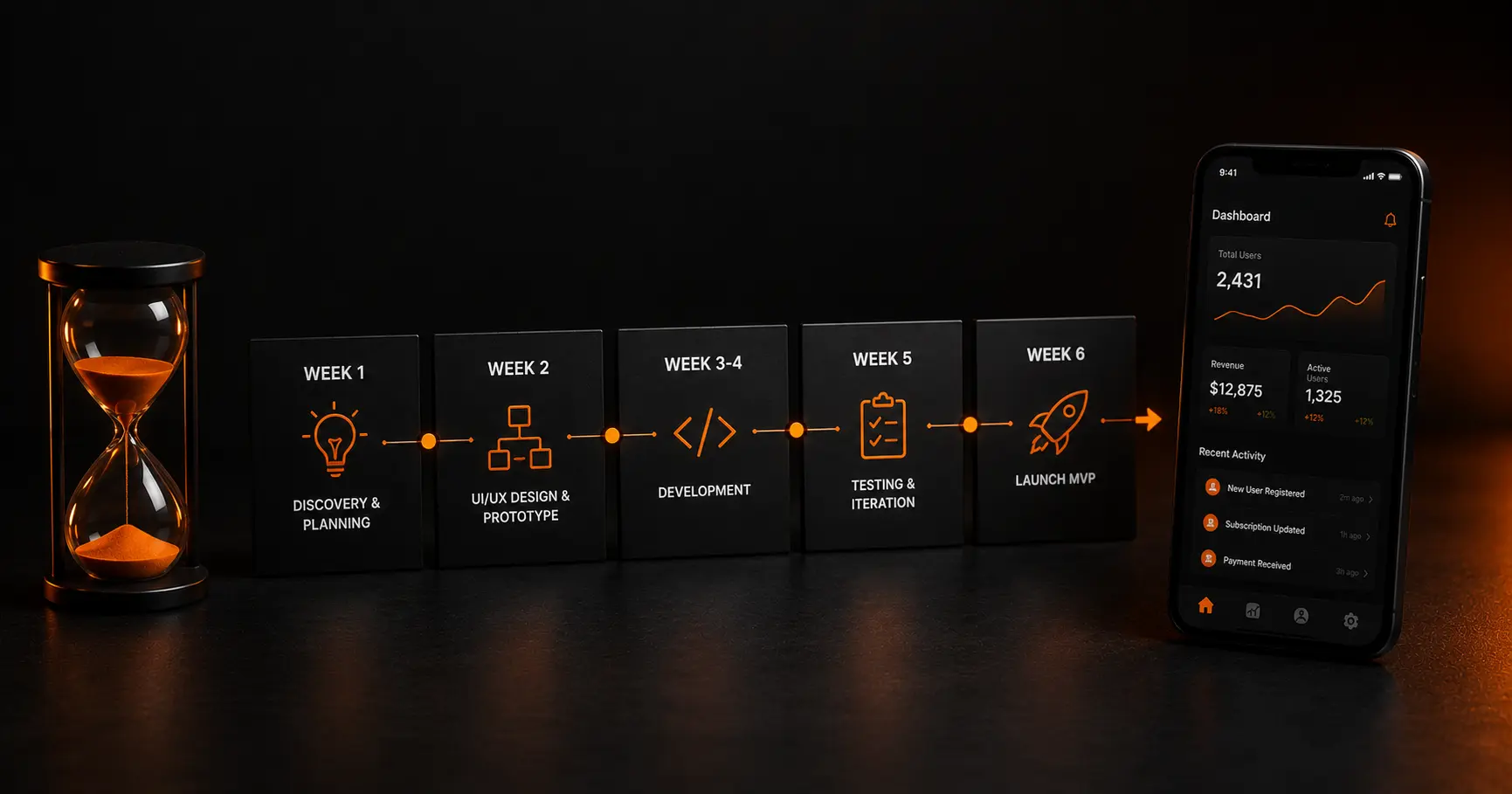
A three-week MVP sprint works because it front-loads decisions and forces a launch. Each week has one job, and nothing bleeds into the next.
Week 1: Scope and Design
The first week is about subtraction, not code. You pin down the single job your MVP must do, map the one user flow that proves it, and turn that into clickable wireframes or a prototype. Everything that doesn’t serve that one job gets cut or parked. This mirrors the Google Ventures design sprint, which compresses months of debate into days by forcing decisions early and testing a prototype before anyone commits to building. The output of week one is a prototype you could put in front of a user, plus a written, locked feature list everyone has agreed to. That agreement is what protects the next two weeks.
Week 2: Build
Week two is the build, and this is where 2026 changes the math. On a no-code, low-code, and AI-assisted stack, a senior team assembles the core flow, wires up authentication, data, and payments, and connects only the integrations that matter. For a marketplace or SaaS MVP, that usually means one working end-to-end path, such as a user signing up, completing the core action, and paying, rather than every screen the final product will eventually have. Builds that used to take months now happen in weeks, not because corners get cut, but because the tooling removed the slow, repetitive parts of engineering.
Week 3: Test and Launch
Week three is where most builds get lazy and most founders get burned. You test the MVP with real users, fix what breaks, wire in analytics so launch actually teaches you something, and ship. Y Combinator’s advice is blunt: launch something imperfect, get real people using it, and iterate from what they do, not what they say. You’re not chasing perfection here; you’re watching whether real people complete the core action and come back. Those two signals tell you more than any internal review. A demo impresses. A launched product teaches.
What Makes a 3-Week MVP Possible in 2026?
A three-week MVP is possible because the build layer got radically faster and the methodology got sharper. Two shifts do the heavy lifting.
First, the tooling. No-code and low-code platforms handle the plumbing that used to eat weeks, and AI-assisted development accelerates everything from data models to UI. A non-technical founder can now reach a working, production-ready application in a fraction of the old time. Second, the method. The design sprint model proved you can validate a real prototype in days instead of quarters, and MVP sprints apply that same discipline to shipping, not just testing.
Together they collapse the old “idea to launch” timeline. The constraint is no longer how fast you can build. It’s how ruthlessly you can scope.
What Does “Investor-Ready” Actually Mean for an MVP?
Investor-ready does not mean feature-complete. It means the MVP proves the two things investors actually fund: that people want this, and that your team can build and ship. In practice that’s a working core flow a stranger can use without hand-holding, early signal from real users, clean analytics that show engagement, a demo that runs live instead of on faith, and code you fully own.
Most pre-seed rounds are decided on traction and team, not on how many features you crammed in. A tightly built MVP with a hundred engaged users beats a bloated one with none. That’s why a sprint prioritizes a launched, measurable product over a long feature list: it produces exactly the evidence a founder needs in the room.
What to Build in Your MVP, and What to Cut
Your MVP should do one job extremely well and defer everything else. The single most common reason a three-week sprint slips is a founder who can’t let go of “just one more feature.”
Keep the one core flow that proves your value, the smallest data model that supports it, and the single conversion or activation moment that matters. Cut the settings pages, the admin dashboards, the second user type, the integrations you “might need,” and anything that doesn’t change whether a user gets value on day one. The lean startup approach frames this as build, measure, learn: you can only learn once something is in a user’s hands, so the fastest route to something real wins.
A useful test: if a feature doesn’t change whether a user or an investor believes the product works, it isn’t MVP scope.
How Do You Keep a 3-Week Sprint From Slipping?
A three-week sprint slips for human reasons, not technical ones. Protect the timeline with a few rules:
- Lock scope in writing before week one starts, and treat the feature list as fixed.
- Give one person final say. Design-by-committee is how three weeks becomes three months.
- Park every new idea in a “version 2” list instead of building it now. The list captures ideas without derailing the sprint.
- Build daily and test mid-sprint, not just at the end, so surprises surface while there’s still time to fix them.
- Prepare content and access early. Missing copy, logins, or brand assets stall more sprints than code ever does.
Discipline is the whole game. The tools can move fast, but the sprint only works if the people around it hold the line.
3 Weeks vs 3 Months vs 6 Months
There’s no universal right timeline, only the right one for your risk. But longer almost always means riskier, not safer.
| Timeline | What Usually Happens | The Trade-Off |
| 3-week sprint | One core flow, shipped and tested with real users | Demands ruthless scope discipline |
| 3-month build | Broader v1, more features, slower first feedback | Scope creep starts; learning comes later |
| 6-month build | A “complete” product before a single user | Highest risk: runway gone, or you built the wrong thing |
Who Should, and Shouldn’t, Build an MVP in 3 Weeks
Do it if you’re a non-technical founder with one clear core use case, you need to validate demand or raise a pre-seed round, and you’d rather learn from real users this month than launch a polished product next quarter. This is the lowest-risk path for the vast majority of early startups.
Don’t do it if you haven’t spoken to a single potential customer yet, because no sprint fixes an unvalidated problem. And be honest if you’re in genuinely heavy, regulated infrastructure where the core cannot be staged safely. Even then, most of the product can usually ship in a sprint while the hard part is handled separately.
How Velcod Ships Investor-Ready MVPs in 3 Weeks
Velcod runs MVP development as a fixed three-week sprint for non-technical founders. Week one scopes and designs, week two builds on an AI-native no-code and low-code stack, and week three tests with real users and ships, with full code ownership handed to you at the end. No scope creep, no mystery invoices, no six-month drift.
You can see the pattern in the case studies: real products with real early traction, built in weeks rather than quarters. The promise is deliberately simple, an investor-ready MVP in 3 weeks or it’s free, because a fixed, honest scope is exactly what keeps a startup out of the failure statistics. Book a build call and get a fixed quote, with no vague timelines and no runway-burning surprises.
Frequently Asked Questions
How long does startup MVP development take?
A well-scoped MVP should take weeks, not quarters. Traditional builds run 8 to 16 weeks, but a focused sprint on a no-code, low-code, and AI-assisted stack can ship a real product in about three weeks. If your build stretches past one to three months, that’s usually a signal your scope isn’t minimal enough.
How much does an MVP cost in 2026?
A simple no-code MVP typically costs $5,000–$20,000 and ships in 4 to 8 weeks, while complex AI or fintech products can reach $60,000–$150,000 or more. A tightly scoped sprint with a senior team lands at the lower end because ruthless scoping, not more engineering hours, is what controls the bill.
Can you really build an MVP in 3 weeks?
Yes, if scope is disciplined. Three weeks is enough to design one core flow, build it on modern no-code and AI-assisted tooling, and launch it to real users. What breaks a three-week timeline is almost never the technology; it’s feature creep and a founder who can’t cut. The speed comes from doing less on purpose.
What should an MVP include?
Only the one core flow that proves your value, the smallest data model that supports it, and the single activation moment that matters. Cut extra user types, admin panels, settings, and “might need it” integrations. If a feature doesn’t change whether a user gets value on day one, it belongs in version two, not the MVP.
Should I use no-code or custom code for my MVP?
Start with no-code or low-code to validate fast and cheap, then graduate to custom code once you have traction and know what to scale. For most founders, building the MVP in no-code and keeping full code ownership means you can move quickly now without a painful rebuild blocking you later.
Resources & Further Reading
- CB Insights: Why Startups Fail: the post-mortem data showing product-market fit and slow validation as top killers.
- Y Combinator: How to Plan an MVP: YC’s framework for scoping the smallest useful product.
- Y Combinator: How to Build an MVP: why launching imperfect and iterating beats waiting for perfect.
- GV: The Design Sprint: Google Ventures’ method for validating an idea in days, not months.
- Google Design: Design Sprints: the five-day sprint structure that inspired fast MVP workflows.
- The Lean Startup: Eric Ries on build-measure-learn and the true purpose of an MVP.