

Key Takeaways
A founder’s honest 2026 guide to choosing an MVP development company without wasting your runway on the wrong partner.
- The risk is real. Large IT projects run 45% over budget on average (McKinsey), and one in six becomes a “black swan” with a 200% overrun.
- Own your code from day one. The contract should say “Work Made for Hire,” with IP transferring on payment. Anything vaguer is a dealbreaker.
- Demand results, not screenshots. A real case study shows sign-up lift, retention, or a funded round, and lets you talk to the founder.
- Watch the pricing structure. A transparent partner splits the quote into discovery, build, and post-launch. A single line labeled “development” is a red flag.
- Expect $30,000–$150,000 for an agency MVP; scope discipline, not cheap hourly rates, is what actually controls the bill.
Choosing an MVP development company is one of the highest-stakes bets a non-technical founder makes, and the base rates are grim. McKinsey found that large IT projects run 45% over budget while delivering 56% less value than promised. For a startup, a blown MVP budget isn’t a line item. It’s the runway you needed to find product-market fit.
The good news: most founders get burned in predictable ways, and every one of them is avoidable if you know what to check. This guide covers how to vet an MVP development company, what it should cost, the contract terms that protect you, and the red flags that should end a conversation.
Quick Verdict: Choose an MVP development company that quotes a transparent, itemized price, gives you full code and IP ownership from day one, shows case studies with real outcomes (not screenshots), and offers 30 to 90 days of post-launch support. Expect $30,000–$150,000 for an agency MVP, less with tight scope. Walk away from anyone who quotes a fixed price before scoping, hides developers behind account managers, or gets cagey about IP. If you want a fixed-scope, full-ownership build, talk to Velcod.
What Does an MVP Development Company Do, and Why Is the Choice So High-Stakes?
An MVP development company designs and builds the first launchable version of your product, ideally shipping it fast enough to validate demand before your runway runs out. The best ones own the whole path: scoping, design, build, launch, and the first round of iteration based on real usage.
The choice is high-stakes because you’re not just buying code. You’re handing a stranger your timeline, your budget, and often your equity story. Get it right and you have a product investors and users can react to. Get it wrong and you have a bill, a half-working demo, and months you can’t get back. That asymmetry is why vetting matters more than the sticker price.
It’s also why “cheap” is the wrong first filter. The difference between a good MVP partner and a bad one is rarely the hourly rate. It’s whether they scope honestly, ship something real, and hand it over clean. A low quote that produces an unusable build is the most expensive thing you can buy as a startup.
Why Do So Many Founders Get Burned?
Most founders get burned because they optimize for the lowest quote instead of the clearest scope, and the cost shows up later. The cheap hourly rate becomes an open-ended bill; the vague proposal becomes a scope fight.
The overrun data is sobering. A landmark Harvard Business Review study of 1,471 IT projects found that one in six became a “black swan” with a 200% average cost overrun and nearly 70% schedule overrun. The Standish Group’s long-running research tells a similar story: only about a third of software projects fully succeed, while roughly half are “challenged” by budget, timeline, or scope problems. And CB Insights reminds us where that leads for startups: running out of cash is a top cause of death, usually because money went to the wrong build.
The specific traps are consistent:
- Vague pricing. A single line labeled “development” hides the scope games to come.
- Fixed quote before scoping. A real number requires a real discovery phase first.
- No IP clarity. If ownership isn’t yours from day one, your fundraise is at risk.
- Account-manager walls. If you can’t talk to the people building your product, updates get spun.
- Disappearing after launch. No post-launch support means you’re stranded the moment real users arrive.
How Do You Vet an MVP Development Company?
Vet an MVP development company by pressure-testing outcomes, ownership, and communication, not by comparing hourly rates. The signals below separate a partner from a template factory.
Green Flags: Ask For These
- Case studies with measurable results. Look for a sign-up lift, a churn reduction, or a funded round, plus the chance to speak directly with a founder they built for.
- Transparent, itemized pricing. A trustworthy partner splits the quote into discovery and design, development, and post-launch iteration.
- Real scoping before any quote. They ask hard questions about your market and users instead of agreeing with everything.
- Open communication. A shared Slack channel, view access to the task board, and a working demo every sprint.
- A stack chosen for you. They recommend tools based on your product’s needs, not the same stack they use for everyone.
Red Flags: Walk Away
- A 12-month MVP timeline. A focused MVP ships in roughly 8 to 16 weeks. Longer means the scope isn’t minimal.
- Cagey IP or termination terms. Difficulty here is a preview of how they’ll behave once your money is in.
- Yes to everything. A team that never pushes back either doesn’t understand your space or cares more about the invoice.
- Post-launch silence. No bug-fix window, no monitoring, no transition plan.
- Reviews only on their own site. Verify on Clutch and G2 instead of taking curated testimonials at face value.
What Questions Should You Ask Before You Sign?
The right questions surface a bad partner before the contract does. Ask these, and listen for specifics rather than reassurance:
- “Can I speak to a founder you built an MVP for?” A confident partner connects you; a nervous one deflects.
- “What happened to those products after launch?” You want adoption, retention, or funding, not just a launch date.
- “What’s in and out of scope, in writing?” A clear line between the MVP and version two prevents the scope fight later.
- “Who exactly will build this, and can I talk to them?” Verify you’re getting senior builders, not a sales team fronting for juniors.
- “What stack do you recommend for my product, and why?” A specific answer signals engineering judgment; the same stack for everyone signals a template factory.
- “What do you need from me to stay on schedule?” Honest partners admit that delays are usually shared.
Vague, buzzword-heavy answers are themselves the answer.
What Should an MVP Development Company Cost in 2026?
An agency MVP typically costs $30,000–$150,000 in 2026, and the right number depends far more on scope than on geography. Roughly, a simple MVP runs $10,000–$30,000, a medium build $30,000–$80,000, and a complex product $80,000–$200,000 or more. AI-assisted development is compressing timelines, and therefore billed hours, by 40 to 60 percent. Here’s how the pricing models compare:
| Model | How It Works | Best For | Watch Out For |
| Fixed price | One quote for a defined scope | Budget certainty, well-scoped MVPs | ~10–15% premium; change orders for any change |
| Time & materials | Pay for hours worked, $50–$150/hour onshore | Evolving scope, agile builds | Total cost is hard to predict; it can drift |
| Offshore or freelancer | Lower rates, $20–$80/hour | Very tight budgets | You absorb project management, QA, and architecture |
Fixed price costs a little more but buys certainty, which is usually worth it for a first build. The metric that actually matters is not the hourly rate but the effective cost per delivered, working feature.
The Contract Details That Actually Protect You
Two clauses decide whether you’re safe. First, IP ownership: the contract should state “Work Made for Hire,” with the code, design assets, and database credentials transferring to you immediately upon payment. Investors will check this. Second, a fair termination clause and a defined post-launch window, typically 30 to 90 days of bug fixes and monitoring. If a company resists either, that resistance is the most honest thing they’ll show you all process.
Is a Cheaper Offshore Team Worth It?
Offshore teams in regions like Eastern Europe and South Asia can cut an MVP’s cost by 30 to 50 percent, and plenty of excellent engineers work there. The savings are real, but so are the hidden costs: timezone gaps that slow feedback, communication friction that breeds rework, and coordination that quietly lands back on you.
The honest answer depends on your role. If you’re technical enough to manage scope, review work, and run QA, a strong offshore team can be a genuine bargain. If you’re a non-technical founder, the money you save on the hourly rate often gets spent, with interest, on the hours you now have to spend managing the build. Cheaper per hour is not the same as cheaper per shipped MVP.
Freelancer vs Agency vs MVP Development Company
The labels blur, but the trade-offs are real.
| Option | Best For | Watch Out For |
| Freelancer | Small, well-defined MVPs on a tight budget | Single point of failure; you manage QA and architecture |
| Staff-aug dev agency | Extra hands when you already have a technical lead | Bills hours, not outcomes; scope can drift |
| MVP development company | Non-technical founders needing a shipped, owned MVP | Quality varies widely; vet for ownership and results |
Who Should, and Shouldn’t, Hire an MVP Development Company
Hire one if you’re a non-technical founder who needs a real product shipped and owned, you value speed and budget certainty, and you’d rather buy senior experience than spend months assembling a team. For most early startups, this is the fastest route to something investors and users can respond to.
Don’t hire one if you have a strong in-house technical team with spare capacity, or if you haven’t validated the problem yet. If you’re not sure anyone wants this, a cheap prototype or a landing-page test teaches you more than any build. Validate first, then hire a company to build the version worth paying for. Spending seed money on an unproven idea is the most common way founders turn a fixable problem into a fatal cash problem.
How Velcod Removes the Risk
Velcod is an MVP development studio built for non-technical founders who can’t afford to get burned. Every part of the model answers the vetting checklist directly: fixed pricing so the budget can’t balloon, full code and IP ownership handed to you at the end, a senior-only team that scopes hard before it builds, and a shipped product in weeks rather than quarters. You can see the outcomes in the case studies, with real founders and real early traction.
No account-manager walls, no vague “development” line items, no disappearing after launch. The guarantee is simple: an investor-ready MVP in 3 weeks or it’s free. If you’re comparing partners, hold every one of them to that standard. Book a call and get a fixed, itemized quote.
Frequently Asked Questions
How much does it cost to hire an MVP development company in 2026?
An agency MVP typically costs $30,000–$150,000, with simple builds at $10,000–$30,000 and complex ones above $80,000. Fixed-price contracts run about 10 to 15 percent higher than hourly billing but give you budget certainty. Scope discipline, not a cheap hourly rate, is what actually controls the final bill.
How do I make sure I own my MVP’s code?
Put it in the contract before work starts. It should state “Work Made for Hire,” with the code, design files, and database credentials transferring to you the moment you pay. You should also hold the accounts and repositories yourself. Investors verify IP ownership, so vague terms here can put a future round at risk.
What are the biggest red flags when choosing an MVP company?
A fixed quote before any scoping, a 12-month timeline for an MVP, resistance to clear IP or termination terms, communication only through account managers, and a portfolio of screenshots with no measurable results. Any one of these is a reason to keep looking. Together they signal a template factory, not a partner.
Should I hire a freelancer, an agency, or an MVP development company?
A freelancer suits a small, well-defined build on a tight budget, but you carry the coordination risk. A staff-augmentation agency adds hands if you already have a technical lead. An MVP development company is the best fit for a non-technical founder who needs a shipped, owned product and wants outcomes rather than billed hours.
How long should an MVP take to build?
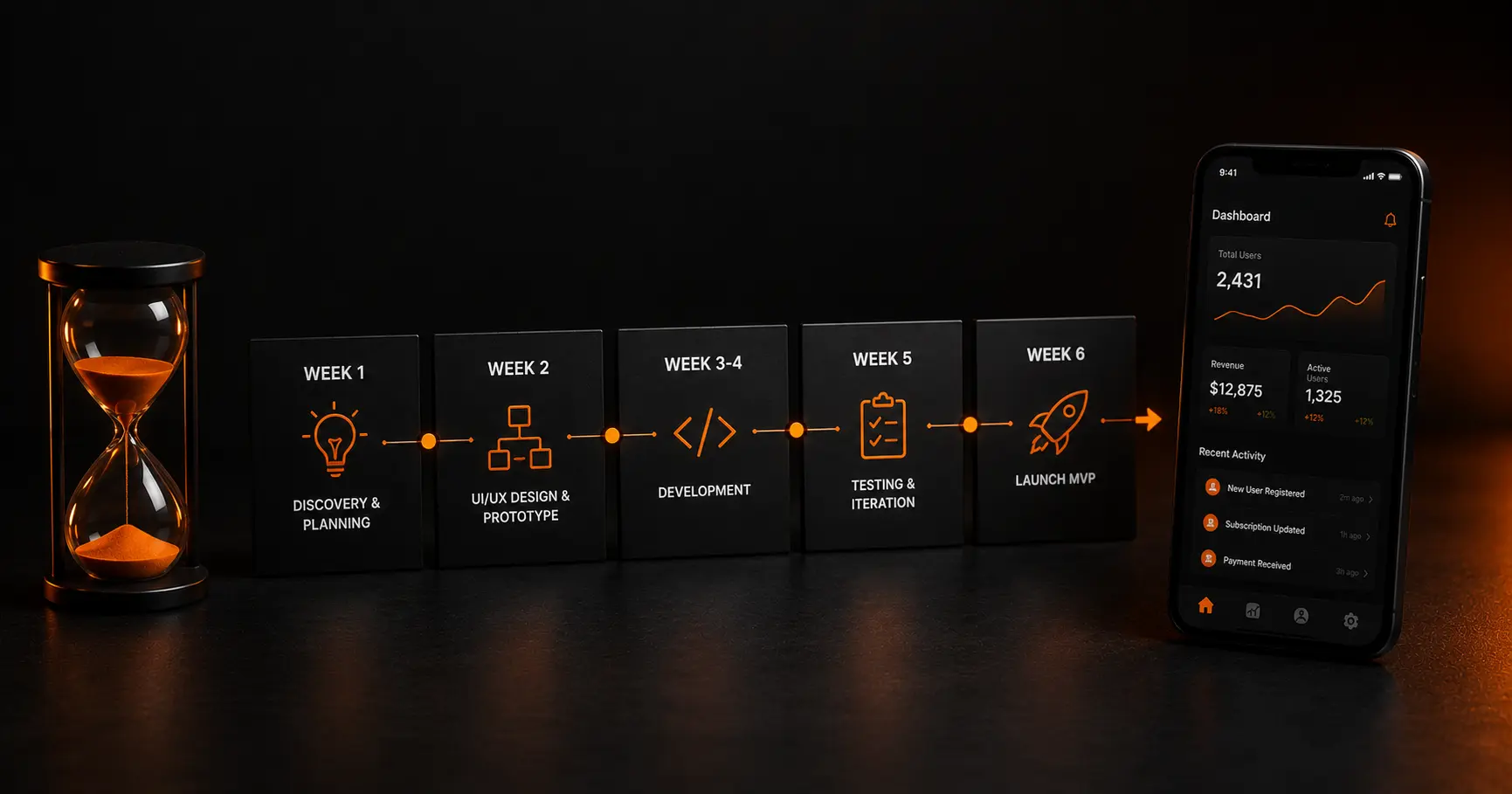
A focused MVP should ship in roughly 8 to 16 weeks, and a tightly scoped sprint can do it in about three. If a company quotes 12 months, the scope isn’t minimal enough or they’re padding. Longer timelines mean more burn before real users get a vote, which is exactly the risk an MVP is meant to reduce.
Resources & Further Reading
- McKinsey: Delivering Large-Scale IT Projects: the data on IT projects running over budget and under value.
- Harvard Business Review: Why Your IT Project May Be Riskier Than You Think: the “black swan” overrun study across 1,471 projects.
- CB Insights: Why Startups Fail: why wasted build budgets translate into dead startups.
- Clutch: verified B2B agency reviews to cross-check any MVP development company.
- G2: third-party software and vendor ratings for tools and platforms.
- Y Combinator: Essential Startup Advice: founder-first guidance on building and shipping the right thing.