
Key Takeaways
A realistic, week-by-week mobile app MVP development timeline for founders, plus the factors that speed it up or quietly blow it out.
- Plan for 8 to 16 weeks from idea to launch for a well-scoped mobile MVP. Simple apps can ship in 6 to 10.
- The build is only part of it. Discovery, design, testing, and app store review each take real time.
- App store review is faster than most expect. Apple usually clears in 1 to 3 days; Google Play in 2 to 7, longer for brand-new accounts.
- Every extra feature adds 1 to 2 weeks. Scope discipline is the biggest lever on your timeline.
- AI tools speed coding 40 to 60%, but only the build phase, not discovery, testing, or review.
The honest answer to the app development timeline question is 8 to 16 weeks for a well-scoped mobile MVP, and most quotes you’ll hear are optimistic because they only count the coding. The build is the visible part, but discovery, design, testing, and app store review each consume real time, and skipping any of them is how “six weeks” quietly becomes six months.
This guide lays out a realistic week-by-week timeline for building a mobile app MVP, from the first discovery session to the day it’s live in the App Store and Google Play. You’ll see how long each phase actually takes, how much app store review adds, what speeds things up, and the common mistakes that wreck a schedule.
How Long Does It Take to Build a Mobile App MVP?
A well-scoped mobile app MVP takes 8 to 16 weeks from concept to launch. The range depends almost entirely on complexity, which is why an honest estimate always starts with scope, not a calendar.
| MVP Complexity | Realistic Timeline |
| Simple (3 to 5 core features) | 6 to 10 weeks |
| Mid-complexity (marketplace, social) | 10 to 14 weeks |
| Complex (AI, real-time features) | 14 to 20 weeks |
A simple MVP with a handful of features and a standard backend lands at the low end. Add a marketplace, real-time messaging, or AI, and each layer pushes you up the range. The single most useful thing to remember: every additional feature adds one to two weeks, so the fastest way to a shorter timeline is a smaller, sharper scope.
It’s worth being clear about what “launch” means here: a real, store-approved app that early users can download and use, not a prototype or a TestFlight build. That distinction is exactly why honest estimates look longer than the ones that quietly count only the coding.
The Week-by-Week Mobile App MVP Timeline
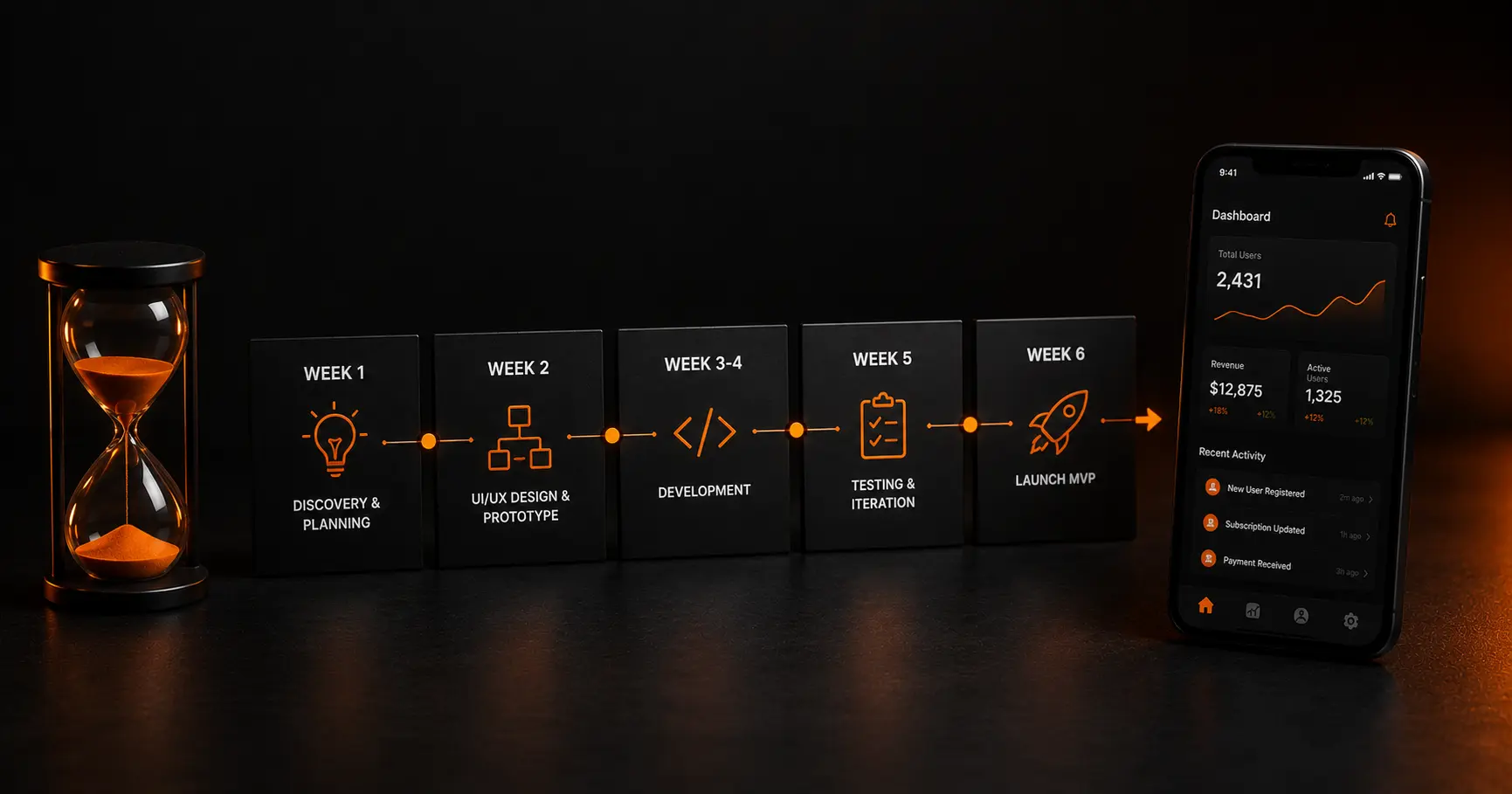
A realistic mobile MVP moves through five phases, and they overlap less than founders hope. Here’s how a typical 12-week build breaks down.
| Phase | Typical Duration | What Happens |
| Discovery | 1 to 3 weeks | Scope, user personas, prioritized features, success metric |
| Design | About 2 weeks | Wireframes and a clickable prototype |
| Build | 8 to 12 weeks | Agile sprints with weekly demos |
| Testing and QA | Overlaps the build | Functional testing, UAT, performance, security, soft launch |
| App store review | 1 to 7 days | Submission and approval on each store |
Weeks 1 to 2: Discovery and design. You lock the problem, the users, and a lean feature list, then turn it into wireframes and a clickable prototype. A design sprint compresses this into about a week when the team is decisive. Rushing this phase is tempting and always backfires, because a vague scope makes every later week longer.
Weeks 3 to 10: Build. The bulk of the timeline. Work happens in weekly sprints with demos so you catch drift early, wiring up the app, the backend, authentication, and any integrations.
Weeks 9 to 12: Testing and QA. Good teams test throughout the build, not at the end. This covers functional testing, user acceptance testing, performance and security checks, and a soft launch to a small group before the public one.
Week 12 and beyond: Submit and iterate. You submit to the stores, then plan 2 to 6 weeks of post-launch fixes and improvements based on how real users behave.
How Long Does App Store Review Take in 2026?
App store review is faster than most founders fear, but it’s not instant, and it belongs in your timeline. In 2026, Apple usually clears submissions in 1 to 3 days, while Google Play takes 2 to 7 days, with brand-new developer accounts waiting longest.
Apple’s App Review has become surprisingly quick, often clearing established accounts within a day, though new apps can sit in “waiting for review” for two to three days. Google Play is generally slower, and a first submission from a new developer account can take 7 to 14 days while your account is vetted, after which updates clear in hours to a few days. The practical takeaway: create and verify your developer accounts early, submit a complete listing, and budget a buffer for review so a rejection doesn’t derail your launch date.
What Affects Your Mobile App MVP Timeline?
Your timeline is driven by scope first and everything else second. Five factors move it the most, and being honest about them upfront prevents painful surprises later.
- Feature count. The biggest lever. Each feature adds one to two weeks, so ruthless prioritization is the fastest accelerant.
- Number of platforms. Building for iOS and Android separately roughly doubles the work versus a shared codebase.
- Backend complexity. A simple managed backend is fast; custom infrastructure, complex data, or heavy integrations add weeks.
- Design maturity. A clear brand and design system speeds things up; inventing it mid-build slows everything down.
- Team and decisions. A senior team with one decision-maker moves far faster than a large team seeking consensus.
None of these factors are hidden; they just get ignored in optimistic estimates. The fix is to name them at the start. A team that tells you a 12-week app will take 12 weeks, and explains which of these factors drive the number, is more trustworthy than one that promises six and quietly slips. Ask any partner to break their estimate down by phase.
What Should You Build Now vs Save for Version 2?
Because scope drives the timeline, deciding what to cut is the highest-leverage way to hit a launch date. The MVP should contain only the features that prove your core value, and everything else waits for version two.
Build now: the single core workflow, account creation and login, and the one action that delivers your main value. That’s usually enough to test whether people want the app. Save for later: social logins beyond one provider, in-app chat, push-notification campaigns, admin analytics dashboards, multiple user roles, and any “nice to have” a user could live without on day one. A blunt test helps: if a feature doesn’t change whether an early user gets value or comes back, it isn’t MVP scope. Every feature you defer is one to two weeks you get back, and features are far easier to add after launch than to remove once users depend on them.
Does Cross-Platform or No-Code Build Faster?
Yes. A cross-platform or no-code approach can cut a mobile MVP timeline dramatically versus building two separate native apps. The choice of build method is one of the biggest timeline decisions you make.
Native development, writing separate Swift and Kotlin apps, produces the most polished result but roughly doubles the effort. Cross-platform frameworks like Flutter and React Native let you build one codebase for both stores, which is why most startups use them for an MVP. No-code and low-code tools like FlutterFlow go further still, letting non-technical founders ship a real app in weeks. For a first version whose job is to validate demand, cross-platform or no-code is almost always the faster, cheaper, and smarter call.
How Is AI Changing MVP Timelines in 2026?
AI-assisted development is compressing the build phase by 40 to 60 percent in 2026, but only the build phase. Tools like GitHub Copilot and Cursor accelerate the actual coding, so the slice of your timeline that used to be the longest is now shorter.
The important caveat is that AI speeds writing code, not the rest of the process. Discovery still takes conversations, design still takes iteration, testing still takes real users, and app store review still takes the stores’ time. A team promising an AI-built app “in days” is usually talking about a prototype, not a launch-ready MVP that survives real users. Used well, AI shifts a 12-week build toward the shorter end of the range; it doesn’t erase the phases around it.
A Realistic Example: An 8-Week Build vs a 16-Week Build
To make the ranges concrete, compare two real-world scenarios. An 8-week build might be a simple booking app: three core screens, email login, and a managed backend like Supabase, built cross-platform in a tool like FlutterFlow. Discovery and design take about a week, the build runs five to six weeks with testing throughout, and store review adds a few days.
A 16-week build might be a two-sided marketplace with payments, in-app messaging, and matching logic. Discovery and design take two to three weeks because the flows are more complex, the build runs ten to twelve weeks, testing is heavier because there’s more that can break, and a brand-new developer account can add a week of Google Play review. Same disciplined process, very different scope. The scope, not the team’s speed, is what sets these two timelines apart, which is why cutting features is the surest way to a shorter one.
What Are the Most Common Timeline Mistakes?
The most common timeline mistake is counting only the build and ignoring everything around it. Founders hear “eight weeks of development” and assume eight weeks to launch, forgetting discovery, testing, and review. The other errors compound it:
- Skipping discovery. A fuzzy scope makes every later phase longer and invites rework.
- Testing only at the end. Bugs found late cost far more time than bugs found each sprint.
- Forgetting app store review. A rejection with no buffer can slip your launch by a week or two.
- Scope creep. “Just one more feature” is how a 10-week plan becomes a 20-week one.
- No single decision-maker. Consensus-seeking quietly adds weeks no one budgeted.
How Do You Ship a Mobile App MVP Faster Without Cutting Corners?
You ship faster by narrowing scope, choosing cross-platform or no-code, testing continuously, and keeping one person empowered to make calls. Speed in mobile MVPs comes from doing less and deciding faster, not from skipping the phases that keep the app from breaking.
This is how Velcod approaches mobile app development for founders: a tight scope, an AI-assisted cross-platform build, and testing baked into each sprint, so a real MVP ships in weeks rather than months, with full code ownership at the end. You can see the pace in the case studies, where mobile products launched fast without becoming demo-ware.
A realistic timeline isn’t the enemy of speed; it’s what makes speed repeatable. Plan for the phases you can’t skip, cut the scope you don’t need, and you’ll hit a launch date you can actually trust. If you want a realistic timeline for your app before you commit, talk to the team.
Frequently Asked Questions
How long does it take to build a mobile app MVP?
A well-scoped mobile app MVP takes 8 to 16 weeks from concept to launch. Simple apps with three to five features can ship in 6 to 10 weeks, mid-complexity apps like marketplaces take 10 to 14, and complex apps with AI or real-time features take 14 to 20. Scope is the biggest factor in where you land.
How long does app store approval take?
In 2026, Apple’s App Store usually approves apps in 1 to 3 days, and Google Play takes 2 to 7 days. A first submission from a brand-new Google developer account can take 7 to 14 days while the account is vetted. Create and verify your developer accounts early and submit complete metadata to avoid delays.
What takes the most time when building an app MVP?
The build phase is the longest, typically 8 to 12 weeks of the total. But discovery, design, testing, and app store review together often add as much time as founders expect the whole project to take. Underestimating those surrounding phases is the single most common reason app timelines slip past the original estimate.
Can AI tools make app development faster?
Yes, but selectively. AI coding tools like GitHub Copilot and Cursor speed the build phase by 40 to 60 percent in 2026. They don’t shorten discovery, design iteration, real-user testing, or app store review. A team claiming an AI-built app in days usually means a prototype, not a launch-ready MVP that holds up under real users and store scrutiny.
Is it faster to build for iOS and Android separately or together?
Together. Building separate native iOS and Android apps roughly doubles the effort. Cross-platform frameworks like Flutter and React Native use one codebase for both stores, and no-code tools like FlutterFlow are faster still. For an MVP focused on validating demand, a shared codebase is almost always the faster and more cost-effective choice.
Resources & Further Reading
- Apple App Review: official guidance and current expectations for App Store review.
- Google Play: Publish Your App: the Play Console publishing and review process.
- Flutter: Google’s cross-platform framework for building both stores from one codebase.
- React Native: Meta’s cross-platform framework, a common MVP choice.
- GV: The Design Sprint: how to compress the design phase into about a week.
- Statista: mobile app market and usage data for context.