
Key Takeaways
A clear guide to multi-tenant SaaS architecture: the single vs multi-tenant choice, the three data models, and how to isolate tenant data safely.
- Multi-tenant means shared, single-tenant means dedicated. Most SaaS runs multi-tenant because it’s cheaper to scale and maintain.
- There are three data models: shared database with a tenant ID, shared database with separate schemas, and a database per tenant.
- Row-level security is the workhorse. It enforces at the database engine that a query only ever returns one tenant’s rows.
- Watch the noisy neighbor. In a shared database, one heavy tenant can slow the rest unless you plan for it.
- Most startups should start shared and go hybrid later, moving enterprise or regulated tenants to dedicated databases as needed.
The multi-tenant SaaS architecture decision is one of the few you make early that’s genuinely painful to reverse. It shapes your costs, your security posture, your compliance story, and how easily you scale, all before you have many customers. Get it right and the app grows quietly; get it wrong and you’re re-architecting your data layer while customers are live.
The good news is that the trade-offs are well understood, and you don’t need to invent anything. This guide explains what multi-tenant architecture is, how it differs from single-tenant, the three data models you can choose from, how row-level security actually isolates tenant data, and how to pick the right model for your stage without over-engineering.
What Is Multi-Tenant SaaS Architecture?
Multi-tenant SaaS architecture is a design where many customers, called tenants, share a single application instance and infrastructure while their data stays logically separated. One codebase, one deployment, many customers. It’s the default for modern SaaS because it’s dramatically cheaper to run and easier to update than giving every customer their own copy.
The contrast is single-tenant architecture, where each customer gets a dedicated instance of the software and its infrastructure. That buys strong isolation at the cost of running many copies. The core tension in all of this is simple: multi-tenancy trades some isolation for enormous efficiency, and your job as an architect is to claw back that isolation through careful data design so no tenant ever sees another’s data.
Think of it as an apartment building versus a row of houses. Multi-tenancy is one building with many units: shared foundation, plumbing, and roof, but locked doors between units. Single-tenancy gives each family a separate house: more privacy and control, and far more to build and maintain.
Single-Tenant vs Multi-Tenant: What’s the Difference?
The difference comes down to whether customers share infrastructure. Single-tenant gives each customer a dedicated stack; multi-tenant shares one stack across all of them. Each has a clear profile:
| Factor | Single-Tenant | Multi-Tenant |
| Cost | Higher, one stack per customer | Lower, shared across all |
| Isolation | Strong, physically separate | Logical, must be enforced |
| Scaling | Harder, more instances to manage | Easier, add shared resources |
| Updates | Deploy to each instance | Deploy once for everyone |
| Compliance | Simpler to isolate data | Achievable with careful design |
Single-tenant shines for heavy compliance, enterprise deals that demand isolation, and deep per-customer customization. Multi-tenant wins on cost, speed of iteration, and scale, which is why the vast majority of SaaS products, especially startups, choose it. The Microsoft multitenancy guidance frames these as a spectrum rather than a binary, and mature products often land somewhere in between.
What Are the Three Multi-Tenant Data Models?
There are three main ways to store tenant data, and they trade isolation against cost and complexity. Picking among them is the heart of multi-tenant schema design.
| Data Model | Isolation | Cost | Best For |
| Shared database, shared schema (tenant ID + RLS) | Logical | Lowest | Most startups, high scale |
| Shared database, separate schema per tenant | Medium | Medium | Middle ground, some isolation |
| Database per tenant | Strong, physical | Highest | Enterprise, regulated tenants |
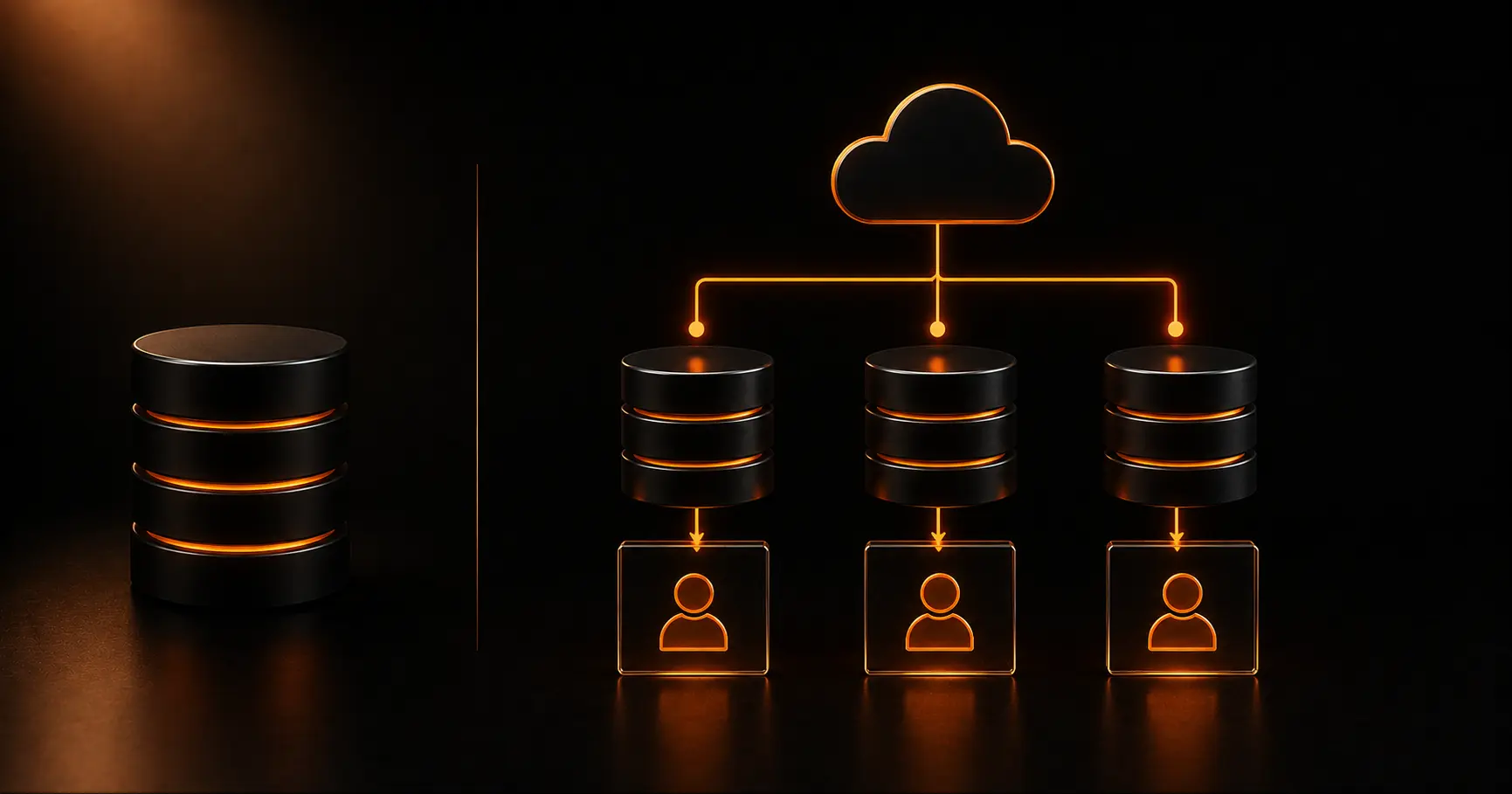
In the shared schema model, every tenant’s rows live in the same tables, tagged with a tenant ID column, and row-level security keeps them apart. It’s the cheapest and most scalable, and it’s where most SaaS should start. The separate schema model gives each tenant its own set of tables in one database, a compromise between cost and isolation. The database-per-tenant model gives each tenant a dedicated database, the strongest isolation and the answer to the noisy neighbor problem, at the highest cost and operational load. Microsoft’s storage guidance covers each in depth, and many teams blend them.
How Do You Design a Multi-Tenant Database Schema?
In a shared-schema model, good multi-tenant schema design starts with one rule: every tenant-owned table carries a tenant ID column, and nothing queries those tables without it. That single column is the backbone of isolation, indexing, and any future migration.
A few practices separate a clean design from a painful one. Put the tenant ID first in composite indexes so tenant-scoped queries stay fast as data grows. Set the tenant context once per request as a trusted, server-side session value that row-level security reads, rather than threading it through application code. Keep shared reference data that every tenant uses, like country or currency lists, in separate tables with no tenant ID. And design migrations to run across all tenants at once, which is a quiet advantage of the shared model over database-per-tenant, where you have to migrate many databases in lockstep.
Done well, the schema makes isolation automatic and turns pulling a tenant out later into a straightforward export rather than a rescue operation.
How Does Tenant Data Isolation Work?
Tenant data isolation in a shared database is enforced primarily by row-level security, a database feature that guarantees a query only ever returns rows belonging to the current tenant. Instead of trusting every query in your application code to include a tenant filter, RLS pushes that rule down into the database engine itself, where it can’t be forgotten.
The mechanism is a policy attached to each table that checks the current tenant context on every read and write. PostgreSQL’s row security policies and Azure SQL both support this, and platforms like Supabase make it the default way to build. AWS documents the same pattern for multi-tenant isolation with PostgreSQL RLS. The reason this matters so much: in multi-tenancy, a single missing WHERE clause can leak one customer’s data to another, and engine-level isolation is what stops a small bug from becoming a breach.
What Is the Noisy Neighbor Problem?
The noisy neighbor problem is when one overactive tenant consumes shared resources and degrades performance for everyone else in the same database. A single customer running heavy reports can slow queries for every other tenant sharing that database, and they’ll never know why their app got sluggish.
Shared models are the most exposed to it, which is the main argument for physical separation at scale. The database-per-tenant model solves it completely at the data tier, since no tenant can touch another’s resources. Short of that, you mitigate it with resource limits, elastic pools that cap and balance usage, connection management, and monitoring that flags a tenant consuming more than its share. The practical answer for most startups is to plan for it early with limits and monitoring, then move the heaviest tenants to dedicated resources when they outgrow the shared pool.
How Does Multi-Tenancy Affect Security and Compliance?
In multi-tenant architecture, tenant isolation is a security boundary, not just a data-modeling choice. A flaw that lets one tenant read another’s data is a breach, so isolation deserves the same rigor as authentication. Row-level security, least-privilege database roles, and a trusted server-side tenant context are the core defenses.
Compliance adds another layer. Regulations like GDPR and HIPAA care about data residency, access control, and a customer’s right to have their data exported or deleted. In a shared database, cleanly deleting one tenant’s data depends on that tenant ID discipline being applied everywhere; in a database-per-tenant model, it can be as simple as dropping a database. This is often the real reason enterprise and regulated customers push for dedicated databases, and why a tiered model that can offer isolation on demand is such a practical answer. Plan the compliance story before a big customer’s security team asks, not after.
How Do You Choose the Right Tenancy Model?
Choose the simplest model that meets your isolation and compliance needs, then evolve. For most startups that means starting with a shared database, shared schema, and row-level security, because it’s the cheapest to run and fastest to build while still keeping data private.
The evolution is where good architecture shows. As you win enterprise or regulated customers who demand stronger isolation, you move them to a dedicated database while keeping smaller tenants on the shared pool. This hybrid, tiered approach is exactly how mature SaaS products operate: shared-everything for free and standard tiers, dedicated resources for premium and enterprise. The mistake is committing to database-per-tenant on day one for scale you don’t have, or clinging to a single shared database long after a major customer needed isolation. Design the shared model so that peeling a tenant out later is a migration, not a rebuild. In other words, optimize for reversibility: the best early decision is the one that keeps your future options open cheaply.
What Are the Most Common Multi-Tenant Architecture Mistakes?
The most common multi-tenant mistake is enforcing isolation in application code instead of the database. One forgotten tenant filter and you have a data leak. The others show up just as predictably:
- No row-level security. Relying on every query being written correctly forever is a losing bet.
- Over-engineering isolation early. Building database-per-tenant before you have enterprise customers wastes money and time.
- Ignoring the noisy neighbor. No limits or monitoring until one tenant takes the app down.
- No path to dedicated. A shared design so rigid that isolating one big customer means re-architecting.
- Weak tenant context. Deriving the tenant from something spoofable instead of a trusted, server-side identity.
The theme is consistent: let the database enforce isolation, and never trust application code to remember what the engine can guarantee for you.
How Do You Build Multi-Tenant SaaS the Right Way?
Build multi-tenant SaaS by starting shared, enforcing isolation at the database with row-level security, and keeping a clean path to dedicated resources for the tenants who will eventually need them. That combination gives you low cost and fast iteration now, without painting yourself into a corner later.
This is the approach Velcod takes when building SaaS products for founders. Multi-tenancy goes in from the first sprint on a Postgres-based stack with row-level security as the default, so tenant data is isolated at the engine level and the architecture can grow into a hybrid model as enterprise customers arrive. You keep full code ownership of the whole system. You can see how that plays out in the case studies.
The right architecture is the one that fits your stage and doesn’t block your next one. For almost every startup, that’s a shared database with strong isolation and a deliberate plan to tier up. If you’re building a SaaS product and want the tenancy model designed correctly from the start, talk to the team.
Frequently Asked Questions
What is multi-tenant SaaS architecture?
Multi-tenant SaaS architecture is a design where many customers share a single application instance and infrastructure while their data stays logically separated. It’s the standard model for modern SaaS because it’s cheaper to run and easier to update than giving each customer a dedicated instance. Isolation is enforced through data design, usually row-level security.
What is the difference between single-tenant and multi-tenant?
Single-tenant gives each customer a dedicated instance of the software and infrastructure, offering strong isolation at higher cost. Multi-tenant shares one instance across many customers, which is cheaper and easier to scale and maintain. Most SaaS products choose multi-tenant and use careful data design to keep each customer’s information private and separate.
How do you isolate data in a multi-tenant database?
The most common method is row-level security, a database feature that ensures every query returns only the current tenant’s rows. It enforces isolation at the engine level rather than trusting application code to filter correctly. Alternatives include a separate schema per tenant or a dedicated database per tenant for stronger, physical isolation.
What is the noisy neighbor problem in multi-tenancy?
It’s when one heavy-usage tenant consumes shared resources and slows performance for other tenants in the same database. It mainly affects shared models. You mitigate it with resource limits, elastic pools, and monitoring, or eliminate it by giving demanding tenants a dedicated database. Planning for it early prevents one customer from degrading everyone’s experience.
Which multi-tenant model should a startup use?
Most startups should start with a shared database, shared schema, and row-level security. It’s the cheapest and fastest to build while keeping data isolated. As you win enterprise or regulated customers who need stronger isolation, move them to dedicated databases in a hybrid model. Avoid database-per-tenant on day one for scale you don’t yet have.
Resources & Further Reading
- Microsoft Learn: Tenancy Models for a Multitenant Solution: the canonical breakdown of tenancy models and trade-offs.
- Microsoft Learn: Storage and Data Approaches for Multitenancy: how to design the data tier for multiple tenants.
- Microsoft Learn: Multitenant SaaS Patterns (Azure SQL): patterns including database-per-tenant and elastic pools.
- AWS: Multi-Tenant Data Isolation with PostgreSQL RLS: a practical guide to isolating tenants with row-level security.
- PostgreSQL: Row Security Policies: the official reference for row-level security.
- Supabase: Row Level Security: applying Postgres RLS in a modern SaaS stack.