

Key Takeaways
A buyer’s guide to nearshore software development: the employer question, the cross-border IP chain, and the three costs outside the quoted rate.
- Four different employment models hide behind the same proposal. Ask which one you are in before you compare rates.
- Under 17 U.S.C. 204(a) a transfer must be signed by the owner of the rights. Your MSA signatory may not be that person.
- The IRS defines a withholding agent as anyone with control or payment of a foreign person’s income. Pay individuals directly and that is you.
- Timezone overlap is real and it is not the whole problem. Decision latency and specification quality consume more founder hours.
- Nearshore is strong for sustained product work with stable scope. It is weak for short projects and unspecified work.
Four proposals, four different answers to one question, and none of them stated it in writing.
A founder sent me quotes from four Latin American vendors. The rates ranged across a predictable band. What none of the four documents said was who would legally employ the engineers doing the work. One vendor employed them. One used contractors. One ran through a staffing partner. One was quietly planning to subcontract the backend to a different firm in a different country.
That single fact changes continuity, the intellectual property chain, and the real cost. It almost never appears in a proposal.
This guide is for US founders evaluating a nearshore vendor, and for the ones already six weeks in and finding the arrangement does not behave the way the deck implied. Three models run through it: THE EMPLOYER QUESTION, THE CHAIN OF TITLE, and WHAT THE RATE EXCLUDES.
A nearshore rate is a delivery rate, not a landed rate
The number on the proposal covers hours of delivery. It does not cover rotation handover, the documentation burden on cross-border payments, or the coordination work that quietly moves onto your calendar.
That gap is not evidence of a bad vendor. It is what a rate is. Rates price labor, and the things that make labor productive sit outside them.
Quick Verdict: Nearshore works well when you have stable scope, a named internal owner, and a vendor who answers the employer question in one sentence. It works badly when you are buying a rate and hoping a team appears around it. Before you compare quotes, settle what an MVP development company owes you at handover. If you would rather buy a fixed outcome than an hourly draw, MVP development services priced as a deliverable remove most of this comparison problem.
Do this: Pull every quote you have received and highlight each line that commits to a named person rather than a role. Most quotes have none.
Ask who employs the developer before you ask the rate
Four structures share the words “our team.” They behave differently under pressure.
| Model | Who employs the developer | Continuity risk | Chain of title | What to ask |
| Direct employment | The vendor, in-country | Lowest. Reassignment is a management decision you can negotiate | Cleanest, if local law vests rights in the employer | “Are they on your payroll?” |
| Independent contractor | Nobody. They contract with the vendor | Moderate. They can take other work or leave with little notice | Needs an upstream assignment from the individual | “May I see the assignment they signed?” |
| Employer of record or staffing partner | A third entity | Moderate. Depends on the partner’s own terms | Two links in the chain instead of one | “Which entity is the employer of record?” |
| Onward subcontracting | A different agency, sometimes a different country | Highest. You have no visibility and no privity | Longest chain, and the one most often incomplete | “Will any part of this be subcontracted, and to whom?” |
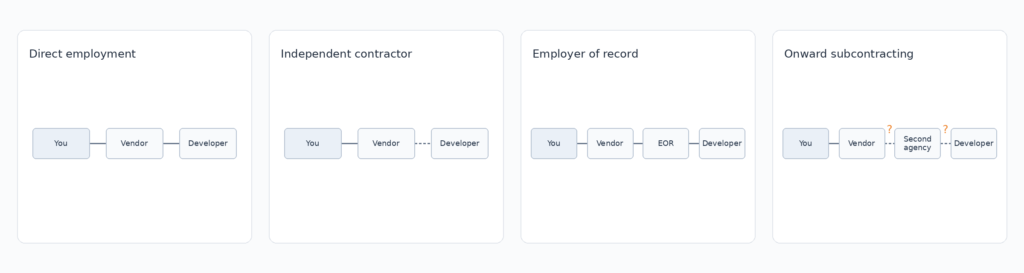
None of these four is automatically bad. Contractor and employer-of-record arrangements are normal, legal, and often excellent. Plenty of strong engineers prefer contracting.
The problem is not the model. The problem is not knowing which one you are in, because continuity and the IP chain both depend on it.
The ask is one sentence: who is the legal employer of each person on my team, and which entity will employ them for the duration of this engagement. A vendor on direct employment answers instantly. Hesitation is the finding, and the same logic applies when you weigh freelancer vs agency at home.
Do this: Send that sentence by email, not on a call, so the answer exists in writing.
Your assignment clause may not reach the keyboard
Most founders believe the IP question is settled by a clause in the master services agreement. The statute is narrower than that.
17 U.S.C. 201(a) states that “Copyright in a work protected under this title vests initially in the author or authors of the work.” Rights start with the person who wrote the code.
Section 204(a) then sets the transfer requirement: “A transfer of copyright ownership, other than by operation of law, is not valid unless an instrument of conveyance, or a note or memorandum of the transfer, is in writing and signed by the owner of the rights conveyed or such owner’s duly authorized agent.”
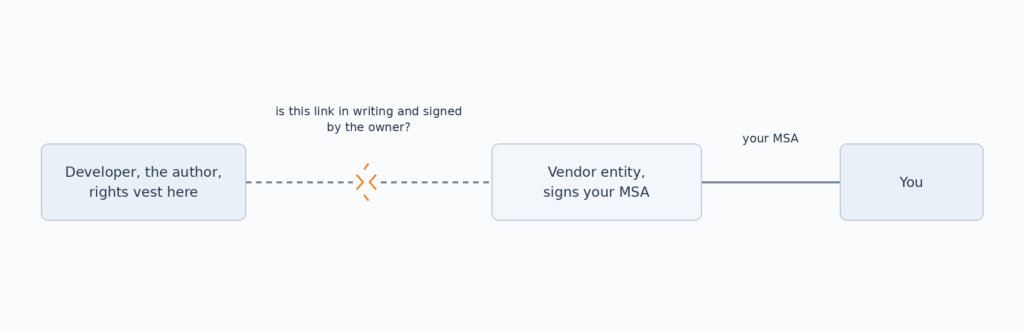
Read those two together and the chain-of-title question writes itself. Your agreement is signed by a director of the vendor entity. Is that director the owner of the rights, or an agent duly authorized by the owner?
If the developer is an employee and local law vests the rights in their employer, the vendor may well be the owner and can sign. If the developer is an independent contractor of the vendor, or is employed by a third entity, the signature on your agreement may not be the signature of the owner. That is a gap in the chain, not a drafting preference.
The statute anticipates the cross-border case. Section 204(b) opens by confirming that “A certificate of acknowledgement is not required for the validity of a transfer,” then provides that for a transfer executed in a foreign country, a certificate is prima facie evidence of execution when issued by a United States diplomatic or consular officer, or by a person authorized to administer oaths whose authority is proved by such an officer’s certificate. Congress built an authentication route for exactly this situation.
Recordation is available, voluntary, and narrower than it sounds
The U.S. Copyright Office will record the paperwork. Its Circular 12 confirms that “Any transfer of copyright ownership or other document pertaining to a copyright may be recorded in the Copyright Office,” and that “Under certain conditions, recordation establishes legal priority between conflicting transfers.”
Three limits matter. Recording “under section 205 is voluntary,” so it is not a validity requirement. Recordation “gives all persons constructive notice of the facts stated in the recorded document” only where the document identifies the work and registration has been made for that work. And the Office “does not determine whether documents satisfy legal requirements,” so recording a defective assignment does not repair it.
One procedural note, because accuracy matters more than tidiness here. Circular 12 states that its own procedural requirements have been superseded by a later interim rule and a final fee rule, so check the Copyright Office’s current recordation guidance before filing anything.
Do this: Ask to see the upstream instrument, the one between the vendor and the individual, not just the contract between you and the vendor.
Three costs sit outside the quoted rate
Rate times hours is not landed cost. The broader picture of what an MVP actually costs covers the drivers that have nothing to do with geography; these three are specific to buying across a border.
| Exclusion | Who absorbs it | How it shows up | The question that surfaces it |
| Rotation handover | You, at full rate | Velocity drops for weeks while a replacement reads code | “What happens to my team if I pause for a month?” |
| Payment documentation | You, in admin and risk | W-8 forms, expiry tracking, withholding exposure if you pay individuals | “Which entity invoices me, and who are the payees?” |
| Coordination hours | You, in founder time | Specs written at night, sequencing decisions nobody else makes | “Who on your side sequences the work?” |

A rotation is billed at full rate while producing less
When a developer leaves or is reassigned, the replacement arrives at the same hourly rate and spends the first stretch reading code rather than writing it. The person who held the context is gone.
This is also how founders end up needing to rebuild an MVP to scale sooner than planned, because three rotations through an undocumented codebase leaves nobody who can explain the data model.
The useful question is what happens to your assigned people if you pause for a month. If they move to another client, you do not have a dedicated team. You have a priority claim on a shared pool, which is a reasonable thing to buy and a different thing from what the word “dedicated” implies.
One honesty note on numbers. Published nearshore attrition and rate figures are largely self-reported by vendors and by directories that earn money from the listings, so treat them as a marketing input rather than a benchmark. I have no defensible attrition figure to give you, so I am not giving you one.
Do this: Put the pause question in writing before signing, and ask for the answer as a contractual commitment rather than reassurance.
The withholding seat is the one to understand
This resolves in most founders’ favor, and the two exceptions are worth knowing precisely.
The IRS defines a withholding agent as “any person, U.S. or foreign, that has control, receipt, custody, disposal, or payment” of a foreign person’s income subject to withholding. “The statutory withholding rate is generally 30%,” generally applied to the gross payment, and a tax treaty may reduce it.
The liability is not abstract. Where the agent does not withhold and the foreign person does not meet its own obligation, “the withholding agent and the foreign person will be held liable for the tax and any associated interest and penalties.”
Sourcing is what usually saves you. The IRS states that “If the services are performed in the U.S., the payment for those services is generally U.S. sourced.” Work done in Latin America by a foreign person generally is not US-source, so no withholding arises. The caveat sits alongside it: where the source cannot be determined at the time of payment, “the payment will be treated as U.S. sourced.”
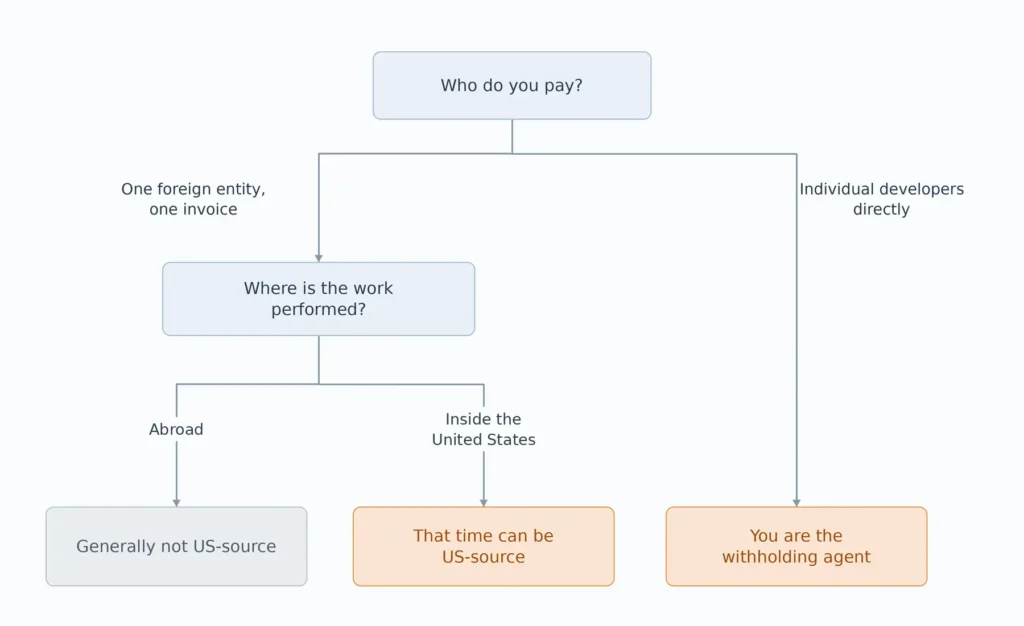
Two situations change the picture. Pay individual developers directly, common under the contractor model, and you have taken the withholding agent seat yourself. Fly a developer in for an onsite sprint, and that time can be US-source income.
The paperwork has a clock. Per the Form W-8BEN instructions, the form is valid for “a period starting on the date the form is signed and ending on the last day of the third succeeding calendar year,” and on a change of circumstances the payee “must notify the withholding agent, payer, or FFI with which you hold an account within 30 days” and file a new form. A move to the United States is expressly such a change.
The IRS says of its own FAQ answers that they “do not constitute legal authority and may not be relied upon as such.” Neither is this. Work with a cross-border tax adviser before you structure payments.
Do this: Confirm you are paying one foreign entity against one invoice, and that you hold current W-8 documentation for that payee.
Overlap hours are necessary and not sufficient
Shared working hours are the genuine structural advantage of Latin America over distant time zones, and that much is settled.
What consumes founder time is what happens inside the overlap. Decision latency, specification quality, and whether a named person on the vendor side sequences the work, or whether that job has quietly become yours.
Do this: Name the person who sequences work, on their side, in the contract.
Nearshore earns its place on sustained product work
The case for it is real and worth stating plainly rather than grudgingly.
You get collaboration inside a shared working day, which changes how a build feels at the daily level. You get access to a deep and growing engineering market. You get a cost structure that funds a larger team at the same budget, which matters when the work is genuinely parallel.
It fits best where scope is stable, the engagement runs for months rather than weeks, and someone on your side is engaged enough to answer questions the same day. That is the profile across most of the products we have shipped that ran with distributed teams.
Do this: Score your own project against those three conditions before you shortlist anyone.
Skip nearshore if you cannot specify work
A pre-qualifier is more useful than a pitch.
- You have no technical counterpart and no appetite to specify work precisely. Distance multiplies ambiguity, and this is the most common failure, especially for non-technical founders buying their first build.
- Your contracts or your regulator require the work to happen in a specific jurisdiction. That is a separate decision with its own rules.
- The project is under about six weeks. Onboarding eats the saving.
- Nobody internally can make decisions weekly. The best vendor cannot fix an absent owner.
Do this: If two or more of these describe you, fix the internal gap before you buy anything.
Five questions settle a nearshore proposal in one call
Ask these in order. The evasions are as informative as the answers.
- Who legally employs each person on my team? Good: a direct answer plus the entity name. Evasion: “they are all part of our team.”
- May I see the assignment instrument between you and the individual? Good: yes, redacted. Evasion: “our MSA covers IP.”
- What happens to my team if I pause for a month? Good: a stated policy with a notice period. Evasion: “that has never come up.”
- Who sequences the work on your side? Good: a named person with a stated role. Evasion: “we are flexible, you set priorities.”
- Which entity do I contract with, and under which law and venue? Good: entity, governing law, and forum, stated plainly. Evasion: “standard terms.”
On that last point: know the contracting entity, the governing law, and where a dispute would be heard, because a favorable clause you cannot practically enforce is decoration. That is separate from who owns the code, which question two covers.
Do this: Run all five on your current vendor, not only on new ones.
What this guide cannot settle for you
It cannot tell you whether a specific vendor is good. Employment model and chain of title are hygiene factors, not quality signals, and a contractor-model vendor with excellent engineers beats a direct-employment vendor with weak ones every time.
It cannot give you a rate benchmark, because the published figures are vendor-reported and I will not pass them off as data.
It cannot substitute for counsel. The statutory text here is quoted accurately and it is not advice about your situation.
What the three questions do is narrow the search to vendors who answer them without flinching. At Velcod that is the same filter we would want applied to us.
The decision is smaller than the market makes it sound. Settle the employer question, see the upstream instrument, price the exclusions, and most of the noise falls away.
If you want a second read on a proposal before you sign, it takes about twenty minutes to pressure-test a nearshore proposal against these five questions.
Frequently Asked Questions
What is a nearshore software development service?
It is an arrangement where a vendor in a nearby country, typically in Latin America for US buyers, supplies engineers who work inside hours that substantially overlap your own. The defining feature is shared working time rather than distance or cost, which is what separates it from offshore delivery models.
Does my contract with a nearshore vendor give me the code?
Not automatically. Under 17 U.S.C. 201(a) copyright vests initially in the author, and 204(a) requires a transfer to be in writing and signed by the owner of the rights or a duly authorized agent. If the developer is not employed by the entity signing your agreement, ask to see the upstream assignment.
Do I withhold US tax on payments to a nearshore team?
Usually not, because services performed abroad by a foreign person are generally not US-source income. The exposure appears if you pay individuals directly, which puts you in the withholding agent position, or if a developer works inside the United States. Confirm the structure with a cross-border tax adviser.
How is nearshore different from offshore development?
The practical difference is synchronous working hours. Nearshore teams share most of a US business day, so a blocking decision can resolve the same morning. Offshore arrangements can work very well, but they need a formally staffed shifted window rather than an informal promise of flexibility.
What does “dedicated team” actually mean in a nearshore proposal?
It varies, and that is why it needs testing. Ask what happens to your assigned engineers if you pause for a month. If they move to another client, you hold a priority claim on a shared pool rather than a dedicated team, which is a legitimate product and a different one.
Resources and Further Reading
- 17 U.S.C. 204, Execution of transfers of copyright ownership: the writing and signature requirement, and the foreign-execution acknowledgment route in 204(b).
- Copyright Act, Chapter 2: Copyright Ownership and Transfer: the statutory text of 201(a) on initial vesting and 201(d) on transfer.
- U.S. Copyright Office, Circular 12: Recordation of Transfers and Other Documents: what can be recorded, what recordation does and does not establish, and the note that its procedures have since been superseded.
- IRS: U.S. withholding agent frequently asked questions: the definition of a withholding agent, the 30 percent statutory rate, liability, documentation, and sourcing of services.
- IRS: Instructions for Form W-8BEN: the validity period, the 30-day change-of-circumstances notice, and the taxpayer identification number requirements.
- IRS Publication 515, Withholding of Tax on Nonresident Aliens and Foreign Entities: the full reference behind the withholding rules summarized above.