

Key Takeaways
A diagnosis order for founders whose offshore build is late, and the one test that separates a bad spec from a team that cannot deliver.
- The code is the cheapest thing you own. The decisions behind it are the expensive part, and a restart destroys those first.
- Three different failures look identical from your side: specification, handoff, capability. Firing the team only fixes the third.
- Test the specification first because it is free to test. Rewrite one ticket so a stranger could verify it, then resend it.
- A change that crossed two sites took 12.7 days against 5 days at one site in a study of 2,227 changes at Lucent between 1997 and 1999.
- Restarting is sometimes right. It is right when a perfectly specified ticket still comes back broken, and almost never before that.
Count what a restart would actually destroy
Quick Verdict: If your offshore build is late, do not open a tender for a replacement team yet. Run the specification test and the handoff measurement first, because both are free and both are more likely to be the cause. Only a failed single ticket test justifies a rebuild, and if you reach that point a three week MVP rebuild is a smaller job than a fresh start. If you have not signed with anyone yet, the real decision is agency or freelancer, not onshore or offshore.
Everyone telling you to start over is pricing the wrong asset.
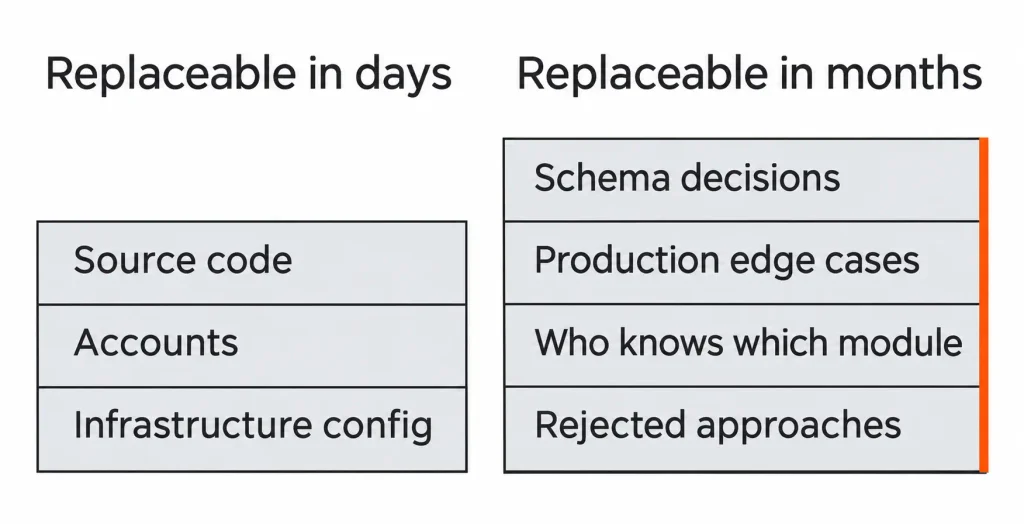
A balance diagram comparing assets replaceable in days against assets replaceable in months after a software restart.
Twelve months into a build, you hold five assets. Only one of them is the code.
| What you hold | Survives a restart | Cost to rebuild |
| Source code | Yes, you can read it | Days to port, weeks to rewrite |
| Accounts and credentials | Yes | Hours |
| Infrastructure configuration | Yes, if documented | Days |
| The reasoning behind the data model | No | Weeks of relitigating settled arguments |
| Edge cases found in production | No | Only by hitting them a second time |
The last two rows are the bill. Nobody quotes you for them, because nobody can.
A new team inherits your repository and none of your reasoning. They will rediscover why the invoice table has that strange nullable column, and they will rediscover it the way you did, from a customer complaint. Rebuilding is not starting from zero. It is starting from negative, because you also pay to relearn.
Do this: Open a document and list every decision made in the last six months that is not visible in the code. If that list runs past ten items, a restart costs more than the quoted cost of rebuilding an MVP suggests.
Run the three diagnoses in cheapest order
Three completely different failures produce the same experience for you: the sprint ends, and the thing you expected is not there.
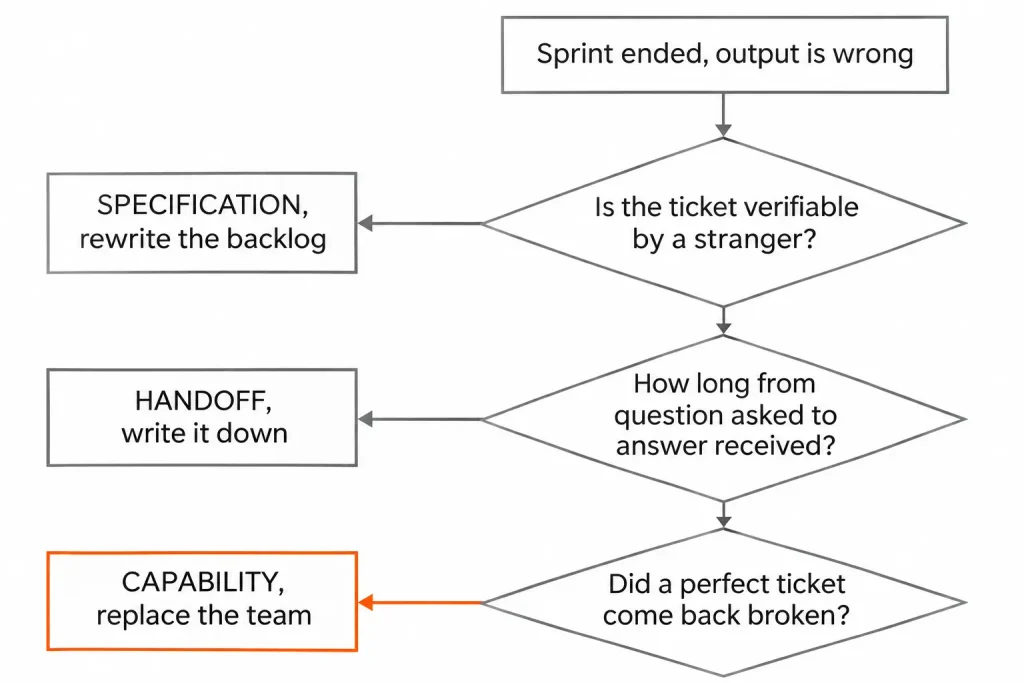
Run them in this order, because the cost of testing rises at every step and the probability falls.
| Order | Diagnosis | What you see | The test | The fix |
| 1 | Specification | The work is not wrong, it is not what you meant | Rewrite one ticket to be verifiable, then resend it | Rewrite the backlog |
| 2 | Handoff | Every question costs a day before work resumes | Timestamp one ticket from question asked to answer received | Write decisions down, stop waiting for overlap |
| 3 | Capability | A perfectly specified ticket still comes back broken | Send one isolated ticket and judge only that | Replace the team |
Most founders start at step three because it is the only one anyone talks about. It is also the only one that costs you the twelve months you already spent.
The order matters for a second reason. A specification failure and a capability failure are indistinguishable until you fix the specification. If you replace the team without testing your own tickets first, you will hand the same ambiguous backlog to a new team and get a second version of the same outcome, four months later.
Do this: Pick the last three deliverables you rejected. For each one, write down whether you rejected it for being broken or for being not-what-you-meant. If two or more were the second kind, you have a specification problem. This is the diagnosis most often missed by founders who cannot read the code themselves.
Test the specification before you test the team
A requirement a stranger cannot verify is not a requirement. It is a hope with a ticket number.

NASA publishes the rules for this and they are free to read. Its Systems Engineering Handbook asks whether requirements are “free of unverifiable terms (e.g., flexible, easy, sufficient, safe, ad hoc, adequate” and continues the list with “robust, quickly, easily, clearly, other ‘ly’ words, other ‘ize’ words”. It also asks whether requirements “express only one thought per requirement statement”.
Two more rules from the same appendix do most of the work. The first: “Requirements should state WHAT is needed, NOT HOW to provide it.” The second: “Distinguish between needs and wants.”
Go and read your backlog against those four tests. In most stalled engagements the tickets fail all four. They name a how instead of a what, they bundle three thoughts, they use “clean” and “intuitive” and “fast” as if those were measurements, and they mix a want into a need so the team guesses which half you cared about.
That is not an offshore problem. That is the same problem you would have with a developer sitting next to you, except that the person next to you would interrupt and ask.
The handbook also supplies the test that turns a ticket into a deliverable. It asks whether “a means exist to measure the accomplishment of the requirement and verify compliance”, and whether “the criteria for verification be stated”. Those two questions are the whole difference between a backlog and a wish list, and they cost nothing to apply.
We write tickets this way on every build we run for a selfish reason. A three week delivery window does not survive one round of clarification, so the ambiguity has to come out before the sprint starts rather than during it.
Do this: Take one ticket and add a single line that starts “This is done when a person who has never seen this product can check that”. If you cannot finish the sentence, the ticket was never deliverable by anyone.
Send one perfectly specified ticket and watch what comes back
This is the test that tells you whether to keep the team, and it takes one sprint.
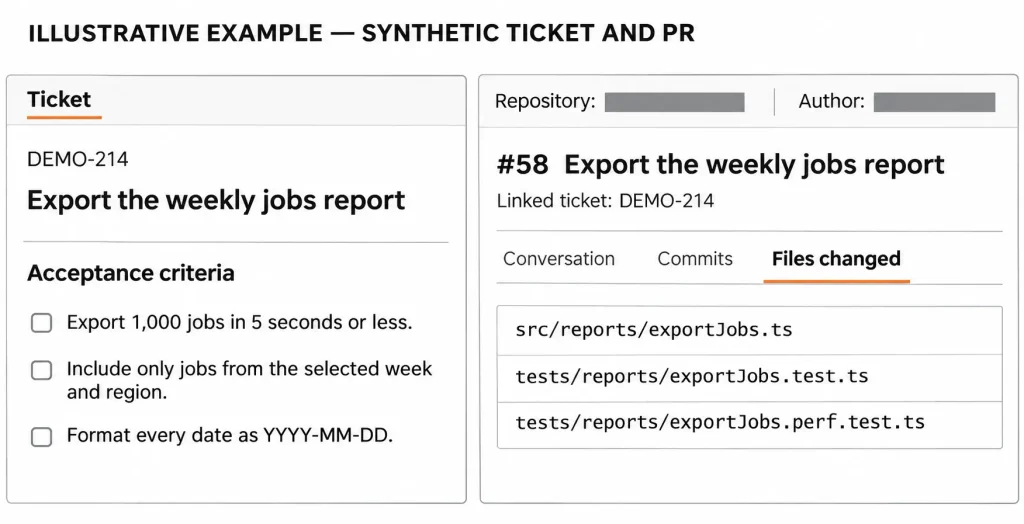
Write one ticket to the four rules above. Make it small enough to finish in three days and real enough to ship. Give it explicit acceptance criteria, the exact copy, the exact states, and one named person to answer questions.
Then change nothing else. Do not add a second ticket. Do not reorganize the sprint. Do not get on a call to explain it, because explaining it on a call is exactly the variable you are trying to remove.
What comes back is your answer. If it arrives on time and passes its own acceptance criteria, the team can build and your specification was the bottleneck. If it comes back broken against criteria a stranger could check, you have a capability problem and the conversation changes.
I will not promise you a timeline for a turnaround. The test tells you which problem you have, not how long the fix takes, and anyone quoting you a recovery date before running it is guessing.
One honest caveat. This test is weakest when the ticket touches a part of the codebase only one offshore developer understands, because then you are testing that person rather than the team. Choose something in a module at least two of them have touched.
Do this: Write the single ticket today and schedule it alone for the next sprint. If the engagement began as the cheapest available option, read what that choice usually costs later before you negotiate.
Measure the handoff, not the hours
Time zones do not slow teams down. Waiting does, and the waiting is measurable.

Herbsleb and Mockus measured this properly in 2003 and the numbers have aged well. Studying modification requests at Lucent between July 1997 and July 1999, they found the average single-site change in one department took about 5 days, while changes involving more than one site took 12.7 days. In a second department the same comparison ran 7 days against 18 days. Their sample was 2,227 changes in the first department and 4,974 in the second.
Their explanation is the useful part. The paper concludes that “splitting work across sites slows the work down primarily because it requires the involvement of more people”. Not the distance. The headcount the distance forces.
Their survey of 92 respondents put cross-site delays at about 2.4 days against about 0.9 days for local delays. So a team eight hours away is not half as fast. It is as fast as the number of people who have to be in the loop before anything moves.
This reframes the fix. You are not trying to buy overlap hours. You are trying to reduce how many people a single decision has to pass through, which is the same work as shortening a realistic delivery schedule.
Do this: Pick five tickets from the last month and record the hours between each developer question and your answer. If the median is over twelve hours, your throughput problem is a queue, not a skill gap.
Write the decision down once instead of explaining it twice
The cheapest handoff fix is documentation that answers the question before it gets asked.

GitLab runs a company this way in public and publishes the rules. Its handbook states that “GitLab has a handbook-first approach to all communication” and defines asynchronous communication as the case where “the recipient of the message and the sender are unlikely to be in the same space at the same time”.
The best line in it belongs to a GitLab team member quoted on that page, who defines the discipline as doing as much as you can with what you have, documenting everything, and transferring ownership of the project to the next person.
That is the whole fix for a handoff failure. Every time you answer a question on a call, the answer dies on the call. Write it in the ticket or in a decision log and the next three people who need it never ask.
The same page is honest about the limit, and so should you be. It says “Working asynchronously is not a goal unto itself” and that capable async work “still allows for, and includes at appropriate moments, some synchronous discussion”. The aim is fewer blocking questions, not fewer conversations.
One more structural piece belongs here. The United States Digital Services Playbook, which publishes thirteen plays for building government software, devotes one to assigning a single accountable leader and asks that “All stakeholders agree that the product owner has the authority to assign tasks”. In a stalled engagement that authority is usually split between you, an account manager, and a team lead, which is how three people each assume someone else decided. We publish what our own engagements produced rather than describing a process in the abstract, and the single owner is the piece clients most often add late.
Do this: Name one person on each side who can approve scope, and write both names at the top of the backlog today.
What fixing the engagement will not repair
Some of this is not fixable, and pretending otherwise wastes another quarter.

If the single ticket test fails, no amount of specification work saves it. A team that cannot deliver a three day ticket against criteria a stranger could verify is not going to deliver your platform, and the kindest thing you can do is stop paying for the attempt.
Contracts that bill for hours rather than outcomes are also outside your reach mid-term. The Digital Services Playbook has a play for exactly this, on structuring budgets and contracts to support delivery, and the point is that you cannot brief your way out of an incentive that rewards elapsed time.
Seniority is the third thing you cannot brief into existence. A separate play in the same document asks for confirmation that “Member(s) of the team have experience building popular, high-traffic digital services”. Ask your vendor that question directly and in writing. If the honest answer is that nobody on your account has shipped a product at the scale you are aiming for, no amount of rewritten acceptance criteria closes that gap, and the engagement was mispriced rather than mismanaged.
I cannot tell you from here which of the three diagnoses you have. Nobody can, including the agency offering to rescue it. The tests above are the cheapest way to find out, and they are deliberately written so you can run all three without hiring anyone.
Where we fit: if the single ticket test fails and you need the existing codebase assessed and continued rather than thrown away, that is the work we do, and the first conversation is a scoping call, not a proposal. We are the wrong call if the test passed, because then your money is better spent on a product manager than on a second development team. Tell us what came back from the single ticket and we will say which of the two you are.
Do this: Run the three tests in order this week. Decide after the third, not before the first.
Frequently Asked Questions
How long should I give an offshore team before replacing them?
Long enough to run the three diagnoses, which is about two sprints. Do not set the deadline by calendar time. Set it by whether a single, properly specified ticket comes back working. A team four months in with a vague backlog has not been tested yet, so replacing them tests nothing.
Should I keep the existing code or rewrite it?
Keep it unless it fails the single ticket test. The code is the cheapest asset you hold, and a rewrite also destroys the reasoning behind the data model and the edge cases found in production, neither of which appears in a quote. Port it, document the decisions, then decide module by module.
What if the agency refuses to accept a rewritten scope?
That answer is useful information. A vendor that will not accept clearer, more verifiable acceptance criteria is telling you the ambiguity was working in its favor. Put the rewritten ticket in writing, ask for a written yes or no, and treat a refusal as a capability or incentive problem rather than a misunderstanding.
Is this different if the team is nearshore rather than offshore?
The diagnosis order is identical. Only the second test changes in weight, because fewer time zone hours means a shorter queue, not a different failure mode. Herbsleb and Mockus attributed cross-site delay mainly to the number of people a decision passes through, and that count does not shrink just because the clocks are closer.
How do I tell whether the problem is me?
Rewrite one ticket to the four verifiability rules and resend it unchanged in every other respect. If the next delivery is correct, the specification was the bottleneck and the bottleneck was yours. That is the cheapest and least comfortable finding available, and it is also the most common one.
Resources
- An Empirical Study of Speed and Communication in Globally Distributed Software Development, James D. Herbsleb and Audris Mockus, IEEE Transactions on Software Engineering 29(9), 2003. The 5 day against 12.7 day and 7 day against 18 day comparisons, the 2,227 and 4,974 change samples, and the finding that cross-site delay is driven by the number of people involved.
- NASA Systems Engineering Handbook, Appendix C: How to Write a Good Requirement, NASA. The unverifiable terms list, the one thought per requirement rule, the WHAT not HOW rule, and the verifiability checklist.
- The Digital Services Playbook, United States government. Thirteen plays, including the single accountable leader, structuring budgets and contracts to support delivery, and bringing in experienced teams.
- Agile Assessment Guide: Best Practices for Agile Adoption and Implementation, U.S. Government Accountability Office, GAO-20-590G, released 28 September 2020. The federal reference for assessing whether an incremental delivery program is actually working.
- All-Remote and Asynchronous Work, GitLab Handbook. The handbook-first principle, the definition of asynchronous communication, and the stated limit that async is not a goal in itself.