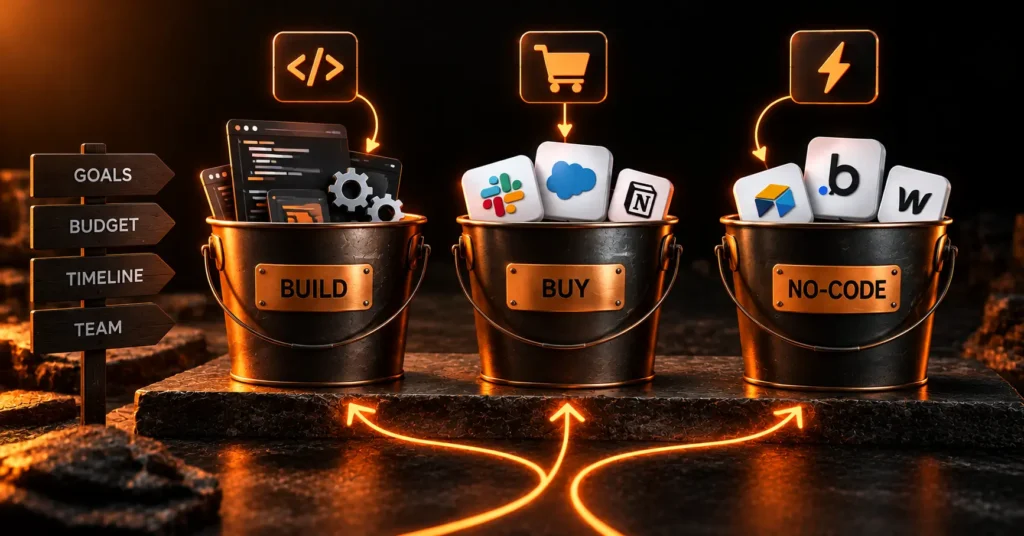

Key Takeaways
The best no-code app builders for non-technical founders in 2026, judged on one test: can they build a real, ownable product, not a throwaway toy?
- Bubble is the best all-around builder for a real web app; FlutterFlow wins native mobile because it exports actual code and reduces lock-in.
- Judge every builder by the real-product test: do you own the data, can it scale past a prototype, custom domain, real integrations, and a migration path.
- Match the tool to the job: Softr for client portals, Glide for fast data apps, WeWeb plus Xano when you expect real growth.
- The common mistake is picking the easiest builder, then hitting a wall. Pick for where the product is going, not just where it starts.
- No-code is a launchpad, not a life sentence. Plan to graduate to custom code when scale, complex logic, or compliance outgrow the platform.
Most “best no-code app builder” lists rank tools by how pretty the demo looks. That is how founders end up with a toy: an app that wows in a prototype and collapses the moment real users, real data, or a real integration show up. For a non-technical founder betting real money, the only question that matters is whether a builder can produce a real product you own and can grow.
This guide ranks the best no-code app builders in 2026 on exactly that. You get the real-product test to judge any tool, the top builders matched to what you are actually building, and an honest view of where no-code stops. The aim is to help you pick the right platform the first time, not the one with the slickest marketing.
What Separates a Real No-Code Product From a Toy?
A real no-code product passes five tests a toy fails: you own your data, it scales past a prototype, it runs on your own custom domain, it connects to real third-party services, and it has a migration path off the platform. Miss these and you have built something you cannot grow or keep.
Here is what each test means in practice. Owning your data means you can export it in full, not just view it inside the tool. Scaling past a prototype means the app stays responsive at a thousand users, not fifty. A custom domain and real integrations mean payments, email, and your other systems actually connect. And a migration path means that if you outgrow the platform, you can move to custom code without starting from zero. A builder that fails two or more of these is fine for a demo and risky for a business.
Most founders judge builders on drag-and-drop ease, which is the wrong lens. Ease matters, but it is table stakes in 2026. The real differentiator is production-readiness: can this app handle a thousand users, process payments, enforce permissions, and let you leave if you outgrow it. We build real products for non-technical founders at Velcod, and this test is how we steer them to the right tool before a dollar is spent.
Quick Verdict: For most non-technical founders, Bubble is the best no-code app builder for a real web product, and FlutterFlow is best for native mobile because it exports real code. Choose Softr for client portals, Glide for fast data apps, and WeWeb plus Xano when you expect serious scale. Judge any tool by the real-product test, not the demo. No-code is the smart, cheap way to launch and validate, and it fits squarely inside sensible MVP development for founders. If your idea is technically deep or you want to keep the knowledge in-house, weigh the honest trade-offs in our no-code versus custom MVP guide first.
What Are the Best No-Code App Builders in 2026?
The best builder depends on what you are building, but a handful lead the field for real products. Here is the shortlist at a glance, then an honest profile of each.
| Builder | Best for | Real-product fit | Starts at |
| Bubble | Full-custom web apps | High: database, logic, integrations | ~$29/mo |
| WeWeb + Xano | Apps built to scale | Highest: real backend, portable | Two tools |
| FlutterFlow | Native mobile apps | High: exports Flutter code | ~$39/mo |
| Softr | Client portals, B2B tools | Medium: fast, data-source bound | ~$49/mo |
| Glide | Data-driven apps, MVPs | Medium: quick, limited at scale | Free tier |
| Adalo | Simple mobile apps | Low to medium: easy, less depth | ~$36/mo |
Bubble: best overall for a real web app
Bubble is the most capable no-code builder for a genuine web product. It gives you a visual database, real workflow logic, user accounts, payments, and more than 2,000 integrations, with no hard user cap. That depth is why it anchors most serious no-code builds. The trade-off is a learning curve and usage-based costs that need watching, but for a non-technical founder who wants one tool to build something real, it is the default pick. Where it stops is raw scale and cost control: a popular Bubble app needs active optimization to keep performance and bills in check, which is a real skill to build or buy.
WeWeb plus Xano: best for apps built to scale
If you expect real growth, a WeWeb front end on a Xano backend is the closest no-code gets to a production-grade stack. Xano gives you a true, scalable database and APIs; WeWeb gives you a custom front end that can point at any backend later. You manage two tools, which adds setup, but you get the highest ceiling and the cleanest migration path of any option here. It asks a little more of a non-technical founder upfront, and in return it is the option least likely to trap you as the product grows, which is exactly the trade serious builders should want.
FlutterFlow: best for native mobile
FlutterFlow is the pick when you need real iOS and Android apps. It builds on a Firebase or Supabase backend, supports real authentication and payments, and crucially exports actual Flutter code. That code export is the anti-toy feature: it means you are far less locked in than with pure no-code. Best for mobile-first founders, and more than most need for a simple web tool. Its learning curve is steeper than spreadsheet-based tools, so it rewards founders willing to invest a little more upfront for a far more portable result.
Softr: best for client portals and internal tools
Softr builds polished client portals, dashboards, and lightweight B2B tools on top of Airtable, Google Sheets, or Supabase. It is fast, genuinely no-code, and strong for membership and permissioned content. The limit is depth and data-source lock-in: complex, custom product logic outgrows it, and you are tied to whatever database sits underneath. That makes Softr excellent for a client-facing portal on top of data you already manage, and a weaker fit for a standalone product that needs its own complex backend and custom workflows.
Glide: best for fast data-driven apps
Glide turns a spreadsheet or its own tables into a clean app with user logins, and a free tier to start. It is the fastest way to validate a data-driven idea in days. Two honest limits keep it in the MVP lane: no native multi-tenancy, and pricing that jumps at the business tier. Great for validation, less so for a scaled product. If your data already lives in spreadsheets, Glide is often the single fastest way to turn it into a usable app your team will actually open.
Adalo: best for simple mobile apps
Adalo is the most beginner-friendly way to ship a simple native mobile app, with drag-and-drop screens and app-store publishing. It is genuinely easy for a non-technical founder. The trade-off is depth: it handles straightforward apps well but strains under complex logic or heavy data, so it fits simple products and early prototypes more than ambitious builds. For a founder who just needs a simple app in the app stores to test an idea, that simplicity is a feature, not a flaw.
How Do You Choose the Right No-Code App Builder?
You choose by matching three things: what you are building, how technical you are, and where the product needs to go. Start from the use case, not the tool. A web SaaS points to Bubble or WeWeb plus Xano; a native mobile app points to FlutterFlow or Adalo; a portal or internal tool points to Softr or Glide.
Then apply the real-product test from earlier as a filter. If owning your data and having a migration path matter, lean toward Bubble, WeWeb plus Xano, or FlutterFlow. If speed to validate matters most and you will rebuild later anyway, Glide or Adalo are fine starting points.
A quick example makes this concrete. A founder building a booking marketplace with payments and two user types should start on Bubble or WeWeb plus Xano, because the logic and scale will break a lighter tool fast. A founder validating a simple directory or an internal tracker is better served by Glide or Softr in a weekend. Same question, opposite answers, and the difference is the product, not the founder.
The most expensive mistake is choosing the easiest builder for today and hitting its ceiling in six months. Pick for where the product is heading. Founders who want help making this call can see how we scope it in our case studies, and tools like WeWeb versus Bubble and Bubble versus Webflow break down the closest head-to-head choices.
What Mistakes Do Founders Make Choosing a Builder?
The most common mistake is optimizing for the wrong thing: picking the tool with the easiest demo instead of the one that fits the product. Ease gets you a prototype; fit gets you a business.
The second is ignoring lock-in until it hurts, then discovering that leaving means a full rebuild. The third is over-building on no-code, pouring months into a complex app the platform was never meant to carry, when custom code would have been cheaper past a certain point. The fourth is choosing on price alone, then hitting usage fees or a feature wall that costs far more than the plan you saved on.
Avoid all four by starting from the product and the real-product test, not the tool’s marketing.
Where Does No-Code Still Stop?
No-code still hits real ceilings, and pretending otherwise is how founders get burned. Performance can degrade as your data and traffic grow. Complex or high-volume logic is harder to optimize than in custom code. Deep or unusual integrations strain most platforms, and strict compliance needs like HIPAA are not supported everywhere.
A concrete example: an app doing heavy, real-time calculations on large datasets, like a logistics optimizer or a live analytics dashboard, will crawl on most no-code platforms no matter how carefully you build it. That is not a skill problem, it is a platform limit, and it is exactly the kind of product that belongs in custom code from the start.
Lock-in is the quiet one. Leaving a pure no-code platform usually means a rebuild, which is why exportability and a clean backend matter so much in the real-product test. Tools like FlutterFlow and WeWeb plus Xano soften this; most others do not. Knowing the ceiling before you build is what lets you launch on no-code without regret.
Who Should Not Use a No-Code App Builder?
No-code is the wrong starting point for a few founders, and honesty here saves months. If your core product is technically deep, real-time, or heavily algorithmic, no-code will fight you from the first week. If you already have strong engineers in-house, building on no-code often adds a layer you will only tear out later.
And if you are in a strictly regulated space where compliance is non-negotiable, start on a stack that can meet those rules. For everyone else, especially non-technical founders validating an idea and chasing paying customers fast, no-code is often the smartest first move. When growth or complexity eventually outpaces the platform, that is the moment to rebuild your MVP to scale on custom code, not a reason to have avoided no-code at the start.
The best no-code app builder is the one that fits your product, your skills, and your ambition, and that still gives you a real, ownable asset at the end. Pick on the real-product test, match the tool to the job, and no-code becomes a launchpad instead of a trap. If you want a straight recommendation for your specific idea, you can talk to our team, and our guide for non-technical founders walks through the decision end to end.
Frequently Asked Questions
What is the best no-code app builder in 2026?
Bubble is the best all-around no-code app builder for a real web product, thanks to its database, workflow logic, integrations, and large ecosystem. FlutterFlow is best for native mobile because it exports real code. The right choice depends on what you are building and whether the tool passes the real-product test of ownership, scale, and a migration path.
Can you build a real product with no-code, or just a prototype?
You can build a real, revenue-generating product with no-code, not just a prototype. Platforms like Bubble, WeWeb plus Xano, and FlutterFlow run genuine apps with real users, payments, and data. The key is choosing a builder that lets you own your data, scale past early traffic, and migrate later, rather than one that only looks good in a demo.
Which no-code app builder is best for non-technical founders?
For most non-technical founders, Bubble offers the best balance of power and learnability for web apps, while Glide and Softr are easier for simple data apps and portals. FlutterFlow suits mobile. Choose based on your product type and how much complexity you need, and favor tools with a migration path so growth does not force a painful rebuild.
Do no-code apps scale, or do they break under load?
Good no-code apps scale to thousands of users and real revenue, especially on architectures like WeWeb plus Xano. But performance and cost get harder to control as data and traffic grow, and very heavy or complex apps can hit ceilings optimization cannot fully solve. Many products validate and grow on no-code, then rebuild in custom code once scale demands it.
Are no-code app builders free?
Several offer free tiers for building and testing, including Glide and Bubble, but a launched product almost always needs a paid plan for a custom domain and real capacity. Expect roughly $29 to $59 a month to start on most serious builders, plus usage-based costs. Free plans are for validating; budget for a paid plan once you go live.
Resources and Further Reading
The following authoritative sources informed and support this article:
- Bubble: Leading full-stack no-code platform for building real web apps.
- Webflow: Reference for no-code web and content-led app building.
- G2: Verified user reviews and ratings across no-code app builders.
- Capterra: Independent software reviews and pricing for no-code platforms.
- Gartner: Research and forecasts on low-code and no-code adoption.
- Y Combinator: Founder guidance on building and validating a product fast.

M. Sabir Junaid
Founder • CEO
M. Sabir Junaid is founder and CEO of Velcod, the senior product studio. He leads product and delivery across MVPs, SaaS platforms, and mobile apps — system architecture, no-code and low-code engineering, and AI integration. An official Bubble partner, Sabir has shipped products across fintech, marketplaces, edtech, and creator platforms. He works with founders raising pre-seed to Series A who need a product built to launch and scale in weeks, not a six-month agency build.
Share
- Previous
- Next
Ready to build?
Your idea, live in 3 weeks.
Book a free strategy call and get a fixed-price roadmap for your MVP, SaaS, or app.