Key Takeaways
A decision framework for non-technical founders choosing build vs buy vs no-code, sorting every feature into edge, commodity, or unknown.
- The real question is not cost, it is whether a feature is your edge, a commodity, or an unknown.
- Build your edge in real code, buy commodities like auth and payments, and no-code anything you have not validated yet.
- Rebuilding a commodity is the most common and most expensive founder mistake.
- Build your edge plus the thinnest slice needed to test your riskiest assumption first, nothing else.
- No-code is a phase for unknowns, not a permanent home for your core, so plan to own the winners in code.
Most non-technical founders agonize over the wrong decision. They treat build vs buy as a budget question, weighing the price of custom development against a monthly subscription, and they pick whichever looks cheaper this quarter.
That framing has sunk more startups than any pricing mistake. The question is not what something costs. The question is what role it plays in your business.
In my experience working with first-time founders, the ones who waste the most money are not the ones who buy too much. They are the ones who build the wrong things, pouring months into rebuilding login, payments, and dashboards that a thousand companies already solved, while the one feature that could actually set them apart ships late or never.
Build vs buy vs no-code is really three questions hiding inside one. This article gives you a single lens to answer all three, called the Three-Bucket Rule, so you stop deciding by cost and start deciding by what each feature is actually worth to your product. It is written for non-technical founders who have to make these calls without a CTO in the room.
Why “build vs buy” is the wrong question
The build vs buy debate assumes two options and one axis, which is cost. That is exactly why it leads founders astray. It ignores a third option, no-code, and it ignores the only axis that matters, which is whether a feature is your competitive edge or just plumbing every app needs.
Ask a sharper question. For any given feature, is this my edge, a commodity, or an unknown? The answer, not the price tag, tells you whether to build it, buy it, or no-code it.
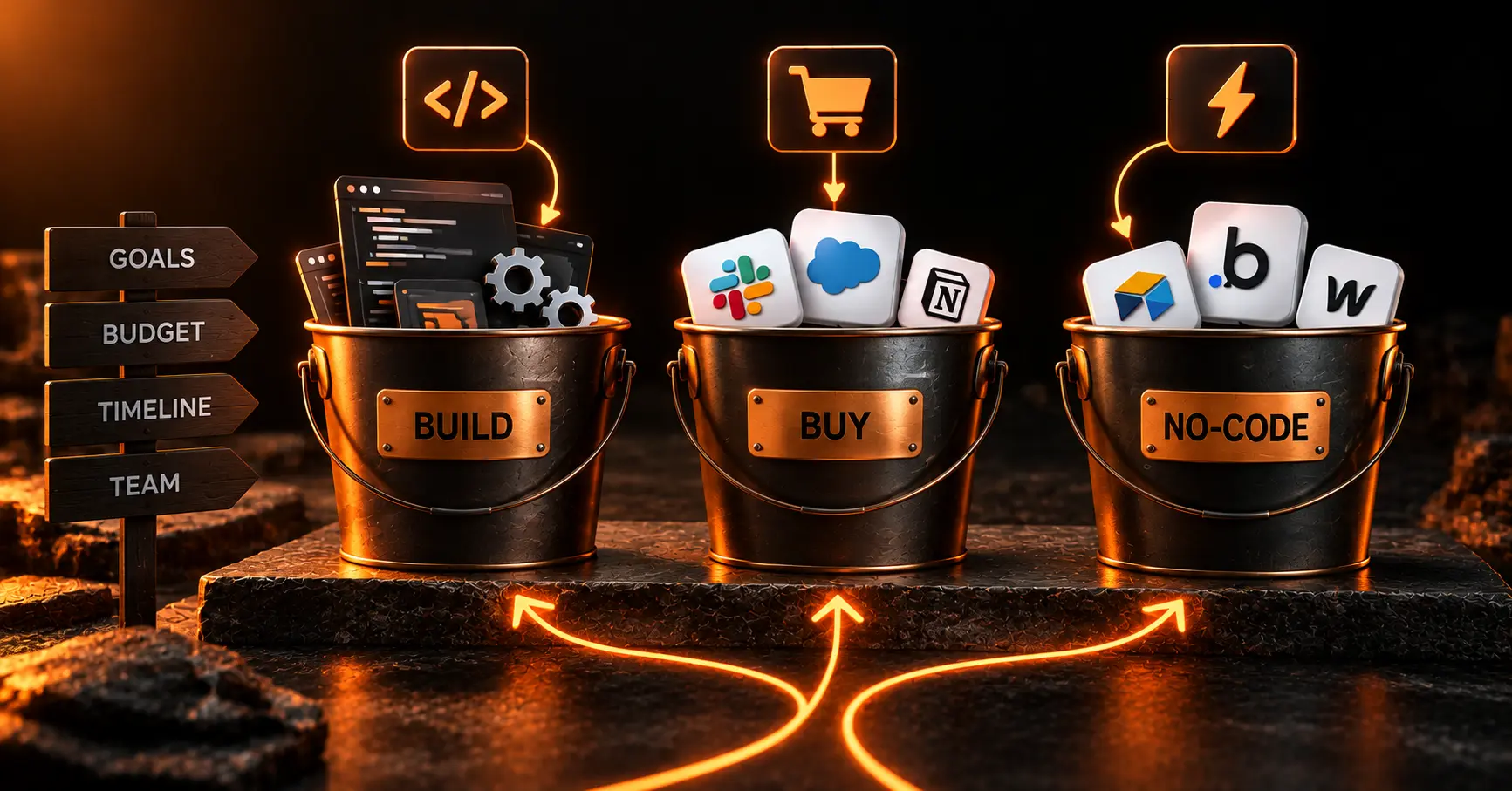
Quick Verdict: Sort every feature into one of three buckets. If it is your EDGE, the thing customers pay you for and rivals cannot easily copy, build it in real code and own it through proper MVP development. If it is a COMMODITY, a solved problem like auth or payments, buy it and never rebuild it. If it is an UNKNOWN you have not validated, no-code it to learn fast and cheap, then rebuild only what proves out. That is the whole decision, and it maps closely to the no-code versus custom call most founders face.
Cost still matters, but it is an output of this decision, not the input. Once you know a feature is a commodity, the build-versus-buy math is already settled: you buy. Once you know it is your edge, the only real question left is when you can afford to build it properly.
The Three-Bucket Rule: edge, commodity, unknown
The Three-Bucket Rule is simple: every feature in your product belongs in one of three buckets, and the bucket decides build, buy, or no-code. It borrows from a classic idea, Geoffrey Moore’s distinction between core and context, and adds the piece founders need most, a bucket for things you have not proven yet.
Here is how the three buckets work.
Bucket 1: Edge (build it)
Your edge is the reason customers choose you over the alternative, and competitors cannot copy it easily. This is your core, in Geoffrey Moore’s language. It might be a matching algorithm, a specific workflow, a proprietary data set, or an experience nobody else offers.
You build your edge in real code and you own it. Outsourcing it to a template or a generic third-party tool means outsourcing the only thing that makes you different. This is the one bucket where custom development is almost always worth it, because the whole business rests on it.
Bucket 2: Commodity (buy it)
A commodity is a problem already solved well by someone else. Authentication, payments, email, analytics, hosting, error monitoring, and customer chat all live here. They are hard to build well, boring to maintain, and add nothing a customer will ever pay you extra for.
You buy commodities, every time. Stripe handles payments better than you will, and rebuilding it wins you nothing. The hours you save by not building commodities are hours you redirect to your edge. Rebuilding a commodity is the most common and most expensive form of founder self-sabotage.
Bucket 3: Unknown (no-code it)
An unknown is an assumption you have not yet validated. You think users want a feature, but you do not actually know. Building it in code is premature, because you might be wrong, and 42% of startups fail precisely because they built something with no market need, the single biggest cause in CB Insights’ analysis of startup post-mortems.
You no-code the unknown. Tools like Bubble, Softr, Airtable, and Webflow let you test an assumption in days for the price of a subscription. No-code here is not a compromise, it is a probe. You are buying information, and information is cheap when you no-code it and expensive when you build it in full.
How do you sort a feature into the right bucket?
Run each feature through two questions in order. First, if a competitor had this exact feature too, would customers still choose me? If yes, it is not your edge, so it is a commodity or an unknown, never a custom build. If no, you may have found your edge.
Second, do I actually know people want this, with evidence rather than a hunch? If yes, and it is your edge, build it. If no, it is an unknown, so no-code it and find out before you spend real money.
Most features are commodities. That is the uncomfortable truth. In a typical early product, the large majority of what you need is plumbing that should be bought, a small slice is genuinely your edge, and a handful of bets are unknowns worth testing. Founders invert this ratio constantly, treating everything as a custom build, which is why so many run out of cash before they find traction. This is where honest guidance matters most for non-technical founders who cannot easily judge what is actually hard to build.
What should you build first?
Build your edge plus the thinnest possible slice needed to test your riskiest unknown. Nothing else comes first. Everything in the commodity bucket gets bought, and every other unknown waits its turn.
The sequencing mistake founders make is building in feature order instead of risk order. They build the easy, obvious things first because those feel like progress, and they leave the scary, uncertain assumption for last. Reverse it. The riskiest unknown is the thing most likely to kill the company, so it deserves your first and cheapest test.
Your first build is not your whole product. It is your edge, wired to enough bought and no-coded parts to put a real version in front of real users. That is the heart of lean startup MVP development, which is proving the risky thing works before you build the rest properly. If budget is the real constraint, understanding true MVP development cost up front helps you spend it on the edge instead of the plumbing.
The two mistakes that cost founders the most
The first mistake is building your commodity. It feels productive, and it is a trap. I have watched a founder spend four months and a serious chunk of their budget on a custom authentication system, custom billing, and a custom admin panel, all before launch. The product had no users, because none of that was the product. Every one of those should have been bought in an afternoon.
The second mistake is the opposite, and just as fatal: no-coding your edge. If the thing that makes you different is a sophisticated matching engine, and you build it on a no-code tool that cannot support it, you will hit a wall exactly when the business starts working. Your edge is the one place you should expect to outgrow no-code, so plan to own it in real code from the start.
Notice that both mistakes come from using one tool for everything. The founders who stay alive mix all three approaches deliberately, matching the tool to the bucket rather than picking a side in a religious war about no-code versus code.
When does no-code become a liability?
No-code becomes a liability the moment a validated feature outgrows the tool it was tested on. That is a success signal, not a failure. It means the unknown became a known, and known winners deserve real code.
The warning signs are consistent. Costs climb unpredictably as usage grows, the tool cannot express the logic your edge now demands, performance degrades under load, or investors start asking whether you actually own your technology. When two or more of those appear, the proven feature should move from no-code to a custom build.
The goal is to do this deliberately, not in a panic while live customers are transacting. Treat no-code as a phase for the unknown, not a permanent home for your core, and plan the handoff early. We cover the mechanics of that transition in our guide to migrating off no-code, because the founders who plan it win, and the ones who deny it end up rebuilding under fire.
A worked example: the non-technical marketplace founder
Picture a founder building a services marketplace. Under the Three-Bucket Rule, the sort is quick. Payments, identity, messaging, and hosting are all commodities, so they buy Stripe, an auth provider, a messaging API, and a managed host, and build none of it.
Their edge is the matching logic that pairs the right provider with the right customer better than a generic directory could. That is the core, so it gets built properly and owned. Everything about the business depends on that match being good.
The unknown is whether providers will even show up and keep their listings current. That is the riskiest assumption, so it gets no-coded first, as a simple Airtable-backed listing flow to see if supply engages, before a single line of custom code is written. If providers pull for it, the matching engine is worth building. If they do not, the founder just saved a year and most of their savings, which is the entire point of the exercise. Notice how only one of those four parts, the matching engine, ever justifies custom code, and even that one waits until the unknown is proven.
The bottom line for founders
Stop deciding by cost, and start deciding by bucket. Build your edge, buy your commodities, and no-code your unknowns, and the build vs buy vs no-code question answers itself one feature at a time.
By 2027, the founders who win will not be the ones who built the most. They will be the ones who bought and no-coded everything except the one thing they could not afford to hand to anyone else, and who spent their real engineering budget there.
At Velcod we help non-technical founders make exactly these calls, then build the edge in real code in three weeks while staying pragmatic about what to buy and what to no-code. If you want a straight read on which of your features are edge, commodity, or unknown, you can talk to us or see how we have done it for others in our case studies. The best money you will ever not spend is on the commodity you almost built.
Frequently Asked Questions
Should a startup build or buy software?
Both, depending on the feature. Build the feature that is your competitive edge, since it is the reason customers choose you. Buy commodities like authentication, payments, and analytics, because specialists already solve them better and cheaper. The build vs buy answer is never universal, it is decided feature by feature based on whether something differentiates you.
What should a non-technical founder build first?
Build your core differentiator plus the smallest slice needed to test your riskiest unproven assumption. Do not build in feature order, build in risk order, because the assumption most likely to kill the company deserves the first and cheapest test. Buy or no-code everything else so you reach a real test with users faster.
Is no-code good enough for a real startup?
Yes, for validating unknowns and running features that are not your core. No-code tools like Bubble and Softr let you test demand in days instead of months. The limit is your edge: once a feature proves out and becomes central, it usually needs real code to scale, so treat no-code as a validation phase rather than a permanent foundation.
What is the biggest build vs buy mistake?
Building a commodity. Founders routinely spend months rebuilding authentication, billing, and dashboards that Stripe, Auth0, and others already perfected, time that produces nothing a customer will pay for. The second biggest mistake is the reverse, no-coding your actual edge and hitting a wall once the product works. Match the tool to the feature’s role.
When should you move from no-code to custom code?
Move when a validated feature outgrows its no-code tool. The signals are unpredictable costs, logic the tool cannot express, degrading performance, or investors questioning whether you own your stack. When two or more appear, rebuild that proven feature in real code deliberately, not in a crisis, so you are not migrating while live customers are transacting.
Resources & Further Reading
The following sources informed and support the arguments in this article:
- CB Insights: Analysis of startup post-mortems showing no market need as the top failure reason.
- Harvard Business Review: Foundational thinking on core competence and competitive differentiation.
- Stripe: Example of commodity payments infrastructure founders should buy, not build.
- Y Combinator: Startup guidance on validating demand and what to build first.
- First Round Review: Operating lessons from founders on build, buy, and focus.
- a16z: Startup and product strategy on differentiation and scaling.

M. Sabir Junaid
Founder • CEO
M. Sabir Junaid is founder and CEO of Velcod, the senior product studio. He leads product and delivery across MVPs, SaaS platforms, and mobile apps — system architecture, no-code and low-code engineering, and AI integration. An official Bubble partner, Sabir has shipped products across fintech, marketplaces, edtech, and creator platforms. He works with founders raising pre-seed to Series A who need a product built to launch and scale in weeks, not a six-month agency build.
Share
- Previous
- Next
Ready to build?
Your idea, live in 3 weeks.
Book a free strategy call and get a fixed-price roadmap for your MVP, SaaS, or app.