

Key Takeaways
Why owning the copyright does not get you the code, what the Bankruptcy Code actually protects, and the deposit standard to hold escrow to.
- Federal contracting defines ownership as a named bundle of rights, not a yes or no, which is a better model for your own agreement.
- GitHub states that if an organization has only one owner, its projects can become inaccessible if that owner is unreachable.
- You cannot promote yourself to organization owner. Someone who already holds the role has to do it.
- Bankruptcy law protects a licensee’s right to obtain the code from another entity, and that other entity is the escrow agent.
- The Copyright Office already publishes a usable deposit standard. Borrow it as the benchmark for what your escrow must contain.
You can own the copyright in your software and be unable to open the repository. You can hold every password and still be unable to build the thing.
Both are common and neither is a contradiction. Ownership is a legal fact, access is an administrative setting on somebody’s account, and buildability is a property of the code and its instructions. Nothing links them automatically.
So the work before you need any of this is narrow. Write down what rights you are actually buying, confirm who can grant access and whether that includes you, and put the source code somewhere that releases to you on terms you have read. None of this is legal advice, and the clause itself belongs to a lawyer.
Title, control and the ability to build are three different things
Three separate questions, three separate answers, and most contracts answer only the first.
Quick Verdict: Answer all three in writing before the first sprint, not after a dispute. Velcod sets this up as part of MVP development, and the wider context sits in startup MVP development.

The third column is where the surprises live. A founder with a clean assignment clause and no administrator rights on the code host has title to something they cannot reach, and a founder with every credential and no build documentation has access to something nobody can ship.
Test each one separately. The answers are usually not the same person.
Do this: Write the three questions on one page and answer each with a name. Not a company, a name.
Name the rights you are buying rather than saying you own it
“We own all the code” is a sentence, not a specification.
Federal contracting treats this properly, and the vocabulary is worth stealing even though the rules bind government buyers rather than you. FAR 52.227-14 defines unlimited rights as the rights “to use, disclose, reproduce, prepare derivative works” and to do so “in any manner and for any purpose, and to have or permit others to do so.”

The same clause carves out a separate category for software the vendor built on its own money. Restricted computer software is defined there as software “developed at private expense” that is a trade secret or is “copyrighted computer software,” including “minor modifications of the computer software.”
That carve-out is the one to look for in your own agreement. Vendors reuse internal libraries, and you will usually get a licence to those rather than title, which is reasonable as long as it is written down. Machine-generated code raises the same question from a different direction, and it is worth asking directly on any AI app development project what the vendor claims to own in the output.
Do this: Ask your vendor to list, by name, every component you will license rather than own. One page, before signing.
Check who can grant access, because it may not be you
Access is a role on somebody’s account, and roles have rules you did not write.
GitHub is explicit about the risk and the fix. Its guidance on maintaining ownership continuity says “we recommend that at least two people within each organization have the owner role,” and warns that “If an organization only has one owner, the organization’
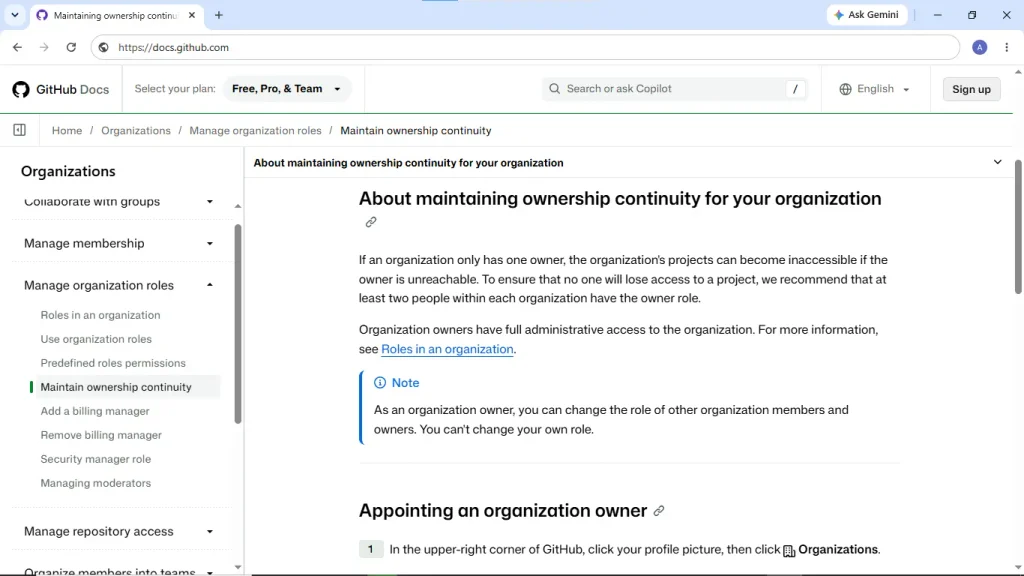
Then comes the sentence that decides the outcome. The same page states that “Organization owners can promote any member of an organization to an organization owner,” and separately that “You can’t change your own role.”
Read those two together. If the vendor is the only owner and stops replying, you cannot make yourself an owner, because the only people who can do that are the owners. This is also why the shape of the engagement matters: an agency can hold two owners between its own staff, while a sole contractor is structurally the single point, which is one of the quieter differences between hiring a freelancer or an agency.
Do this: Open your code host’s organization settings and count the owners. If the number is one and it is not you, fix that this week.
Escrow is what makes a retained right worth anything
Vendor insolvency is the case founders assume is hopeless. The law is better than that, and still not sufficient on its own.
Under 11 U.S.C. 365(n), when a trustee rejects a contract in which the debtor licensed intellectual property, the licensee may elect “to retain its rights” under that contract as they stood before the case began, including “any embodiment of such intellectual property to the extent protected by applicable nonbankruptcy law.” The trustee “shall allow the licensee to exercise such rights.”

Two clauses decide whether that election is worth anything. Under (n)(3)(A) the trustee must hand over the intellectual property and its embodiment on written request, but only to the extent the contract or a supplementary agreement provides it. Under (n)(3)(B) the trustee must not interfere with your right to obtain it “from another entity.”
That other entity is the escrow agent. So the statute protects the route, and your contract has to have built the route first. Retained rights to code you cannot obtain are rights to nothing.
One precision point, because it changes who this applies to. Section 365(n) protects licensees, so if you commissioned the work and hold a valid assignment you are not a licensee of that code, though you are almost certainly still a licensee of the vendor’s own libraries and tooling.
Do this: Check whether your agreement names a deposit obligation at all. If it does not, 365(n) gives you a protected route to nowhere.
Most escrow deposits release something nobody can build
An escrow that nobody verified is a filing cabinet with a zip file in it.
The failure is predictable. A deposit gets made once at signing, the product changes for three years, nobody re-deposits, and the release eventually produces a snapshot that does not match production and will not compile. The agreement was satisfied and you got nothing usable.

Verification is the part worth paying for. A verified escrow means the agent, or someone you nominate, has actually compiled the deposit on a clean machine and confirmed it produces the running system. Without that step you are buying storage.
Deposit frequency matters as much as content. A deposit tied to each release, or at worst each quarter, is the difference between a current copy and an archaeological one, and our case studies record the deposit cadence alongside the build because clients ask for it later rather than at the start.
Do this: Ask your vendor when the last deposit was made and whether anyone has ever compiled it. Both answers in writing.
Borrow the Copyright Office deposit standard
Somebody has already written down what a usable code deposit looks like, and it is free to copy.
The US Copyright Office publishes deposit requirements for registering a computer program. Circular 61, revised March 2021, instructs applicants to “Submit the source code for the specific version of the computer program you want to register,” and to submit “one copy of the first twenty-five pages and last twenty-five pages of the source code” where no trade secret is involved.
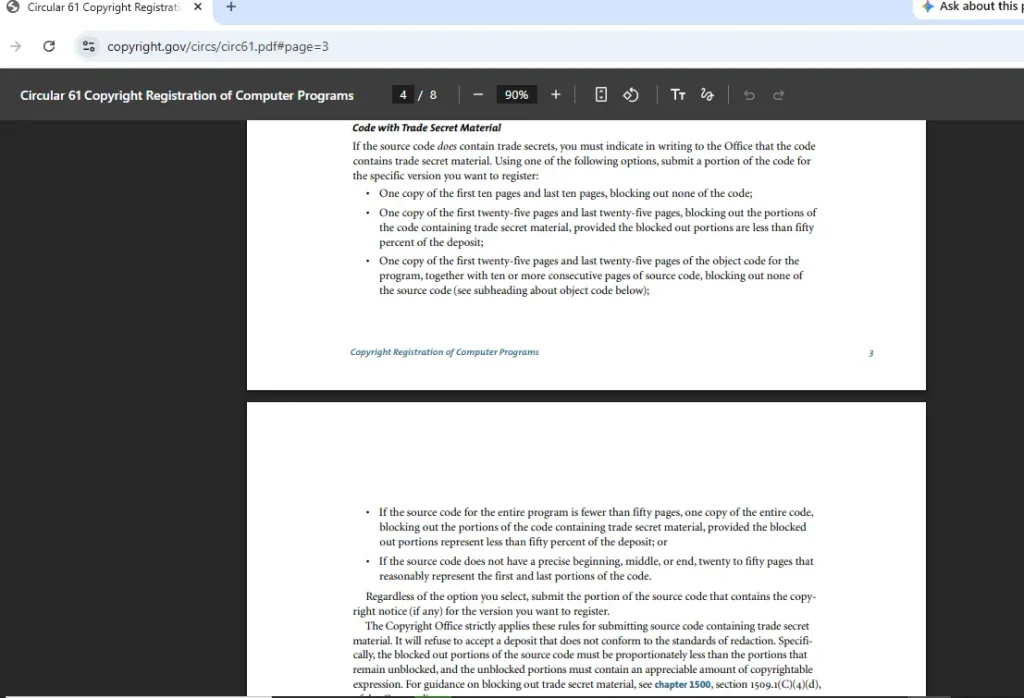
Three rules there are worth lifting into an escrow schedule. Source code rather than object code, because the Office “strongly prefers” source and treats an object code deposit under the Rule of Doubt. A specified version rather than “the current code.” And a hard limit on redaction, where “the blocked out portions of the source code must be proportionately less than the portions that remain unblocked.”
This is a registration procedure rather than an escrow standard, and that is exactly why it is useful. It is an independent, published definition of a deposit that a third party will accept, which is a stronger benchmark than whatever your vendor proposes.
Do this: Write your escrow schedule to name a version, require source code, and cap redaction. Three lines.
Set the release triggers wider than bankruptcy
Insolvency is the trigger every template includes and the least likely one to fire.
The Administrative Office of the US Courts defines an executory contract as “A contract under which both parties have material duties remaining to be performed,” and liquidation as “The sale of a debtor’s property with the proceeds generally used for the benefit of creditors.” Those are precise events with court involvement. Most vendor failures are quieter than that.
| Trigger | Fires when | Usually in a template |
| Insolvency or liquidation | A court process begins | Yes |
| Breach of the support obligation | Response times are missed repeatedly | Sometimes |
| Failure to maintain the deposit | A scheduled deposit is skipped | Rarely |
| Abandonment | No substantive contact for a stated period | Rarely |
| Change of control | The vendor is acquired | Rarely |

Abandonment is the one to argue for, because it is the common case and it needs a definition rather than a judgment. A stated period of no substantive contact, measured in business days, with a written notice step, turns an argument into a clock.
Change of control deserves a mention too. An acquisition is not a failure, and it can still end the support you were relying on, which is a reasonable thing to protect against in advance.
Do this: Add abandonment and missed deposit to your trigger list, each with a number of days attached.
Put the ownership schedule in the agreement as an exhibit
A clause describes an intention. An exhibit lists the actual accounts, and it is the thing that gets checked.
Attach it as a numbered exhibit rather than burying it in a paragraph, because an exhibit gets updated when things change and a paragraph does not. Review it at each milestone, and treat a stale exhibit as a finding rather than an administrative detail.
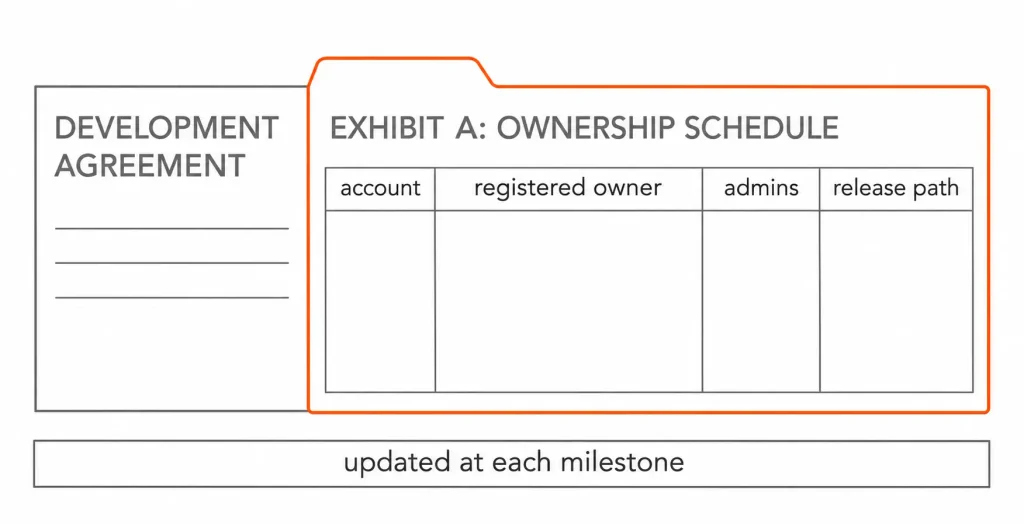
The content is unglamorous and that is the point. Every account the product depends on, who is the registered owner of record, how many administrators exist, and what happens on release. Five columns, one page.
Cheap builds are where this gets skipped, because the setup feels like overhead against a small budget. It is the opposite: the smaller the budget, the less you can afford the recovery, which is worth weighing when you are looking at the cheapest way to build an MVP.
Do this: Draft the exhibit yourself, in a spreadsheet, before your lawyer drafts the clause. You know the accounts, they do not.
What this will not fix
Paperwork improves your position. It does not guarantee an outcome.
A deposit you never verified is still a gamble, and a release trigger is only as good as your willingness to invoke it. Escrow agreements take weeks to negotiate and cost real money annually, which is proportionate for a system your business runs on and disproportionate for a prototype.
The legal picture also varies more than a single statute suggests. Section 365(n) protects licensees in US bankruptcy, and whether it reaches your situation depends on how your agreement is structured, which court is involved, and whether you are a licensee at all. Nothing here is legal advice.
And none of it substitutes for the simpler protections. Two owners on every account, your name as the registered owner, and a build that someone other than the author has run are cheaper than any escrow and prevent more problems.
The ownership schedule
Copy this into a spreadsheet, fill it, and attach it as Exhibit A. One page.
EXHIBIT A: OWNERSHIP SCHEDULE
Reviewed at each milestone. Last reviewed: [date] by [name]
ACCOUNT REGISTERED OWNER ADMINS RELEASE PATH
Domain registrar [legal entity] [n] [n/a, we hold it]
Code host org [legal entity] [n] [n/a, we hold it]
Cloud / hosting [legal entity] [n] [n/a, we hold it]
App Store Connect [legal entity] [n] [transfer on exit]
Play Console [legal entity] [n] [transfer on exit]
Payments [legal entity] [n] [n/a, we hold it]
Email / DNS [legal entity] [n] [n/a, we hold it]
Analytics [legal entity] [n] [n/a, we hold it]
Error monitoring [legal entity] [n] [n/a, we hold it]
Vendor libraries [licensed, not owned] [n/a] [escrow, see below]
RULE: every row shows at least 2 admins, and at least one is ours.
Any row showing 1 admin is a finding, not a note.
RIGHTS SCHEDULE
Owned outright (assigned to us): [list]
Licensed from the vendor: [list, by name and version]
Open source, by licence type: [list]
Machine-generated, ownership basis: [state it]
ESCROW SCHEDULE
Deposit contents: source code for a NAMED VERSION, build
instructions, dependency lockfiles, schema and
migrations, environment config structure
Redaction: blocked portions proportionately less than
unblocked portions
Frequency: every release, minimum quarterly
Verification: compiled on a clean machine by [who], [how often]
Last verified: [date]
Release triggers: insolvency, liquidation, change of control,
support breach after [n] notices, missed deposit,
abandonment after [n] business days no contact
Notice procedure: [who notifies whom, in what form]
We attach a version of this before starting, including on three-week MVP builds, because it takes an hour at the beginning and is unrecoverable at the end.
Where we fit
We are a vendor, so we are the party this exhibit is written to constrain. Worth saying first.
What we do about it is open every account in the client’s name on day one and put ourselves on as administrators rather than owners. The exhibit above is the document we fill in, and on a short build the escrow schedule is usually unnecessary because there is nothing we hold that you do not.
This is not the right spend for everyone. A prototype does not need a negotiated escrow agreement, and the annual fee on one is hard to justify below a certain system value. Two owners per account and a verified build cost nothing and prevent most of the same problems.
If you want your current setup checked against the exhibit, book a call with us and bring your account list, however incomplete.
Frequently Asked Questions
What is a software escrow agreement?
A three-party arrangement where a vendor deposits source code with an independent agent, and the agent releases it to you on defined triggers. The useful versions specify what goes in the deposit, how often it is refreshed, and who has verified that it compiles. Without those three, it is storage rather than protection.
Do I need escrow if the contract says I own the code?
Possibly not, and check what you own. If a valid assignment gives you title to the custom work, escrow matters mainly for the vendor’s own libraries and tooling that you license rather than own. Ask for a named list of licensed components, then decide whether those need a deposit.
How much does software escrow cost?
Annual fees plus setup, with verification priced separately and usually the largest line. Treat it as proportionate to what the system is worth rather than to the build price. Below a certain value, two owners on every account and a build another engineer has run gives you more protection per pound.
Does bankruptcy wipe out my licence?
Not automatically. Section 365(n) of the Bankruptcy Code lets a licensee elect to retain its rights when a trustee rejects the contract, and it protects the right to obtain the code from another entity such as an escrow agent. The election is only useful if the contract created a route to the code first.
What should I set up on day one?
Open every account in your company’s legal name, add the vendor as an administrator rather than an owner, keep at least two owners on each account with one of them yours, and attach an ownership schedule to the agreement. Then decide whether the system’s value justifies a verified escrow.
Resources
- 11 U.S.C. 365, Executory contracts and unexpired leases, United States Code, 2024 edition, Government Publishing Office. Subsection (n) on the licensee’s election to retain rights and the protected route to obtaining the embodiment from another entity.
- FAR 52.227-14 Rights in Data, General, Federal Acquisition Regulation. The definitions of unlimited rights, limited rights and restricted computer software, used here as vocabulary rather than as a rule binding commercial contracts.
- Maintaining ownership continuity for your organization, GitHub Docs. The recommendation of at least two organization owners, the single-owner risk, and the rule that you cannot change your own role.
- Circular 61, Copyright Registration of Computer Programs, United States Copyright Office, revised March 2021. Source code deposit requirements, page counts, trade secret options and the redaction proportionality standard.
- Bankruptcy Basics Glossary, Administrative Office of the United States Courts. Definitions of executory contract, trustee, bankruptcy estate and liquidation.