

Key Takeaways
Why identical-looking briefs return wildly different prices, and the six fields federal acquisition already publishes to force comparable proposals.
- Federal acquisition rules direct agencies to describe work by required results rather than by how the work is to be accomplished.
- FAR 37.602(c) lists the six minimum fields of a Statement of Objectives. That list is a brief template you can copy today.
- FAR 15.304(d) requires evaluation factors and their relative importance to be stated clearly in the solicitation, before proposals arrive.
- 18F recommends capping vendor proposals under 10 pages and suggests a hard limit of five.
- A code sample with no Git history or a single commit is a documented red flag, not a hunch.
You did not receive five different quotes. You sent five different briefs.
A document that lists features is not a specification. Five vendors read the same wish list, each fills the gaps with a different set of assumptions, and each prices the assumptions. The spread you are looking at is the spread in what they assumed.
The fix is not a longer document. Describe the required results instead of the implementation, state your evaluation criteria before you ask for a price, and send exactly the same thing to everyone. Federal acquisition has done this for decades and published the format, which is the fastest shortcut available to a founder.
Five different quotes is a brief problem
The price spread is information about your document, not about the market.
Quick Verdict: Rewrite the brief around required results and state your evaluation criteria in it, then resend. Velcod scopes MVP development from that kind of brief, and the broader context sits in MVP development for non-technical founders.
One published list of startup complaints about development agencies puts the outcome plainly: founders “expect a lean MVP but get a codebase that looks like it was built to run NASA.” That is not a vendor failing to listen. That is a brief that never said how much engineering was enough.

The regulation says it directly. FAR 37.602, effective 13 March 2026 under FAC 2026-01, directs agencies to “Describe the work in terms of the required results rather than either ‘how’ the work is to be accomplished,” and to leave out the number of hours.
Read your current document against that line. If most of it describes screens, tables and technologies, you wrote a wish list.
Do this: Count the sentences in your brief that describe a result versus an implementation. The ratio is your diagnosis.
Describe the result, not the implementation
A result is something that happens to a user or a number. An implementation is how you imagine it happening.
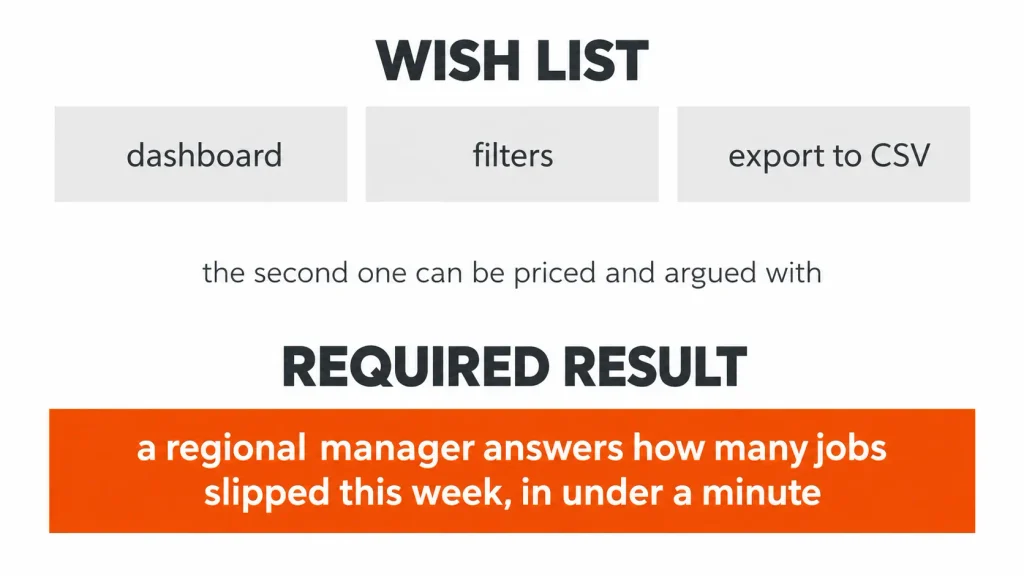
The difference is not pedantry. A vendor reading “a dashboard with filters and exports” has to invent the point of it. A vendor reading “a regional manager can answer how many jobs slipped this week in under a minute” can price that, and can argue with it.
18F makes the same distinction when it describes performance objectives as required results, and prefers criteria “that can be verified objectively and continuously throughout the performance period.” Verifiable is the operative word.
The practical test is whether a number can sit next to it. A result with no number attached becomes an opinion at acceptance time, which is when opinions are expensive, and picking the right number is the same work as choosing startup metrics you will actually run the business on.
Do this: Take your top five features and rewrite each as one sentence about a person completing a task, with a number in it.
Use the six fields the government already publishes
You do not need to invent a brief format. One exists, it is short, and it is public.
FAR 37.602(c) sets out the minimum contents of a Statement of Objectives. Six fields, and the regulation adds that “Offerors use the SOO to develop the PWS; however, the SOO does not become part of the contract.”
| FAR field | What a founder writes |
| Purpose | Why this exists, in two sentences |
| Scope or mission | What is in, and explicitly what is out |
| Period and place of performance | Dates, and where the team works |
| Background | What exists today, including the spreadsheet |
| Performance objectives | The required results, with numbers |
| Operating constraints | Budget, stack, compliance, people |
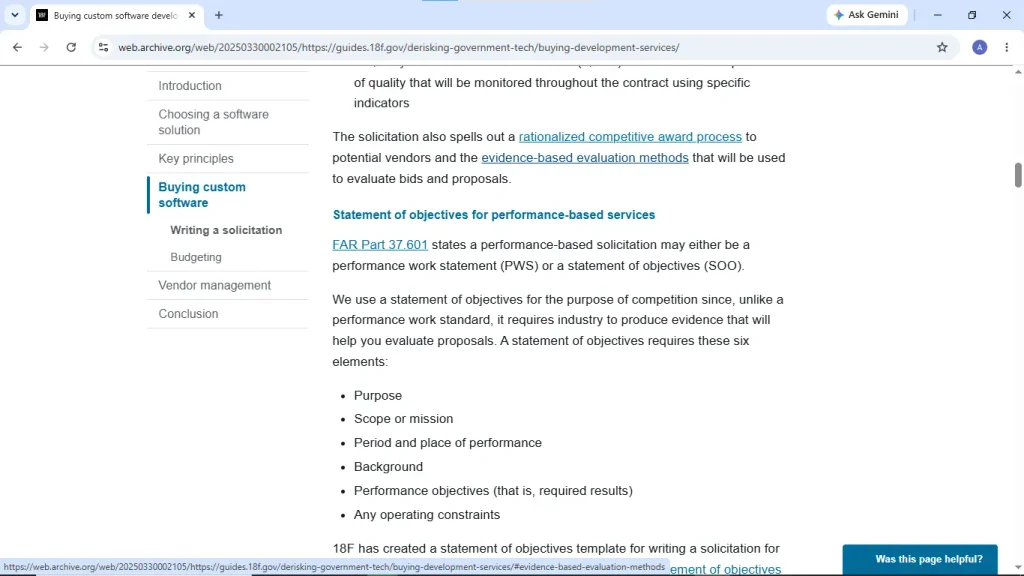
18F prefers this shape for a specific reason. Its guide on buying custom software development services notes that unlike the alternative, a statement of objectives “requires industry to produce evidence that will help you evaluate proposals.”
That is the whole trick. You are not writing the solution. You are writing the question in a form that forces every answer into the same shape.
Do this: Open a blank page, put those six headings on it, and fill them. Stop at one page.
State how you will choose before you ask for a price
Vendors price what they think you will reward. If you have not said, they are guessing.
FAR 15.304 requires that “All factors and significant subfactors that will affect contract award and their relative importance” be “stated clearly in the solicitation.” It also requires the solicitation to say whether the non-price factors combined are significantly more important than price, roughly equal to it, or significantly less important.

That last part is the sentence most founders skip, and it changes every proposal you get back. A brief that says price matters less than technical approach gets different documents from one that says nothing, because silence reads as price.
18F goes further and weights three technical factors, covering technical approach, staffing approach and similar experience, as significantly more important than price. Decide your own weighting, then publish it alongside your MVP development cost expectations rather than hiding both.
Do this: Write one sentence naming your factors in order and whether they outrank price. Put it in the brief.
Write the constraints down, including the ones you dislike
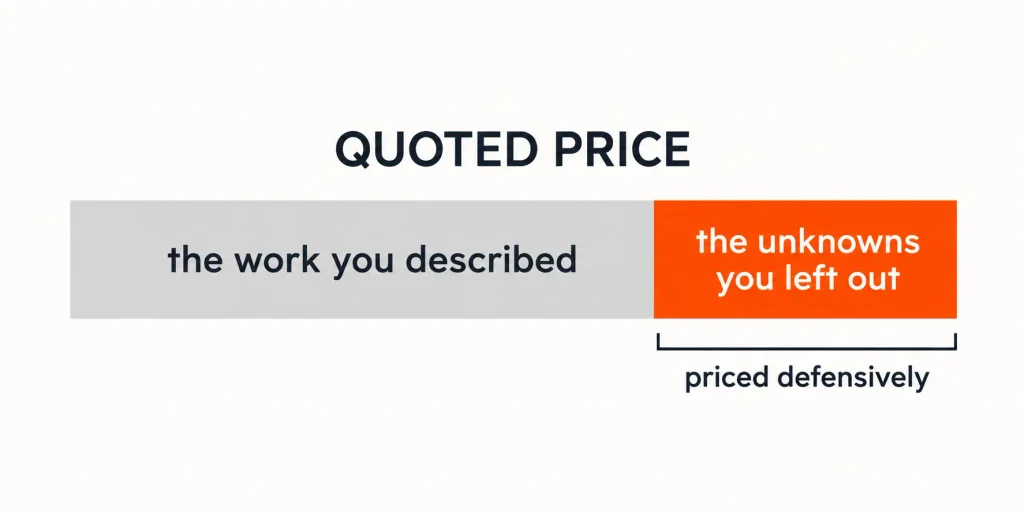
The constraints you leave out are the ones that get priced as unknowns, and unknowns are expensive.
Budget is the obvious one, and the one founders withhold hoping for a lower number. The effect is the opposite. A vendor who cannot see the ceiling either prices the full version or prices defensively, and neither is the quote you wanted.
| Constraint | Say it even when |
| Budget range | You fear anchoring high |
| Stack limits | Your preference is weakly held |
| No-code acceptable or not | You have not decided yet |
| Compliance obligations | They are not confirmed |
| Who on your side is available | The honest answer is nobody |
The constraint founders most often leave vague is the build approach. Stating whether a no-code platform is acceptable removes a whole axis of disagreement, and the honest version of that decision is the no-code versus custom question rather than a preference you reveal after bids arrive.
The last row matters more than it looks. A build where nobody on your side can answer questions within a day is a different project, and vendors who have been burned will price it as one.
Do this: Add your budget range to the brief as a range, with the sentence that you want the best use of it rather than the lowest bid.
Define done as something a stranger can verify
Acceptance disputes are brief failures that surface three months late.
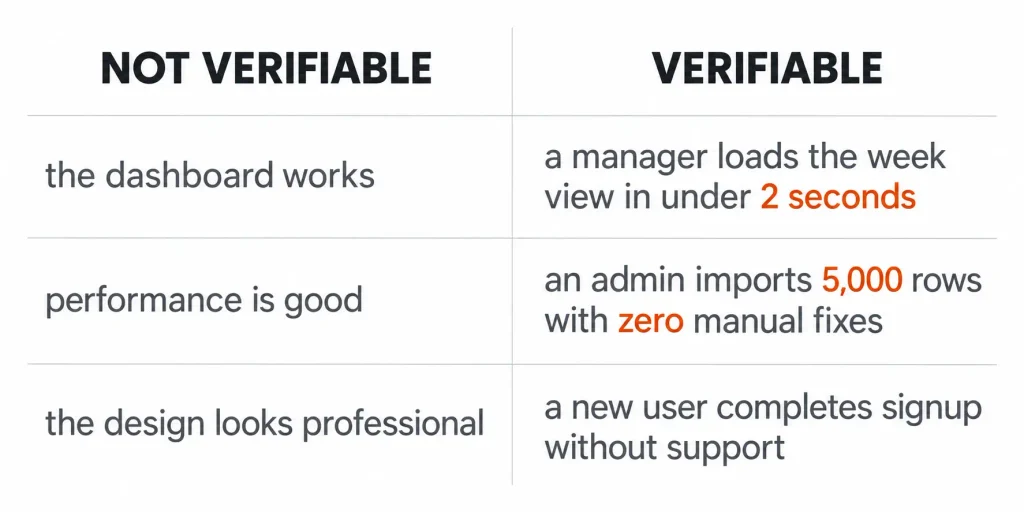
“Working” is not a definition. A definition of done is a sentence a person who was not in the room can test, with no judgment call: a named user completes a named task, on named data, within a named time, without help.
GAO’s 2020 spotlight on agile software development names the predictable friction here. It lists mistrust in iterative delivery as a challenge, noting that customers “may be disappointed by the delivery of a small piece of functionality.”
A written definition of done defuses that, because the first increment either meets the stated test or it does not. We publish acceptance criteria alongside outcomes in our case studies for the same reason, since the criteria are the part that gets reused.
Do this: Write the acceptance test for your single most important feature. One sentence, one number, no adjectives.
Cap the proposal and ask for code
Long proposals hide differences. Short ones expose them.
18F recommends keeping vendor proposals “under 10 pages” and suggests a “hard limit of five pages.” A five page cap forces every vendor to spend their space on the same decisions, which is exactly what makes two documents comparable.
Then ask for something a sales team cannot write. 18F advises asking “for links to two or three source code repositories that illustrate the work of the company or technical lead,” and treats verbal interviews as “a critical quality control measure that confirms the information provided in the written proposal.”
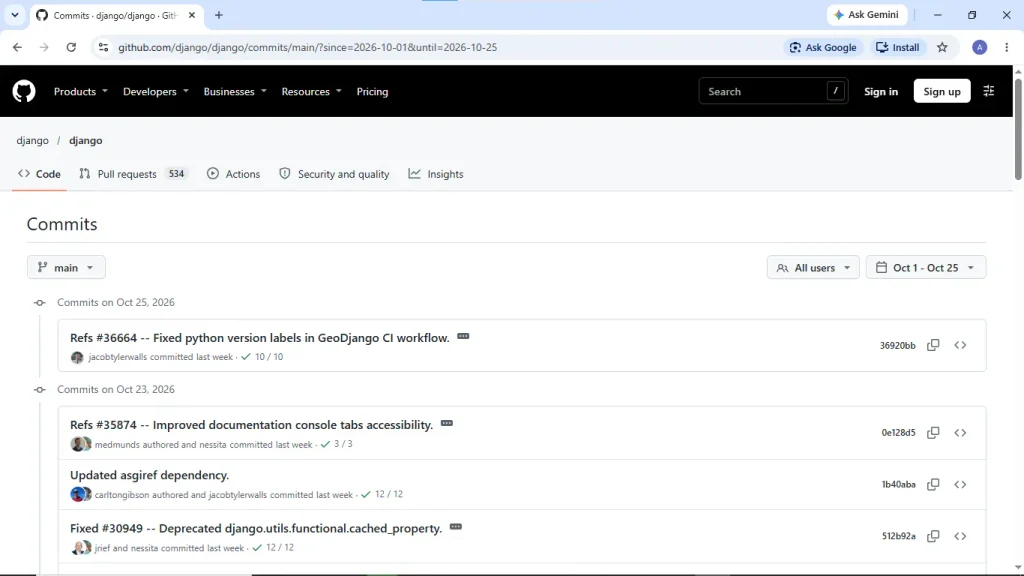
18F’s published red flags for code samples are worth copying verbatim into your evaluation sheet. One is that “There is no Git history or only a single commit, which indicates that this is not the actual code repository.” Another is that the samples “do not demonstrate an understanding of writing a modern, maintainable application.”
Who you send this to changes what you can reasonably ask for. A solo developer will not have a staffing approach, which is one of the real differences between hiring a freelancer or an agency and worth deciding before the brief goes out.
Do this: Add a five page cap and a request for two repository links. Both lines cost you nothing.
Send it identically, then compare on one axis
Identical input is the whole point, and it is the step most often broken by helpfulness.
Answering one vendor’s clarifying question privately breaks comparability. Collect questions, answer them in writing, and send every answer to everyone, including the vendors who did not ask. Federal practice does this through amendments, and it exists for this reason rather than for fairness alone.
Then compare one axis at a time. Not totals.
| Compare | Not |
| What each quoted against objective one | Headline totals |
| What each assumed you would supply | Timeline promises |
| What each excluded explicitly | Feature counts |
| What each priced as a contingency | Day rates |

he exclusions row finds most of the price spread. A quote that is half the price of another is often identical work with migration, content, integrations or support quietly left out, and the exclusions are where that shows.
Do this: Build the four row grid before the first quote arrives. Fill it as they land, and never compare totals first.
What this will not fix
A better brief gets comparable quotes. It does not get accurate ones.
Estimation stays hard because the work is genuinely uncertain at the start. 18F puts the limit plainly: a vendor cannot know whether a proposed approach will be effective until development begins. A comparable quote is a quote you can reason about, not a quote that will prove correct.
The federal format also carries overhead you should ignore. You are not running a source selection, you do not need amendments, debriefings or a scoring panel, and copying that machinery into a six person company is how a two week process becomes two months.
And a brief cannot substitute for a decision. If you genuinely do not know whether no-code is acceptable or what the budget ceiling is, writing the brief will surface that, but it will not answer it. Those are yours.
The one page brief
Copy this, fill it, keep it to one page. The headings are the six FAR 37.602(c) fields in plainer words.
PURPOSE
Why this project exists, in two sentences. The business reason, not the feature.
SCOPE
In scope: [3 to 6 bullets]
Out of scope: [list it explicitly, this section prevents most disputes]
TIMING AND PLACE
Target start: [date] First release wanted by: [date]
Working arrangement: [remote, overlap hours required, onsite days]
BACKGROUND
What exists today: [the spreadsheet, the old system, the manual process]
What we have tried: [and why it did not work]
REQUIRED RESULTS
1. [Named user] can [complete named task] on [named data] in [number] [unit].
2. …
3. …
(Each line has a number in it. No line names a technology.)
CONSTRAINTS
Budget range: [state it]
Stack limits: [or “none, propose and justify”]
No-code acceptable: [yes / no / propose both]
Compliance: [or “none known”]
Our availability: [who answers questions, and within what time]
HOW WE WILL CHOOSE
Factors in order: [1, 2, 3]
These factors combined are [more important than / equal to / less important than] price.
WHAT WE WANT BACK
Maximum 5 pages. Two or three source code repository links.
One 45 minute call with the people who would do the work.
Questions by [date]. All answers sent to all bidders.
That is the artifact. We use the same shape before starting any three-week MVP builds, because a brief this size is faster to write than a feature list and far harder to misread.
Where we fit
We bid on briefs like this, so we benefit when founders write them. Saying it plainly.
What we do about it is answer the brief as written, name our exclusions in the proposal rather than discovering them later, and tell you when an objective is not achievable at the budget you stated. If you send us a wish list, we will send back the required results we think you meant, and you can correct us before anyone prices anything.
This is not always worth the effort. If you have one vendor you trust and a small first project, a conversation and a written scope beats a competitive process. If you are buying something standard, the brief matters less than the product comparison.
If you want your brief read before you send it to anyone, book a call with us and bring whatever document you have now.
Frequently Asked Questions
How long should a software development RFP be?
Shorter than most founders expect. One page of brief gets better proposals than ten pages of requirements, because a long feature list invites vendors to price different subsets of it. Keep the brief to the six fields and cap the responses instead. 18F suggests keeping vendor proposals under 10 pages and recommends a hard limit of five.
Should I tell vendors my budget?
Yes, as a range, with a sentence saying you want the best use of it. Withholding the number does not produce lower bids. It produces either a quote for the full version or a defensive quote with contingency built in, and neither is comparable to the others you receive.
Why do agencies quote such different prices for the same project?
Usually because they are not pricing the same project. A feature list leaves gaps, each vendor fills them with different assumptions about scale, quality, testing and support, and then prices those assumptions. The exclusions section of each proposal is where most of the spread is hiding.
Is an RFP overkill for a first MVP?
Often yes, if you mean the full procurement process. The brief is not overkill, because writing the six fields takes under an hour and forces decisions you need anyway. Skip the formal machinery: no scoring panel, no amendments, no debriefings. Keep the document and the identical distribution.
What if a vendor refuses to send code samples?
Treat it as information rather than as an obstacle. Some have genuine client confidentiality, which is a reasonable answer when they offer an alternative such as a walkthrough of a sanitized repository. A flat refusal with no alternative, on a project where you cannot assess code yourself, is a risk you are accepting knowingly.
Resources
- FAR 37.602 Performance work statement, Federal Acquisition Regulation, section effective 13 March 2026 under FAC 2026-01. The instruction to describe work by required results, and the six minimum contents of a Statement of Objectives.
- FAR 15.304 Evaluation factors and significant subfactors, Federal Acquisition Regulation. The requirement to state all award factors and their relative importance clearly in the solicitation, and to rank them against price.
- Buying custom software development services, 18F, General Services Administration. The case for a statement of objectives, the proposal page caps, modular contracting, and the request for source code repositories.
- How to evaluate bids and proposals, 18F, General Services Administration. The published red flags for code samples and the weighting of technical factors against price.
- Science and Tech Spotlight: Agile Software Development, U.S. Government Accountability Office, GAO-20-713SP, published 29 September 2020. Requirements evolving during delivery, and mistrust of iterative delivery as a named challenge.