

Key Takeaways
Why a resignation reclassifies your system as legacy, the cheapest first move before a rebuild, and the three plan elements to write first.
- The UK government’s legacy IT definition makes a shortage of skills and knowledge a standalone criterion that classifies a system as legacy on its own.
- GAO found the eleven most critical federal legacy systems are about 23 to 60 years old and cost roughly $754 million a year to run.
- Seven of those eleven systems carry known vulnerabilities that cannot be fixed without modernization.
- Only three of eleven federal modernization plans contained all three key elements, and seven incomplete plans belonged to work already underway.
- BLS projects computer programmer employment to decline 7 percent from 2025 to 2035, with all annual openings coming from replacement.
Eleven systems. Twenty-three to sixty years old. Roughly $754 million a year just to keep running.
Those are the figures in GAO-25-107795, published 17 July 2025, covering the federal systems most in need of modernization. The number that matters for you is a different one. Eight of the eleven run on languages like COBOL and assembly, and GAO notes that Treasury depends on languages with “a dwindling number of people available with the skills needed to support them.”
That is the actual failure mode. A system does not become unmaintainable when its framework reaches end of life. It becomes unmaintainable on the day the last person who understands it walks out. So before you price a rebuild, buy what is in that person’s head, write down three things, and only then decide what to replace.
The clock is a resignation date, not an end-of-life date
Your deadline is in someone’s notice period, and almost nobody treats it that way.
Quick Verdict: Book the knowledge-capture sessions this week, before you scope anything. Velcod handles the follow-on as web application development, and the decision of whether to rebuild or scale what you have comes after the capture, not before.
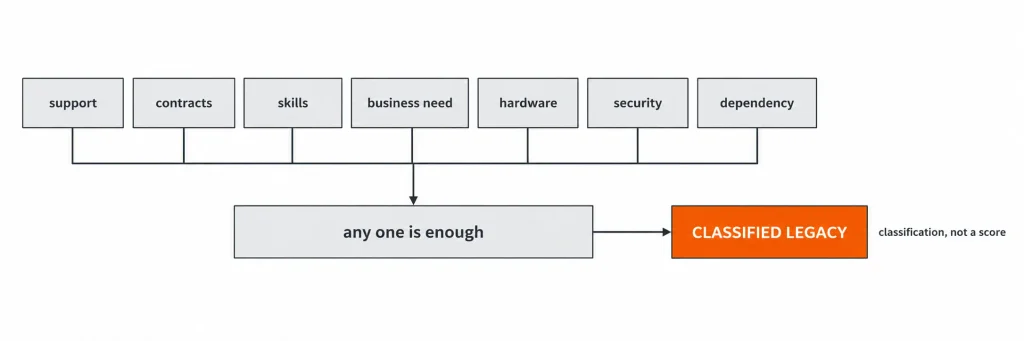
Call it THE KNOWLEDGE CLOCK. The UK government now writes this into policy. Its updated definition of legacy IT, first published 17 August 2026, lists “Lack of required skills and knowledge” as one of seven criteria, defined as the situation “When there are not enough individuals within an organisation who possess the expertise needed to effectively manage, maintain, and support outdated systems.”

The framework’s own logic is the useful part. It states that “Legacy IT is a classification, not scored, which means that if a system meets the threshold for unacceptable in any of the above criterion, then the system is classified as legacy and requires remediation.”
One criterion is enough. So a resignation can reclassify a perfectly modern system as legacy without a single line of code changing. The framework even has a name for the state just before that: Action-Required, meaning a system that “is not yet legacy but will become legacy within the next 12 months if no action is taken.”
Do this: Write down who is the only person who understands each system you depend on. That list is your real risk register.
Classify the system before you price anything
Classification is free and takes an hour. Pricing a rebuild takes weeks and is usually premature.
Run the seven criteria against your system before any vendor conversation. The answer tells you whether you have a staffing problem, a security problem, a contract problem or a genuine replacement problem, and those have different cheapest fixes.
| Criterion | What it actually asks |
| Out of support systems | Has the vendor stopped supporting it |
| Missing or inadequate contracts | Have licences or support contracts lapsed |
| Lack of required skills and knowledge | Is one person the only one who knows |
| Inability to meet user or business needs | Is it blocking the business today |
| Unsuitable hardware | Is the hardware failing or unrepairable |
| Failure to meet cyber security standards | Are there exploitable weaknesses |
| Reliance on a legacy dependency | Does it sit on something already legacy |
Most inherited internal systems fail on the skills criterion long before they fail on any technical one. That is the pattern with an inherited accounting, scheduling or operations tool, and it is why custom ERP development conversations so often start with a person leaving rather than with a feature request.
Be honest about which criterion you actually failed. A system failing only on skills needs a week of recording. A system failing on security and support needs a plan.
Do this: Score your system against all seven criteria in one sitting. Note which ones you failed and which you did not.
Buy what is in their head this week
This is the cheapest move available and it is almost never the first one taken.
Every page of advice on this topic sells a rebuild. A rebuild takes quarters and starts with discovery. Recording the person who already knows takes days and makes the discovery unnecessary. Do it while they are still employed and still willing.

Six things are worth recording, in this order. Record the screen and the voice together, and do not let anyone write a document instead.
The data model walkthrough, where they explain what each important table means and which fields lie. The deploy path, performed live, including the steps that are not in any script. The failure list, meaning what breaks, how often, and what they do about it. The integration map, naming every external system and who owns the credentials. The decisions they would defend, and the ones they regret. And the people, meaning who to call at each vendor.
Do this: Book three two-hour recorded sessions in the next five working days. Screen and voice, no slides.
Measure the archaeology tax instead of arguing about it
Everyone agrees the codebase is painful. Nobody has a number, so the argument goes in circles.
The measurement is simple and you can run it without us. Give a competent engineer who has never seen the system one small, real, safe change. Time how long it takes from first checkout to a deployed change that nobody had to roll back. That figure is your archaeology tax.

Run it twice, before and after the recording sessions, with two different engineers and comparable changes. The gap between the two figures is what the knowledge capture bought you, in the only unit anyone cares about.
We start engagements with this measurement rather than with a proposal, and the figures sit in our case studies because the before number is usually what persuades a board. Keep the method honest: same size of change, same definition of safe, written down before you start.
Do this: Pick one small real change and time a new engineer end to end. Write the number down today.
Write the three plan elements before anyone writes code
GAO has a standard for what a modernization plan must contain, and most plans fail it.
A complete plan has milestones, a description of the work to be performed, and the disposition of the legacy system. In GAO-25-107795, nine of the eleven systems had some documented plan, only three included all three elements, six were partial, and two had no plan at all.

The detail worth sitting with is this: seven of the incomplete or missing plans belonged to modernizations that were already underway. Work had started without a finished plan, which is the normal condition rather than the exception.
GAO’s view of the consequence is plain enough. Incomplete plans raise the risk of cost overruns, schedule delays and outright failure. The third element is the one private companies skip most often, because deciding what happens to the old system feels like a problem for later.
Do this: Write one page with three headings: milestones, work to be performed, disposition of the old system. If you cannot fill the third, you are not ready.
Decide what you are required to keep before you switch anything off
Disposition is not a technical step. It is a records decision with legal weight.
Federal records practice makes the obligation explicit. The National Archives instructs agencies to “write recommended cutoffs, retention periods, and other disposition instructions for all records,” and states that “The timing of destruction or transfer to the National Archives must not be left to chance.”
That guidance governs federal agencies rather than your company, and the principle underneath it is general. Something inside the old system is subject to a retention obligation, whether that is tax records, signed contracts, payroll history or regulated customer data, and you need to know which before the server is turned off.
The bar rises with the data. A system holding health information carries retention and access obligations that outlive the software, which is the same reason HIPAA compliant systems are harder to decommission than to build.
Do this: Ask your finance lead and your lawyer what inside the old system has a retention period. Get it in writing before any cutover date is set.
Modernize the part that changes, keep the part that does not
Replacing everything is the most expensive option and rarely the necessary one.
Split the system by rate of change rather than by age. The parts nobody has edited in three years are not your problem, however old the code is. The parts that change monthly are where the archaeology tax is actually being paid.
| Part of the system | Default move |
| Changes monthly, business-critical | Modernize first |
| Changes monthly, low value | Retire the feature instead |
| Stable for years, still correct | Leave it, document it |
| Stable but unsupported or insecure | Replace on a security timeline |
| Nobody can say what it does | Capture knowledge before deciding |
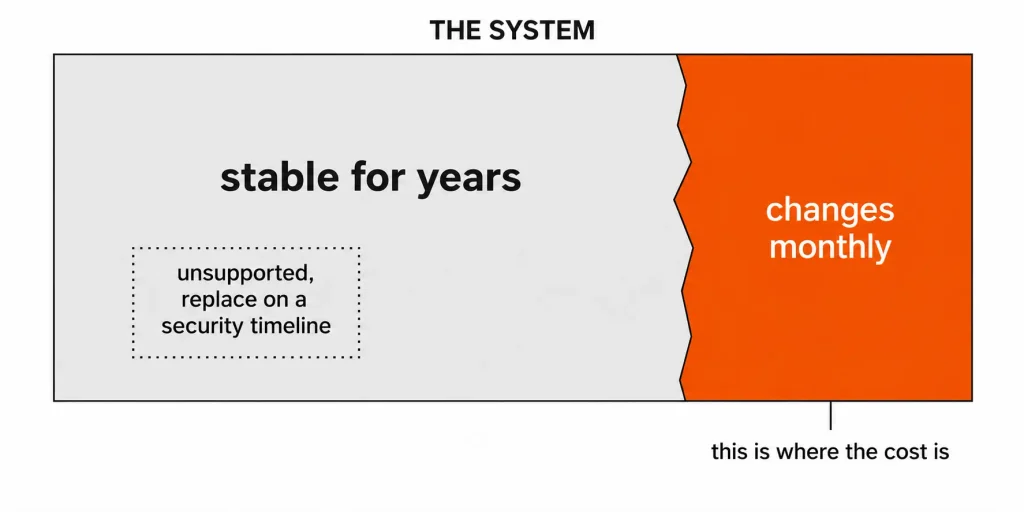
This is also the honest answer to the question of what happens after a modernization. The replaced parts need owners, patching and an on-call path, which is the same obligation as any ongoing maintenance and support arrangement rather than a one-time project cost.
The documentation step on the stable parts matters more than it sounds. A stable system with no documentation is one resignation away from being the problem you just solved.
The UK guidance on preventing technical debt turns that into a question worth stealing. Its self-assessment asks whether “a legacy owner been identified with responsibility for the technical health of the product or service,” and whether “there is money available for future legacy remediation and technology upgrades.” Both are questions about a named person and a budget line, not about code.
Do this: Pull the commit history and list the ten files changed most often in the last twelve months. Start there.
What the first increment must prove
The first release is not a replacement. It is proof that a stranger can change this system safely.
Pick one workflow from the frequently changed list and move it, leaving everything else alone. The pass condition is not that users prefer it. The pass condition is that an engineer who did not sit in the recording sessions can make a change to it, deploy, and not break anything.

That gate tests the thing you actually bought. If the answer is no, the recordings missed something, and the fix is another session rather than more code.
Set the gate in writing before scoping, and agree who judges it. Whether you run this internally or with an outside development company, the condition should be identical either way, because it is a test of the system rather than of the supplier.
Do this: Write the pass condition in one sentence, naming the engineer who will attempt it and the date.
What this will not fix
Capturing knowledge buys you time and options. It does not make an old system new.
The structural problems stay structural. GAO found that seven of the eleven systems carry known vulnerabilities that cannot be fixed without modernization, and that two agencies run systems where all the hardware, software and operating systems are no longer supported by vendors. No amount of recording addresses that.
The staffing picture is also not improving on its own. BLS reports that computer programmers held about 110,800 jobs in 2025, projects employment to decline 7 percent from 2025 to 2035, and notes that the roughly 4,400 annual openings are all expected to come from replacing workers who leave the occupation or the workforce. The pool you would hire from is shrinking, not growing.
And none of this tells you whether to modernize or replace. That depends on the archaeology tax you measured, what the system is worth, and how long you have. Anyone quoting a rebuild before seeing those numbers is guessing.
The one-week capture plan
Five days, one departing person, three people in the room. This is the cheapest insurance available and the reason to forward this page to whoever runs operations.
DAY 1 DATA MODEL
90 min recorded. They walk the schema table by table.
Must capture: what each important table means, which fields are
unreliable, where the same thing is stored twice.
In the room: the departing person, one engineer, one note taker.
DAY 2 DEPLOY AND ENVIRONMENTS
90 min recorded. They deploy a trivial change live, narrating.
Must capture: every step not in a script, every credential used,
what rollback looks like, what has gone wrong before.
DAY 3 FAILURES AND INTEGRATIONS
90 min recorded. Two halves.
Must capture: what breaks, how often, what they do about it,
every external system, who owns each set of credentials,
which vendor contact actually answers.
DAY 4 DECISIONS AND REGRETS
60 min recorded, conversational.
Must capture: choices they would defend and why, choices they
regret, the change they were about to make and did not,
what they would tell their replacement on day one.
DAY 5 VERIFY, DO NOT SUMMARIZE
An engineer who was not in sessions 1 to 4 attempts one small
real change using only the recordings.
Output: a written list of what the recordings did not cover.
Then book one more session to close those gaps.
OUTPUTS, kept somewhere durable
Raw recordings, indexed by topic and timestamp.
One schema map. One deploy runbook. One failure list.
One integration and credential register.
The gap list from Day 5.
Day five is the step people cut, and it is the only one that tests whether the other four worked. We run the same sequence before three-week MVP builds when we inherit an existing system rather than starting clean.
Where we fit
We take over systems other people built, so we have an interest in telling you a rebuild is necessary. Saying it before anything else.
What we do about it is run the capture week and the archaeology measurement first, and give you both numbers before we quote anything. On a meaningful share of these, the honest finding is that the system is fine and the knowledge was the whole problem, in which case the capture week is the entire engagement and we say so.
This is not always the right call. If the departing person has already gone, there is nothing to capture and you are into reconstruction, which is a different and worse project. If the system is unsupported end to end, security sets your timeline rather than convenience.
If someone with the only copy of the knowledge is leaving in the next ninety days, book a call with us and bring their notice date.
Frequently Asked Questions
What makes software legacy?
Age is not the test. The UK government’s definition lists seven criteria, and a system is classified as legacy if it meets the unacceptable threshold on any one of them. Those include a lack of required skills and knowledge, lapsed support contracts, unsupported hardware and exploitable security weaknesses. One criterion is enough on its own.
How much does legacy modernization cost?
Nobody can quote it honestly before two numbers exist: your time to first safe deploy for a new engineer, and what the system is worth to the business. Get the first by timing one small real change end to end. Any proposal written before that measurement is pricing an unknown and will move.
Can we modernize without a rewrite?
Usually yes, and splitting by rate of change is how. Parts nobody has edited in three years are not costing you anything, whatever their age. Move the parts that change monthly, retire low-value features instead of porting them, and replace unsupported components on a security timeline rather than all at once.
What if the person has already left?
Then you are reconstructing rather than capturing, which costs more and takes longer. Start with the commit history, the deploy logs and the integration credentials, and expect the data model to be the hardest part. The practical lesson is for the next system: record before the notice period, not during it.
Is it worth modernizing a system that still works?
It depends on which criterion you failed. A system that works, is supported, and is understood by more than one person is not a priority however old it is. A system that works but is understood by exactly one person who is leaving is urgent, and the urgency has nothing to do with the code.
Resources
- Information Technology: Agencies Need to Plan for Modernizing Critical Decades-Old Legacy Systems, GAO-25-107795, U.S. Government Accountability Office, published 17 July 2025. The eleven most critical federal legacy systems, their ages and annual cost, the skills shortage on legacy languages, and the three elements of a complete modernization plan.
- Updated Definition of Legacy IT, UK Government Legacy IT Risk Assessment Framework, first published 17 August 2026. The seven legacy criteria, the classification logic, and the Action-Required outcome for systems twelve months from becoming legacy.
- Computer Programmers, Occupational Outlook Handbook, U.S. Bureau of Labor Statistics. The May 2025 median wage, the projected decline from 2025 to 2035, and the finding that annual openings come from replacement rather than growth.
- Preparing Disposition Instructions, National Archives and Records Administration. Federal practice on writing cutoffs and retention periods, and the requirement that timing of destruction or transfer is not left to chance.
- Prevent technical debt and legacy, UK Government, published 23 February 2024 and last updated 23 October 2024. The self-assessment questions on naming a legacy owner, identifying a business risk owner, and funding future remediation.