

Key Takeaways
Deciding and building are different jobs. Here is how to tell which one you need, and what to demand in writing from either.
- A fractional CTO sells judgment. An agency sells delivery. Buying one while expecting the other is the most common mistake here.
- The Bureau of Labor Statistics puts the median wage for computer and information systems managers at $175,140 in May 2025, before benefits.
- Run the conflict test: a fractional CTO who tells you to build less earns the same, and an agency that tells you to build less earns less.
- An agency that explains itself does part of the deciding job as a byproduct, because every recommendation arrives with its alternatives attached.
- A decision is only explained when it is written down, owned, and superseded rather than quietly edited.
A full-time technical leader costs more than most pre-seed rounds will carry. The Bureau of Labor Statistics puts the median annual wage for computer and information systems managers at $175,140 in May 2025, and that figure is wages only.
So founders go shopping for a fraction of that person. Reasonable. The problem is that most of them are not actually shopping for a decision maker. They are shopping for someone to make the uncertainty stop, and those are different purchases.
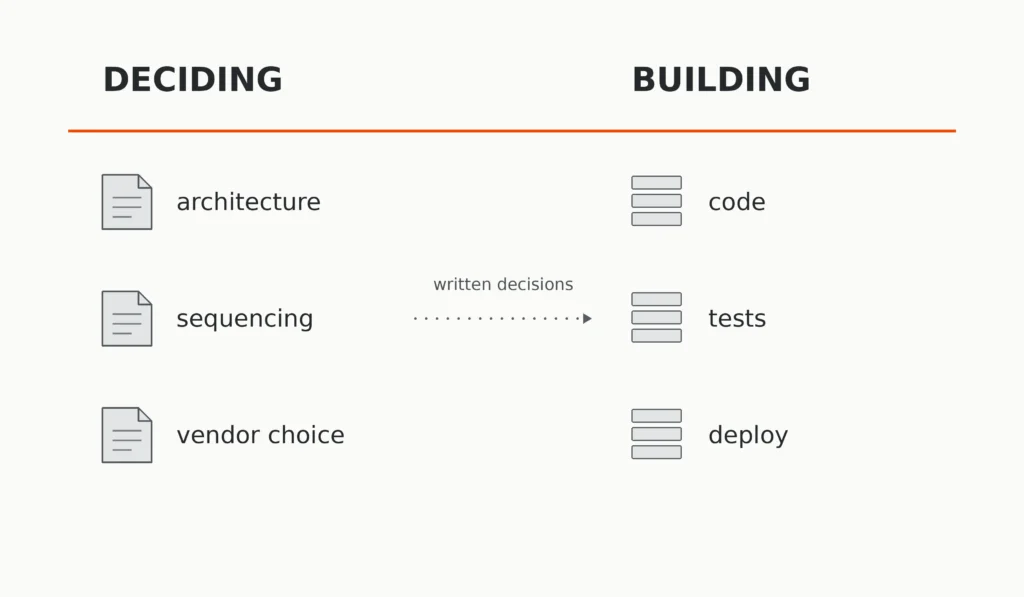
Here is the split that matters. A fractional CTO is paid to decide: architecture, hiring, vendor choice, sequencing. An agency is paid to build what has already been decided. If nobody has made those decisions yet, the agency will make them for you by default, and you will never see it happen.
Separate the deciding from the building
Deciding and building are different jobs. They get sold as if they were one job, which is why the comparison feels confusing.
Quick Verdict: If your decisions are already made and written down, hire a builder. If they are not, buy the deciding first, from a fractional CTO or from a build partner that shows its reasoning. Velcod runs MVP development with the decisions recorded as we go, and the wider non-technical founder MVP guide covers the full path.
Call it THE TWO JOBS. Job one is deciding what to build, in what order, on what stack, with what tradeoffs accepted. Job two is building it. A fractional CTO does job one. An agency does job two.
An agency that explains itself does part of job one as a byproduct, because it cannot hand you a reason without also handing you the alternatives it rejected. That is the asymmetry nearly every comparison article misses.
| Job one: deciding | Job two: building | |
| What you buy | Judgment and sequencing | Working software |
| Output | Written decisions, tradeoffs, a plan | Code, tests, a deployed product |
| Who owns it | You, advised | The build team, scoped |
| Failure looks like | A plan nobody can execute | A product nobody decided on |
The failure mode here is documented, not theoretical. AWS lists it as an anti-pattern in its guidance on architectural decision records: “No decision is made at all, out of fear of making the wrong choice.” A founder who cannot evaluate technical options often resolves that fear by hiring a builder and hoping the decisions resolve themselves.
Do this: Write down the five technical choices your product depends on. If you cannot name who made each one, you have a deciding problem, not a building problem.
Price the full-time version before you shop for a fraction of it
Every fractional engagement is priced against a full-time salary you probably have not calculated.
Start with the BLS figure of $175,140 for the median computer and information systems manager in May 2025. That is wages. The BLS Employer Costs for Employee Compensation release reports that benefits accounted for 30.0 percent of total compensation in private industry, with wages and salaries making up the rest.
Run that forward and a full-time technical leader at the median sits near a quarter of a million dollars a year in loaded cost, before equity. That is the number a fractional arrangement is competing with, and it is why we built Velcod’s MVP studio around a fixed three-week window instead of an open retainer.
The market for that person is also tightening. BLS projects employment of computer and information systems managers to grow 16 percent from 2025 to 2035, which is well above the average for all occupations.
| Shape | What you are buying | Typical commitment |
| Full-time CTO | All of job one, plus hiring and management | Salary plus benefits plus equity |
| Fractional CTO | Job one on a schedule | Monthly retainer, fixed hours or days |
| Advisor | Opinions, not ownership | Equity or a small monthly fee |
| Agency that explains itself | Job two, plus the reasoning behind it | Scoped project fee |
Do this: Put your own loaded number on a full-time hire before you take a fractional quote. Without it you have nothing to compare against.
Run the conflict test on every recommendation
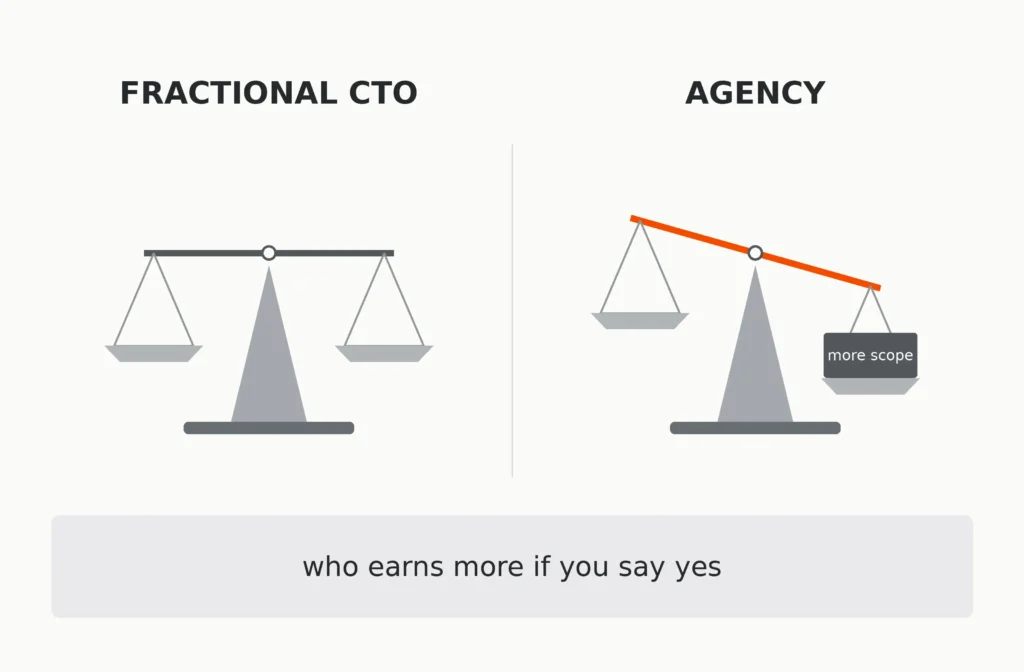
Ask one question about any technical recommendation you receive: who earns more if you say yes.
Call it THE CONFLICT TEST. A fractional CTO who advises you to build less earns exactly the same next month. An agency that advises you to build less earns less. That is an incentive, not a character flaw, and we sit on the wrong side of it.
Naming it is the point. We are an agency. When we tell you a feature is worth building, that recommendation carries a financial interest, and you should discount it accordingly unless we have shown you the option we rejected and what it would have cost.
| If the honest answer is | A fractional CTO earns | An agency earns |
| Build less than planned | The same | Less |
| Delay the build by a quarter | The same | Nothing yet |
| Use an off-the-shelf tool | The same | Nothing |
| Rebuild from scratch | The same | More |
The counterweight is not trust. It is traceability. The UK government’s Architectural Decision Record Framework, published 4 November 2025, frames good practice as decisions “made at the appropriate level, with the right stakeholders, and with proper visibility and traceability,” and describes itself as balancing “autonomy with accountability.”
That framing works for a founder buying from a vendor. You are not auditing motives. You are checking whether the reasoning is visible. The same logic applies when you are weighing hiring freelancers versus an agency, where the incentive shapes differ again.
Do this: For the next three recommendations you get, write down what the vendor earns if you agree and if you refuse. Keep the note.
A fractional CTO’s week is mostly meetings and documents
The work is not coding. Expect calls, written decisions, vendor reviews, and hiring screens.
A typical fractional engagement runs one to three days a month at the light end and one to two days a week at the heavy end. What you get is a decision cadence, not throughput.
The recurring work
Standing calls with you, a review of whatever the build team shipped, a running risk list, and a decision log that gets added to rather than rewritten. AWS describes the purpose of architectural decision records as work that “support team alignment, document strategic directions for a project or product, and reduce recurring and time-consuming decision-making efforts.”
That last clause is the measurable part. If the same architectural argument keeps resurfacing in your calls, the deciding work is not being captured.
The one-off work
Stack selection, vendor and agency evaluation, a security and compliance read, interviewing your first engineers, and due diligence support when you raise. These are the moments where a few hours of senior judgment changes a year of cost.
One of those moments is usually choosing no-code or custom code, which is close to irreversible once you have users and data in the wrong place.
Do this: Ask any fractional candidate for a redacted decision log from a past engagement. If no such document exists, they were advising, not deciding.
Hold whoever you hire to the explanation standard
A decision is not explained because someone talked you through it on a call. It is explained when it is written down in a form you can reread in six months.
Call it THE EXPLANATION STANDARD. The public sector version of this is already specified. The GDS Way guidance on architecture decisions says you “should record decisions that affect the architecture of your service, in order to preserve the context of your choices,” and sets out the sections each record carries.
| Section | What goes in it |
| Title | A description of the decision, not the problem |
| Status | Proposed, accepted, or superseded |
| Context | The facts behind the need to make the decision |
| Decision | What the team has decided to do |
| Consequences | Both positive and negative consequences |
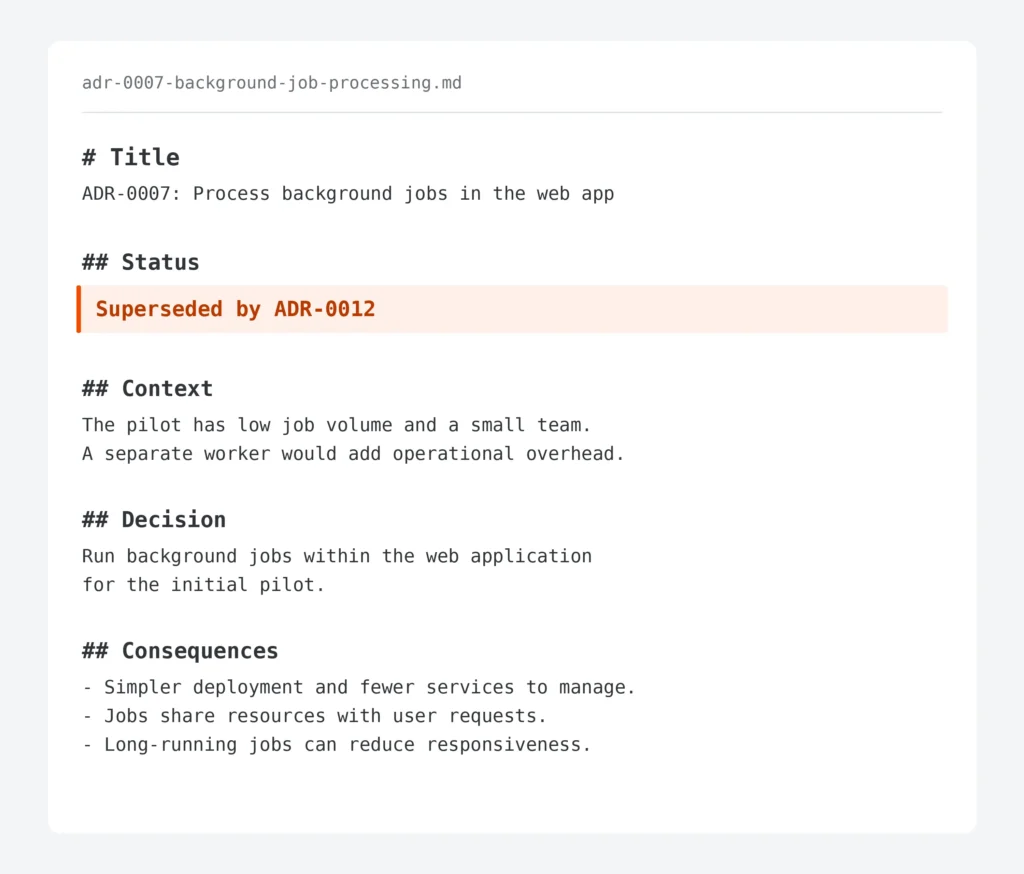
Two rules make the difference between a record and a wiki page nobody trusts. AWS states that “each project team member should be empowered to create and own an ADR,” and that records “should have a change history, and each change should have an owner.” When a decision changes, the old record is marked superseded and kept, rather than edited into agreement with the present.
Keeping the superseded version is what lets a new engineer, or a new agency, see why the current shape exists. GDS Way makes the same point about handover, noting this matters “as new people join the projects when those involved in the early stages are no longer around.” That is also why we publish our case studies with the decisions attached rather than only the outcomes.
Do this: Require one written record per significant decision, with a status field, from whoever you hire. Make it a deliverable in the contract.
Choose a technical cofounder only when equity buys something a contract cannot
A technical cofounder is not a cheaper fractional CTO. It is a different instrument with a different price.
The honest case for a cofounder is continuity and shared risk over several years, plus the kind of availability no retainer buys. The honest case against is that you are recruiting from a small pool, on a long timeline, while your product sits still.
The BLS figures explain why that pool is small. Entry into these roles typically requires a bachelor’s degree and, by the BLS description, “5 years or more” of work experience in a related occupation. Those people are employed, and demand for them is projected to grow 16 percent through 2035.
So the sequencing question is practical. If your runway is measured in months, a search measured in quarters is not a plan. Buying the deciding now and the equity conversation later is usually the cheaper order of operations, and it keeps your cheapest MVP build options open while you look.
[IMAGE-06] PLACE HERE: under the sequencing paragraph
TYPE: Diagram, safe to GENERATE
PROMPT: “Clean editorial diagram, light background, flat vector, no people, no 3D, no stock photography. Two horizontal timeline bars stacked and left-aligned to the same start point. Upper bar labeled RUNWAY, shorter, divided into month ticks. Lower bar labeled COFOUNDER SEARCH, visibly longer, divided into quarter ticks and extending past the end of the runway bar. The overhang beyond the runway bar is marked in a single orange accent #F54A00 and labeled ‘product sits still’. Sans-serif labels, thin rules, generous white space, muted greys elsewhere.”
CAPTION: The sequencing problem, drawn to scale. The orange section is the part founders do not plan for.
ALT: Two stacked timelines showing a cofounder search measured in quarters running past a runway measured in months.
UPGRADE: A dated screenshot of a real cofounder search pipeline, with candidate names and companies redacted and the first-contact and last-stage dates left visible, would outrank this diagram. Capture it only if a real pipeline exists. Never generate one.
Do this: Give your cofounder search a hard deadline and a fallback. Write both down before you start looking.
Five ways founders get this choice wrong
The mistakes cluster, and four of the five are versions of the same confusion.
[IMAGE-07] PLACE HERE: directly under the opening line of the mistakes section
TYPE: Diagram, safe to GENERATE
PROMPT: “Clean editorial diagram, light background, flat vector, no people, no 3D, no stock photography, no icon grids. A two-by-two grid. Horizontal axis labeled WHAT YOU NEEDED with columns ‘a decider’ and ‘a builder’. Vertical axis labeled WHAT YOU HIRED with rows ‘a decider’ and ‘a builder’. The two matching cells are plain grey and read ‘correct’. The two mismatched cells carry a single orange accent #F54A00 and read ‘competent build, wrong product’ and ‘reports, no software’. Sans-serif labels, thin rules, generous white space.”
CAPTION: The two expensive cells. Both are hiring mistakes, not execution mistakes.
ALT: A two-by-two grid matching what a founder needed against what they hired, marking the two mismatched outcomes.
Hiring a builder when you needed a decider. You hand over a feature list nobody senior has pressure-tested. The build is competent and the product is wrong.
Hiring a decider when you needed a builder. Your decisions were already made and documented. You then pay a retainer to have them reviewed again, which produces reports and no software.
Paying for an opinion you cannot act on. A recommendation that assumes a team you do not have is not advice. It is a description of someone else’s company.
Keeping no written decision record. AWS names this precisely as an anti-pattern: “The decision isn’t captured in an architectural decision repository, so team members forget or don’t know that the decision was made.” The second symptom is the expensive one, because the argument restarts with every new hire.
Treating a vendor’s recommendation as your decision. The GOV.UK framework defines an architectural decision as “a choice that affects the structure, quality attributes, or behaviour of a system.” That choice is yours to make and yours to own, whoever drafted the options. This cuts hardest on model and vendor questions, which is where a lot of founders are now when they look at building an AI app.
Do this: Read the five above and name the one you are closest to today. Fix that one before you sign anything.
What none of this will fix
Written decisions do not make decisions correct. They make them reviewable, which is a smaller and more useful claim.
A decision log also does nothing about work already shipped. AWS says it plainly: “The ADR process doesn’t solve the issue of non-compliant legacy code.” If you already have a codebase built on undocumented choices, this practice starts from today and leaves the history where it is.
Neither arrangement removes your judgment from the loop. A fractional CTO narrows your options and explains the tradeoffs. You still pick. Any vendor promising to take the decision off your plate entirely is selling you the thing that caused the problem.
We also cannot tell you a timeline for finding the right fractional candidate. That depends on your network, your category, and your ability to be specific about the decisions you need made.
The questions to ask before you sign
Five questions separate a decider from a describer, and a builder from a black box. Ask all five, of both.
- Which decisions will you own, and which stay with me?
- What does the written record look like, and can I see a redacted example?
- When you recommend more scope, what did you consider and reject?
- Who on your side can create and own a decision record?
- What happens to the records when this engagement ends?
The fifth question catches more problems than the other four combined. If the answer is a shared document nobody maintains, you are buying a conversation, not a decision trail.
Where we fit
We are a build partner, which means we are on the wrong side of the conflict test and we would rather say so than have you find out later.
What we do about it is narrow and checkable. Velcod builds MVPs in three weeks in real code, and every significant technical choice we make arrives with the alternative we rejected and what it would have cost you. If your decisions are already made and documented, you need exactly that and nothing more. If they are not, say so on the call and we will tell you whether you should be talking to a fractional CTO first.
Not every project should start here. Teams with a strong technical founder usually need delivery capacity, not reasoning. Teams with no decisions made at all sometimes need two months of deciding before anyone writes code.
If you want to see what the written version looks like on your product, book a call with us and bring your feature list. You will leave with the decisions named, whether or not you build with us.
Frequently Asked Questions
What does a fractional CTO cost in the US?
Fractional CTO pricing is usually a monthly retainer tied to days of availability, commonly one to four days a month at the light end. Compare any quote against a loaded full-time cost: the BLS median wage for computer and information systems managers was $175,140 in May 2025, and benefits add roughly 30 percent on top of wages.
Can an agency replace a fractional CTO?
Not entirely. An agency owns delivery, not your technical strategy. An agency that documents its reasoning covers part of the deciding work, because each recommendation arrives with the rejected alternatives attached. What it will not do is tell you to spend less with it, which is the specific judgment a fractional CTO can give you for free.
Do I need a technical cofounder to raise a pre-seed round?
No. Investors want evidence that the technical decisions are sound and that someone credible is accountable for them. A documented decision trail plus a named technical advisor or fractional CTO satisfies that in most pre-seed conversations. A cofounder search that stalls your product for two quarters usually hurts the raise more than it helps.
How is this different from what my current agency already does?
Ask for a written decision record with a status field. Most agencies will describe their reasoning on a call and never put it in a document you keep. The test is not whether they can explain a choice today. It is whether you can reread the explanation in six months, after the people who made it have moved on.
When should I skip the fractional CTO entirely?
Skip it when the decisions are already made, written down, and owned by someone technical on your side. At that point you are buying delivery, and a retainer for judgment you already have is pure overhead. Also skip it if you cannot name three specific decisions you need help making.
Resources
- Computer and Information Systems Managers, Occupational Outlook Handbook, U.S. Bureau of Labor Statistics. Median annual wage of $175,140 in May 2025, typical experience requirements, and projected 16 percent employment growth from 2025 to 2035.
- Employer Costs for Employee Compensation, U.S. Bureau of Labor Statistics. The wage and benefit split in private industry, used here to turn a salary figure into a loaded cost.
- Using architectural decision records to streamline decision-making during development, AWS Prescriptive Guidance. The purpose of decision records and the three anti-patterns that appear when decisions go uncaptured.
- Best practices for using architectural decision records, AWS Prescriptive Guidance. Ownership, change history, superseding rather than editing, and the limits of the practice.
- Architectural Decision Record Framework, UK Government, published 4 November 2025. Definitions of an architectural decision and the visibility and traceability standard applied across the public sector.
- Architecture decisions, The GDS Way, UK Government Digital Service. The record sections used in the table above and the handover rationale for keeping them.