

Key Takeaways
What actually breaks when a pilot app meets an enterprise customer, in the order it breaks, and how to tell a hardening pass from a rebuild.
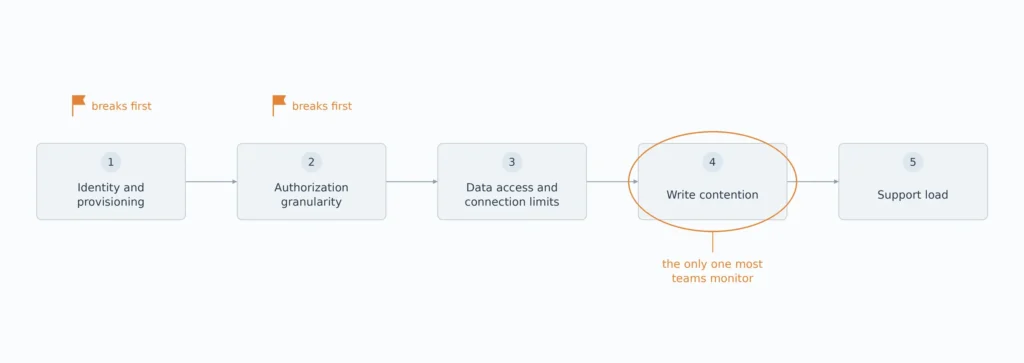
- The failure order is identity, authorization, data access, write contention, then support load. Performance sits fourth and gets all the attention.
- SSO and automated deprovisioning are different claims. RFC 7642 puts provisioning in a separate context from authentication, and the security review audits offboarding.
- PostgreSQL ships with max_connections at a default of typically 100, minus three reserved, and it cannot be raised without a server restart.
- OWASP ASVS Level 2 is “the recommended level for most applications.” Your pilot was implicitly Level 1 and nobody sent notice when the bar moved.
- If three requested changes all touch the data model or auth layer, you are looking at a rebuild priced as a hardening pass.
An app that served 20 pilot users for eight months fell over in week two of its first enterprise rollout. CPU sat under 30 percent the whole time.
The team had spent the prior month on query optimization, because that is what “it needs to scale” sounds like. What actually broke was the connection pool, then the permissions model, then the support queue. None of the three appeared on the dashboard they were watching.
Scale does not arrive as a single wave of traffic. It arrives as a sequence of specific failures, in a fairly predictable order, and the order is not the one most teams prepare for.
This guide is for founders and engineers whose product worked at pilot scale and is now being bought by an enterprise. One model runs through it: THE FAILURE ORDER, with two named members, THE DEPROVISIONING GAP and THE CONNECTION WALL.
Performance is the fourth thing that breaks
Identity and provisioning break first. Then authorization granularity. Then data access patterns and connection limits. Then write contention. Then support load.
Raw performance usually ranks fourth, yet it is the only item on that list most teams instrument before the rollout.
| What breaks | Typical trigger | How it looks from outside | What it actually is | When to fix it |
| Identity and provisioning | The customer’s IT team asks for SSO and user sync | “Can you support our directory?” | A standards problem, not a feature request | Before the contract, in the security review |
| Authorization granularity | A customer wants permissions their org chart needs | “Can you add a read-only regional manager?” | Your role model does not match their hierarchy | Before you promise the second role |
| Data access and connections | Concurrency rises, not total users | Intermittent errors under load, idle CPU | A fixed ceiling, not a strength problem | Before the first large rollout |
| Write contention | Reports and bulk actions run during business hours | “The app freezes when payroll runs” | Lock duration, not query speed | When the first bulk feature ships |
| Support load | Each new configuration enters production | Tickets outpace seat growth | Configuration count, not user count | As soon as integrations start |
Quick Verdict: If an enterprise customer is in your pipeline, work the order above rather than the dashboard. Identity and authorization decide whether the deal closes; connection limits decide whether week two survives. The tenancy decisions underneath all of it are set out in multi-tenant SaaS architecture, and most of the cost of getting this wrong is locked in during the original build, which is where web application development scoped for a second customer earns its money.
Do this: Write the five items above on one page and put a name next to each. Unowned items are the ones that fail.
Identity stops being a feature and becomes a contract
At 20 users you create accounts by hand. At 2,000 across several customers, account lifecycle becomes a control their security team audits.
Most teams hear “enterprise ready” and build single sign-on. SSO answers one question: can this person log in. It says nothing about whether a person who left the company last Tuesday still can.
That second question is the one that stops deals.
SSO and SCIM answer different questions
The distinction is written into the standard itself. RFC 7642, the SCIM definitions and requirements document, states that “SCIM provides provisioning and de-provisioning of resources in a separate context from authentication.”
Separate context. Not a subset of login.
| Capability | What it answers | Standard | What the questionnaire asks |
| Single sign-on | Can this person authenticate | SAML 2.0 or OpenID Connect | “Do you support our identity provider?” |
| Provisioning | Does an account appear when someone is hired | SCIM 2.0, RFC 7643 and RFC 7644 | “Can accounts be created automatically?” |
| Deprovisioning | Does access end when employment ends | SCIM 2.0, RFC 7644 | “How quickly is access revoked on termination?” |
| Attribute sync | Do role and department changes propagate | SCIM 2.0, RFC 7643 core schema | “What happens when someone changes teams?” |
RFC 7642 states the intent plainly: “to reduce the cost and complexity of user management operations” and “In essence, make it fast, cheap, and easy to move users in to, out of, and around the cloud.”
The RFC even models the lifecycle. Section 2.2.1 defines a delete trigger as one that “represents a specific and deliberate action to remove an identity from a given SCIM service point,” and section 2.4.3 walks an example where a suspend request goes out when an employee leaves and a terminate request follows a week later.
That two-step shape is the thing to copy. Suspend, then terminate, with both logged.
My read: this is the single most common gap I see in a product moving upmarket, and it is cheap to close early and expensive to retrofit, because deprovisioning touches every place you cached a user record. Teams building a B2B SaaS MVP can design for it in days at the start.
Do this: Open your own app, disable a test user in your identity provider, and time how long their session keeps working. That number is your answer to the questionnaire.
Role count grows faster than you can test it
Three roles work at 20 users. The trouble starts with the second enterprise customer, because their org chart is not your first customer’s org chart.
Each request sounds reasonable in isolation. A regional manager who can see two offices. An auditor who can read everything and change nothing. A contractor locked to one project.
My read: the failure is combinatorial rather than conceptual. Every new role multiplies the permission states you have to test, and test coverage falls behind quietly, which is how an authorization bug ships without anyone being careless.

The named alternative is attribute based access control. NIST SP 800-162, published January 2014 and carrying updates as of 2 August 2019, defines it as “a logical access control methodology where authorization to perform a set of operations is determined by evaluating attributes associated with the subject, object, requested operations, and, in some cases, environment against policy, rules, or relationships that describe the allowable operations for a given set of attributes.”
In practice that means you stop naming roles and start writing rules against properties: department, region, project membership, record owner, time of day.
To be accurate about the source: that NIST document defines ABAC. It does not claim role-based access control fails at scale, and I am not attributing that argument to it. The role-explosion problem above is my own read.
Do this: Count the distinct permission states in your app today, then ask how many your next two customers will add. If the second number is larger, decide now.
Your database runs out of doors before it runs out of strength
This is the ceiling that surprises people, because every instinct says scale problems are about power.
The PostgreSQL documentation states that max_connections “Determines the maximum number of concurrent connections to the database server. The default is typically 100 connections, but might be less if your kernel settings will not support it (as determined during initdb). This parameter can only be set at server start.”
Separately, superuser_reserved_connections has a default of “three connections,” also settable only at server start.
So the usable default is roughly 97 concurrent connections, and raising it requires a restart. For a non-technical reader, the shape is this: the database has a fixed number of doors, not a fixed amount of strength. A thousand people cannot walk through 97 doors at once no matter how fit the building is.

Two things make this arrive early. A per-request connection model, which is how serverless functions and freshly started containers behave, opens connections far faster than user count would suggest. And the documentation notes that “PostgreSQL sizes certain resources based directly on the value of max_connections. Increasing its value leads to higher allocation of those resources, including shared memory,” so the number is not free to raise either.
The fix is ordinary and it has to be decided in advance: a connection pooler in front of the database and a bounded pool per service.
Do this: Find your current max_connections value and your peak concurrent connections in the same hour. If the second is above half the first, you have a date with this problem.
The security review arrives before the traffic does
The bar moves when the customer’s data moves in, and nobody sends a notice.
OWASP’s Application Security Verification Standard is the instrument worth knowing by name. The OWASP Developer Guide describes ASVS as “an open standard that sets out the coverage and level of rigor expected” for web application security verification, and states that “version 4.0.3 has a list of 286 verification requirements.”
The levels are what matter commercially. Level 1 covers “applications that only need low assurance levels; these applications are completely penetration testable.” Level 2 covers “applications which contain sensitive data that require protection; the recommended level for most applications.” Level 3 is for “the most critical applications that require the highest level of trust.” The guide adds that “Most applications will aim for Level 2.”

Read that against your own situation. A pilot app with 20 friendly users is implicitly a Level 1 application. The moment an enterprise customer puts their employee or customer data inside it, they hold you to Level 2, and the first you hear of it is a spreadsheet from their security team.
Separately, they will ask what independent evidence you hold, which is where SOC 2 evidence becomes a procurement question rather than an engineering one.
Do this: Read the ASVS Level 2 requirement list once, before a customer reads it to you.
Support load tracks configurations, not seats
Ten times the users does not mean ten times the tickets. It usually means more than that, for a reason that has nothing to do with headcount.
At 2,000 users the customer wants your product connected to the systems they already run, and every integration is a support surface with its own failure mode. Each one also creates a configuration, and configurations multiply the states your product can be in.
Support volume tracks edge cases. Edge cases track the number of distinct configurations running in production.
This is the point where teams discover that connecting to a customer’s finance or HR system is closer to custom ERP development than to adding a feature, with the integration testing and version coupling that implies.
Do this: List every configuration option a customer can change. That list, not your seat count, predicts your support load.
Decide whether this is a hardening pass or a rebuild
There is a test for this, and it takes one conversation.
Name the three changes your enterprise customer has actually asked for. Ask an engineer how long each takes in the current codebase, and listen to what the answers touch.
If the work sits in the application layer, you have a hardening pass, measured in weeks. If any of the three reaches into the data model or the auth layer, you are looking at a rebuild rather than a hardening pass, and pricing it as hardening is how projects run double.
The reverse error is just as common and more expensive. Teams rebuild from scratch when four focused weeks on connection handling and permissions would have carried them two more years. A rebuild is justified by a structural blocker, not by discomfort with the existing code.
The honest version of this call usually comes from someone who has shipped both outcomes, which is the shape of most of the products we have shipped that later had to carry a second customer.
Do this: Run the three-change test this week and write down which layer each answer landed in.
What this guide cannot settle for you
It cannot name your bottleneck. That requires your traces, your query logs, and your concurrency numbers, and anyone who diagnoses it from a blog post is guessing.
The PostgreSQL figures above are the documented defaults. Managed providers frequently set them differently by instance size, so check your own configuration rather than assuming 100.
And the ASVS level a given customer holds you to is a commercial negotiation, not a published rule. Level 2 is the guide’s recommendation for most applications, not a certification you can point at.
The useful thing about the failure order is that it is cheap to work through before the rollout and expensive afterward. Most of what makes this transition affordable gets decided during the original build, which is the part Velcod actually works on.
If an enterprise deal is in your pipeline and you want a second read on which of the five items will bite first, it takes about half an hour to walk through your scale plan against your current architecture.
Frequently Asked Questions
What counts as an enterprise web application?
Practically, it is an application where someone other than your team sets the requirements for identity, access control, data handling and uptime. The user count matters less than that shift. A 200-seat deployment inside a regulated company imposes more structure than 5,000 self-serve signups.
Is SSO enough to be enterprise ready?
No. SSO handles authentication, while SCIM handles the account lifecycle, and RFC 7642 explicitly places provisioning and deprovisioning in a separate context from authentication. Security questionnaires ask how fast access ends after termination, and that question cannot be answered by a login integration.
How many users before we need a connection pooler?
It depends on concurrency, not totals. The PostgreSQL default of typically 100 connections, minus three reserved, is reached by concurrent requests rather than registered accounts, so a serverless deployment can exhaust it with modest traffic. Compare peak concurrent connections against your configured limit.
Should we move to microservices to handle enterprise scale?
Usually not for this reason. Nothing in the failure order above is solved by splitting services, and several items get harder because identity, authorization and support surface all multiply. Fix connection handling and the permissions model inside the current architecture first.
How long does enterprise hardening take?
It depends on which layer the work touches, and anyone quoting a duration before running the three-change test is guessing. Application-layer changes tend to be measured in weeks. Work reaching the data model or auth layer is a different project with a different budget.
Resources and Further Reading
- RFC 7642: SCIM Definitions, Overview, Concepts, and Requirements: the statement that provisioning and deprovisioning sit in a separate context from authentication, plus the suspend-then-terminate lifecycle example.
- RFC 7643: SCIM Core Schema: the user and group schema that attribute synchronization is built on.
- RFC 7644: SCIM Protocol: the API operations an identity provider calls to create, update and remove accounts.
- PostgreSQL: Connections and Authentication: the documented defaults for max_connections and superuser_reserved_connections, and the server-start restriction.
- OWASP Developer Guide: ASVS: the three verification levels and the note that most applications aim for Level 2.
- NIST SP 800-162: Guide to Attribute Based Access Control: the formal definition of ABAC used in the authorization section.