

Key Takeaways
Why generic project tools fail on site, the dated legal obligations they do not model, and the unit of work that makes every report correct.
- The EPA requires electronic records to be accessible to an inspector on site to the same extent as paper, which makes offline a compliance matter.
- Covered contractors must submit certified payroll weekly, and the signed Statement of Compliance carries penalties under 18 U.S.C. 1001.
- A storm producing 0.25 inches of rain starts a 24 hour inspection clock that no generic project tool knows about.
- Construction models a contract with cost to date, not a project, because IRC 460 forces a recomputation of prior years at completion.
- BLS reports that residential construction productivity trended downward across 2007 to 2019, so the baseline you are improving on is low.
The EPA’s Construction General Permit says something most software buyers have never read. Electronic records must be “accessible to the inspector during an inspection to the same extent as a paper copy stored at the site.”
Read that twice. A cloud tool that needs a signal is not equivalent to a binder in a trailer. On a site with no bars, the binder wins, and the regulator is the one deciding.
That single sentence explains most of what goes wrong. Off-the-shelf construction tools fail on real sites for three reasons: they assume connectivity, they do not model the dated federal obligations a contractor carries, and they treat the project as the unit of work when the contract is. Fix those three and the software stops getting abandoned.
Off-the-shelf breaks because the site is not an office
Connectivity is the first thing to design around and the last thing most tools consider.
Quick Verdict: Specify offline capture and later sync before you compare feature lists, because a field record you cannot create without a signal is not a record. Velcod handles this as web application development with a field client, and the back-office half usually looks like building a custom ERP.
Call it THE OFFLINE FIRST RULE. Sync is the product, not a feature you add later. A tool that captures a photo, a timestamp and a signature with no network, then reconciles when the truck reaches a road, is a different piece of software from one that posts a form to an API.
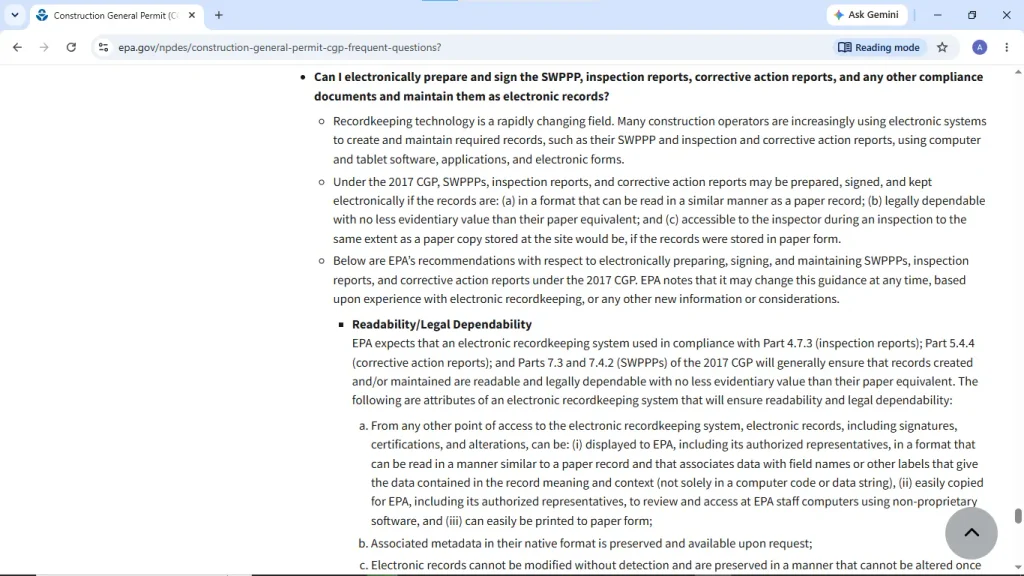
The permit scope is wide enough that this applies to most real projects. The Construction General Permit “applies to operators of construction activities that will disturb one or more acres of land,” and also to smaller sites that are “part of a common plan of development or sale that will ultimately disturb one acre or more.”
So the question to ask a vendor is narrow. Can a foreman create a complete, signed, photo-bearing record with the phone in airplane mode, and will it survive until it syncs. Most demos are run on office wifi, which is why the answer rarely comes up.
Do this: Put a candidate app in airplane mode and try to file one inspection. That test takes four minutes and settles most of the shortlist.
Your software carries a compliance payload with fixed dates
Construction software is not a productivity tool with extra fields. It is a filing system with statutory deadlines attached.
Call it THE COMPLIANCE PAYLOAD. Generic project software models tasks, assignees and due dates you choose. A contractor’s calendar contains dates nobody on your team chose, and missing one is not a productivity problem.
| Obligation | The clock | Who sets it |
| Certified payroll | Weekly, every week of covered work | Copeland Act and contract clauses |
| OSHA 300A electronic submission | A fixed annual date | 29 CFR 1904.41 |
| OSHA 300A posting | February 1 to April 30 | 29 CFR 1904.32 |
| Stormwater inspection | Within 24 hours of 0.25 inches of rain | EPA Construction General Permit |
| Look-back interest | At contract completion | IRC 460 |

The weather row is the one that breaks generic tools completely. A due date you can predict can live in any task manager. A due date created by rainfall needs the software to know what the weather did, which almost none of them do.
That is the test for whether a product was built for this industry or merely sold to it. Ask how the system creates an inspection task after a storm, and whether a foreman has to remember.
Do this: List the dated obligations for one active job. If any row has no owner and no system, that is the first thing to build.
Weekly certified payroll is a signed legal statement
This is not a report. It is a sworn document with criminal exposure, produced every week.
The Department of Labor’s guidance on Form WH-347 explains that the form “is available for the convenience of contractors and subcontractors to submit certified weekly payrolls,” and that “Properly completed, this form will satisfy the requirements of the regulations in parts 3 and 5 of Title 29.”

Using the form is optional. The reporting is not. Covered contractors “are required by the DBRA regulations and the contract clauses to submit payroll information on a weekly basis,” and the Copeland Act at 40 U.S.C. 3145 requires a contractor to “furnish a statement on the wages paid each employee during the prior week.”
Then comes the part generic payroll software cannot produce. “Each certified payroll must be accompanied by a signed ‘Statement of Compliance'” confirming “that the certified payrolls are accurate and complete” and that each worker “has been paid not less than the required Davis-Bacon prevailing wage rate(s).” That statement “is subject to the penalties provided by 18 U.S.C. 1001.”
Do this: Ask whoever signs your certified payrolls how the numbers are assembled. If the answer involves re-keying from a spreadsheet, you have found your highest-risk process.
Safety and environmental records run on clocks you do not set
Two more filing obligations, both annual or weather-driven, both poorly served by a task list.
OSHA’s injury reporting guidance states that for 2025 records “The due date to complete this submission is March 2, 2026,” with the submission window opening on 2 January 2026. The obligation repeats annually on that pattern, so the system needs to produce the data on a date set by the agency.
The thresholds decide whether this applies to you. Electronic submission covers establishments with “250 or more employees and is not in an industry listed in the Exempt Industries list,” and those with “20-249 employees and is in an industry listed in Appendix A to Subpart E of 29 CFR Part 1904.” Separately, Form 300A must be posted “for three months from February 1 through April 30.”
Environmental records are the harder build, because the trigger is rainfall. Under the EPA permit “an inspection is required within 24 hours once a storm event has produced 0.25 inches of rain,” though “inspections are only required during a project’s normal working hours.” Capturing that on site, with photographs, is what a field client exists for, and it is the same shape of problem as any mobile app MVP that has to work where the user actually stands.
Do this: Check whether your current system can prove a rain-triggered inspection happened within 24 hours. Proof means a timestamp and a photo, not a note.
Get the unit of work right or every report is wrong
Generic software models a project. Construction runs on contracts, cost codes, change orders and draws.
This is the mistake with the longest tail, because the unit of work decides what every report can say. A tool that cannot hold cost to date against a cost code against a change order will produce numbers that look fine and reconcile to nothing.
| Generic tool models | Construction needs |
| A project with tasks | A contract with a schedule of values |
| A budget | Cost codes with committed, spent and remaining |
| Change requests | Change orders that move the contract price |
| Invoices | Draws, retainage and lien waivers |
| Percent complete, by feel | Cost to date, auditable |
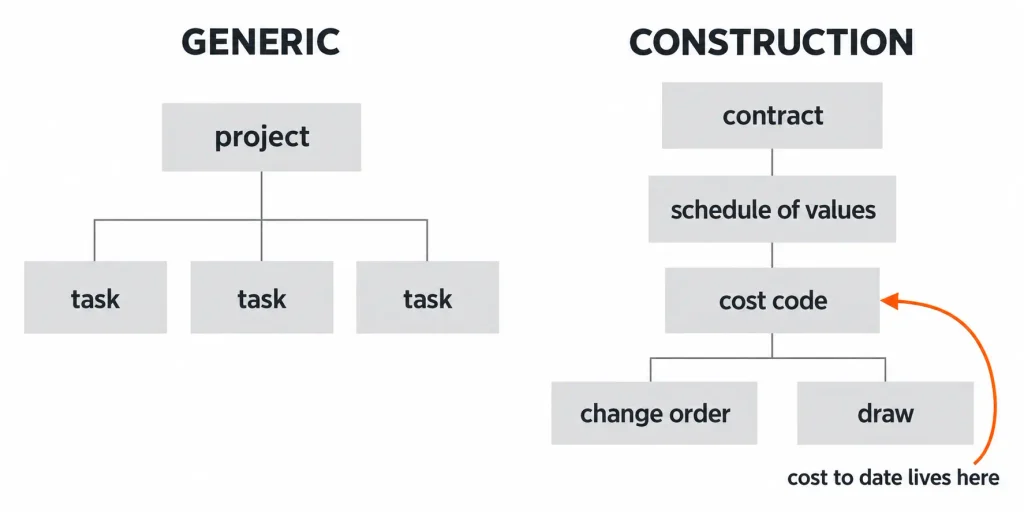
The tax code assumes the construction shape. IRS guidance on look-back interest explains that income “is allocated among the prior taxable years based on actual contract price and costs,” and that Form 8697 “is used to compute and report look-back interest due or to be refunded.”
In plain terms, at completion you recompute earlier years using what the job actually cost. A system that never held auditable cost to date per contract cannot do that, and our case studies start from the data model for exactly this reason.
Do this: Pick one finished job and try to produce cost to date by cost code from your current system. The effort that takes is your answer.
Integrations decide whether anyone opens it
Field software dies when it becomes a second place to type things that already exist somewhere else.
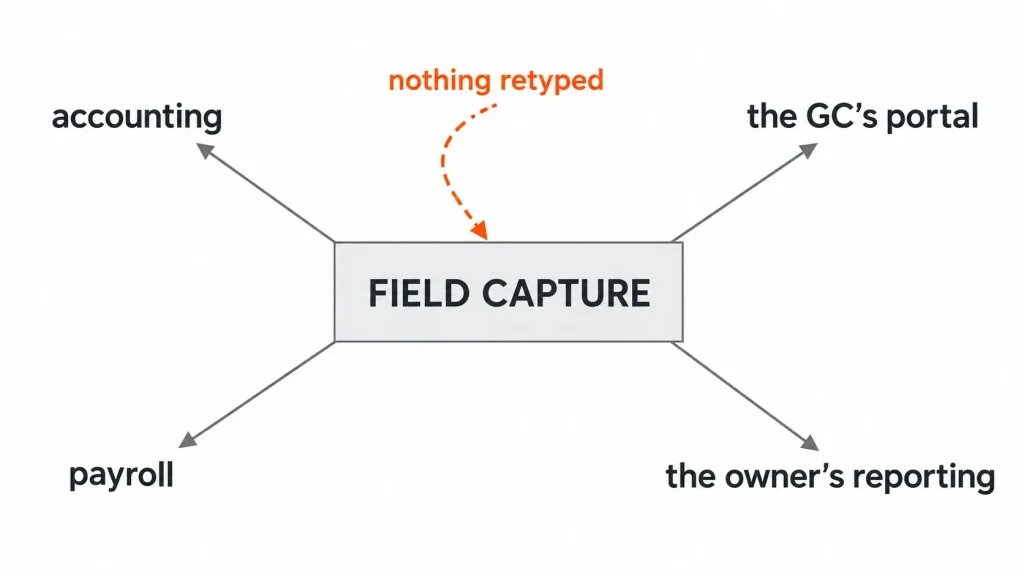
The integration surface is usually accounting first, then payroll, then whatever the general contractor mandates. If hours captured in the field do not reach payroll without a human retyping them, the field app will be abandoned within two months and nobody will tell you why.
Decide early whether this tool is only for you. A contractor who later wants to sell the same software to other contractors is building a SaaS MVP, and that changes the integration work from one accounting system to many.
The honest sequencing is to pick one integration and make it complete. A half-working connection to three systems is worse than a finished connection to one, because partial sync teaches people to distrust the numbers.
Do this: Name the one system that must receive field data without retyping. Build that connection before the second feature.
Buy, configure or build, the honest test
Three options, and custom is the right answer less often than a development company would like to admit.
Buy an off-the-shelf product when your work matches how it already thinks. Configure a flexible platform when your process is unusual but your data is simple. Build when the shape of your work is the thing that makes you money and no product holds it.
| Option | Right when | Watch for |
| Buy a product | Standard trades, standard reporting | Per-seat cost as crews grow |
| Configure a platform | Unusual process, simple data | Offline gaps and export limits |
| Build custom | The data model is your edge | Ongoing ownership after launch |

The configure option is underrated and worth testing first. A no-code platform can carry a genuinely unusual process at a fraction of a build, and the comparison between WeWeb or Bubble is a more useful hour than another vendor demo.
Where configuring falls down is the offline requirement from section one. If the platform cannot capture records without a signal, it fails the permit test, and that is usually the fact that decides a build.
Do this: Run the airplane mode test on a configurable platform before you price a custom build. One of those two paths closes immediately.
What to build first
One workflow, end to end, for one crew. Not a module, and not a pilot across three trades.
The right first build is the record that carries legal weight and is currently captured on paper. Usually that is the daily report with photos, or the inspection record, because both have a defined format and a defined audience.

Ship that one workflow to one crew and watch it for three weeks. You will learn more from which fields they skip than from any requirements document, and the fields they skip are almost always the ones someone added for a report nobody reads.
Then sequence the rest against the compliance calendar rather than against enthusiasm. Payroll week is a worse time to launch anything than the week after, and a realistic build timeline accounts for the fact that your users are outside and busy.
Do this: Pick the one paper record that currently carries legal weight. That is the first build, and nothing else goes first.
What this will not fix
Software does not make a job run better. It makes the record of the job accurate, which is a narrower and more defensible claim.
The industry-level evidence is genuinely mixed. BLS reports that “In the residential construction industries, productivity trended downward over the 2007-19 period,” while industrial building construction “grew at a series record of 45.8 percent” in 2023 before falling 12.1 percent in 2025. BLS itself adds that “Data users should be cautious when interpreting the data.”
Read that as a warning against promising productivity gains. Anyone quoting you a percentage improvement from a software purchase is extrapolating from numbers that move by double digits in both directions year to year.
This also will not remove your obligations. A system that files certified payroll correctly does not make the signature less serious, and the penalties under 18 U.S.C. 1001 attach to the person signing rather than to the vendor.
The specification checklist
Eight questions. Take them to every vendor conversation and every internal build meeting.
- Can a foreman create a complete signed record in airplane mode?
- Does the record survive until it syncs, with both timestamps kept?
- How does the system create an inspection task after a rain event?
- Can it produce weekly certified payroll data without re-keying?
- Can it produce cost to date by cost code for a finished contract?
- Which single system receives field data without anyone retyping?
- What happens to per-seat cost when the crew doubles?
- Who owns and maintains this after launch, by name?
We use this list before writing any code, including on three-week MVP builds where the temptation is to start with the screens.
Where we fit
We build custom field and back-office software, so we are the wrong people to ask whether you should buy a product instead. Saying it plainly.
What we do about it is run the buy, configure or build test first and tell you when the answer is buy. Most of the construction work we take on is a single field workflow plus one integration, because that is the part no product holds and the part that carries legal weight.
This is not the right purchase for everyone. If you run standard trades with standard reporting, an off-the-shelf product configured properly will beat a build on cost and on time. If your data model is simple, try a configurable platform before you price custom work.
If you want the eight questions answered against your actual jobs, book a call with us and bring one finished job and one active one.
Frequently Asked Questions
How much does custom construction software cost?
Scope drives it, and the honest first step is cheaper than a full build. A single field workflow with one integration is a different purchase from a full job-costing system. Ask any vendor to price the first workflow separately, so you can test adoption with one crew before committing to the rest.
Why do contractors abandon construction software?
Two reasons dominate. The record cannot be created without a signal, so crews fall back to paper, and the data has to be retyped into accounting, so the field entry feels like duplicate work. Both are design decisions rather than training problems, which is why more training rarely fixes adoption.
Can off-the-shelf construction software handle certified payroll?
Some products do it well and many do not, so treat it as a specific question rather than a feature checkbox. The requirement is weekly submission with a signed Statement of Compliance under 29 CFR 5.5(a)(3)(ii). Ask to see the output for a real pay period before you buy anything.
Do we need offline capability if our sites have coverage?
Treat it as a compliance question, not a convenience one. The EPA permit requires electronic records to be accessible to an inspector on site to the same extent as a paper copy. Coverage that works most days is a weaker position than a system that works with no signal at all.
Should we build or buy construction management software?
Buy when an existing product already models how your work runs. Configure a platform when your process is unusual but your data is simple. Build when the shape of your work is your advantage and no product holds it. Run the airplane mode test before deciding, because it closes one path quickly.
Resources
- Construction General Permit frequent questions, U.S. Environmental Protection Agency. The one-acre threshold, the rain-triggered 24 hour inspection requirement, and the rule that electronic records must be accessible to an inspector on site.
- Instructions for Form WH-347, U.S. Department of Labor, Wage and Hour Division. Weekly certified payroll, the Statement of Compliance, and the penalties that attach to it under 18 U.S.C. 1001.
- Injury reporting frequently asked questions, Occupational Safety and Health Administration. The Form 300A electronic submission date, the establishment size thresholds, and the February to April posting window.
- Examination and closing procedures, Form 8697 look-back interest, Internal Revenue Service. Percentage of completion under IRC 460, the allocation of income using actual contract price and costs, and the small contractor exception.
- Construction Labor Productivity, U.S. Bureau of Labor Statistics, updated 28 September 2026. Sector productivity trends by construction industry, and the caution about interpreting the data.