

Key Takeaways
The one difference that decides everything, a six-question detector from federal regulation, and why the cheaper model carries a management bill.
- A federal agency may not buy staff augmentation by default. The FAR calls it a personal services contract and bars it without specific statutory authority.
- The statute that does permit it, 5 U.S.C. 3109, caps the services at not more than one year.
- The FAR says the employer-employee relationship arises from the contract’s terms or the manner of its administration. Your behavior decides this, not your paperwork.
- The Department of Homeland Security did not identify specific oversight activities on six of the eight service contracts GAO reviewed in 2020.
- Choose staff augmentation when the work is clear and your direction is cheap. Choose a delivery team when the outcome is clear and the path is not.
The only difference that matters is who owns the outcome
Two buyers can sign the same arrangement, and one of them is legally barred from it.
Quick Verdict: If you can write the tickets and review the work yourself this quarter, staff augmentation is cheaper and faster. If you cannot, buy a delivery team and pay for the outcome instead of the hours, because the management load has to come from somewhere. A web application build under a fixed scope is the delivery-team shape. If you have no in-house engineering at all, the decision you are actually making is agency or freelancer rather than this one.
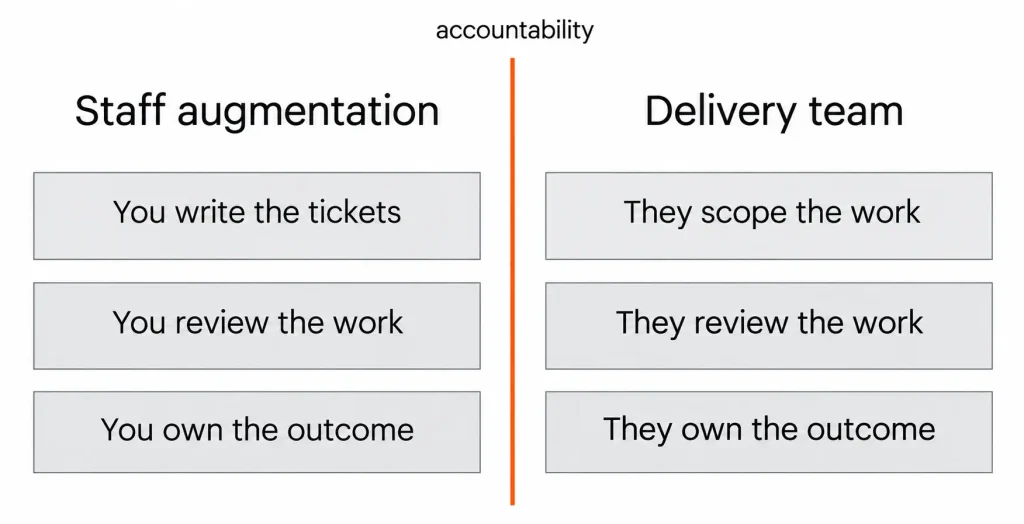
The Federal Acquisition Regulation has clean language for both shapes, and it is worth borrowing because it was written by people who buy services at scale.
FAR 37.101 defines a service contract as a contract that directly engages the time and effort of a contractor whose primary purpose is to perform an identifiable task rather than to furnish an end item of supply. The same section defines a nonpersonal services contract as one under which the personnel rendering the services are not subject, either by the contract’s terms or by the manner of its administration, to the supervision and control usually prevailing in relationships between the Government and its employees.
| Staff augmentation | Delivery team | |
| FAR’s nearest concept | Personal services | Nonpersonal services |
| Who directs the work day to day | You | The vendor |
| Who decides how it gets built | You | The vendor, inside your constraints |
| What you buy | Hours | A defined outcome |
| What you must supply | Direction, review, coordination | Acceptance criteria |
Do this: Write one sentence naming who will reject bad work on this project. If the name is yours, you are buying staff augmentation whatever the proposal says.
The federal government is barred from buying staff augmentation by default
This is the fact that reframes the whole category, and it is three clicks from any browser.
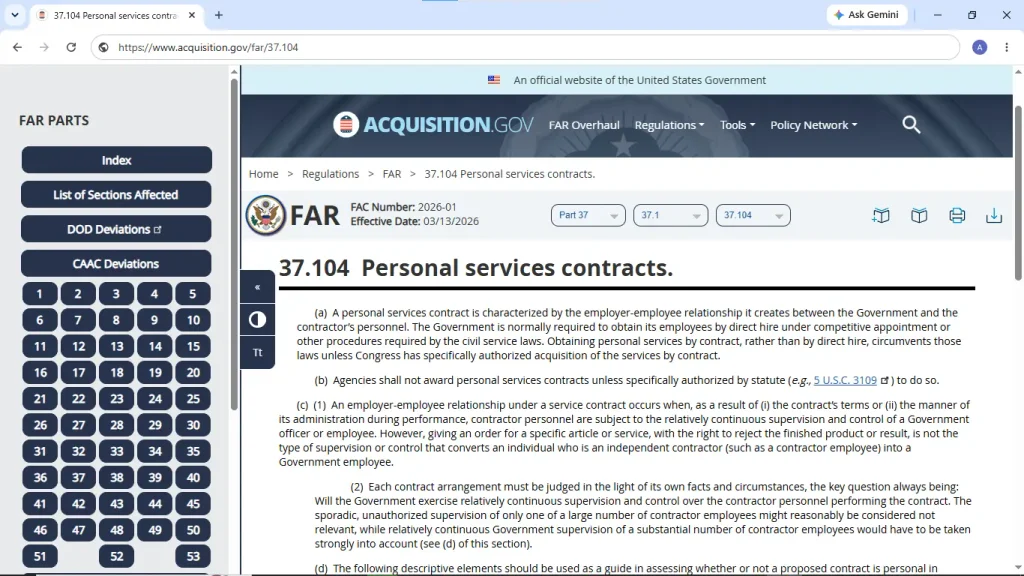
FAR 37.104(a) states that a personal services contract is characterized by the employer-employee relationship it creates between the Government and the contractor’s personnel. It goes on to say that obtaining personal services by contract, rather than by direct hire, circumvents the civil service laws unless Congress has specifically authorized acquisition of the services by contract.
Then FAR 37.104(b): agencies shall not award personal services contracts unless specifically authorized by statute, citing 5 U.S.C. 3109 as the example.
Go and read that statute. Section 3109 is titled Employment of experts and consultants, temporary or intermittent, and it permits an agency head to procure by contract the temporary, not in excess of 1 year, or intermittent services of experts or consultants.
So the one route the regulation points at carries a one year ceiling written into it.
My read: a buyer with professional procurement capability treats this arrangement as something that needs specific permission and a time limit. You can buy it freely. That does not make the risks the regulation is guarding against disappear, and the one they name first is losing control of the function.
Do this: Open FAR 37.104 and read subsections (a) through (d) once. It takes four minutes and it is the clearest writing on this topic anywhere.
Run the six tests on the arrangement you are being sold
The FAR does not stop at a definition. It publishes a detector, and it works just as well on a private contract.
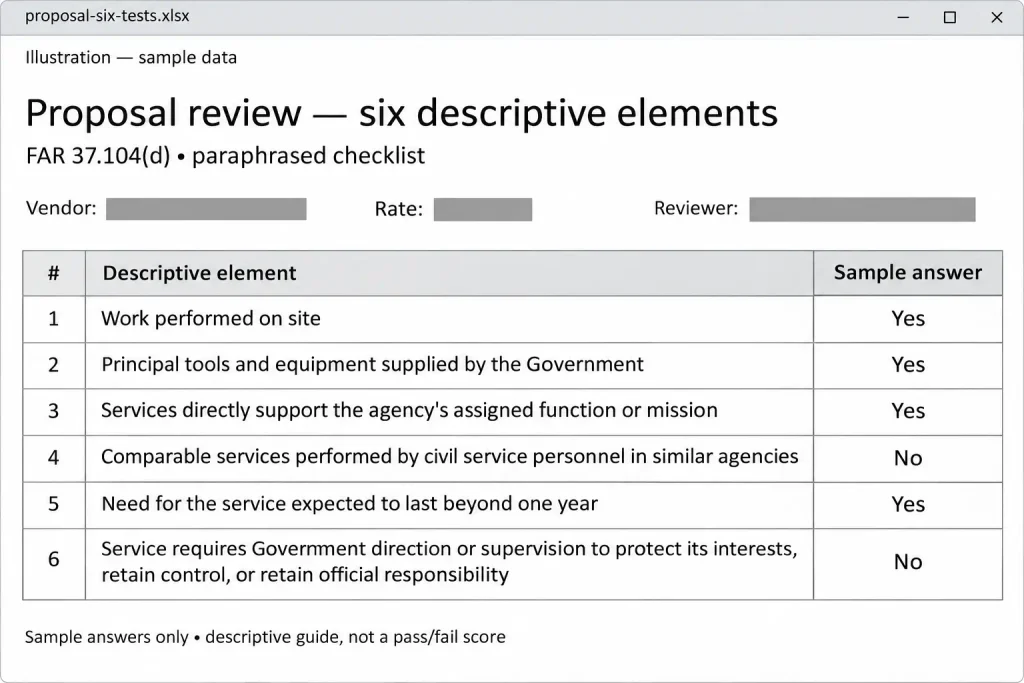
FAR 37.104(d) says the following descriptive elements should be used as a guide in assessing whether or not a proposed contract is personal in nature. Here they are, with what each one means when you are the buyer.
| FAR 37.104(d) element | What it means for you |
| Performance on site | They work in your tools, your repo, your standups |
| Principal tools and equipment furnished by the Government | You supply the environment, the accounts, the laptops |
| Services applied directly to the integral effort in furtherance of assigned function or mission | The work is your core product, not a side system |
| Comparable services performed in the same agencies using civil service personnel | Your own employees already do this job |
| The need can reasonably be expected to last beyond 1 year | This is not a burst, it is a permanent gap |
| The inherent nature of the service reasonably requires direction or supervision | Nobody can do this work without you telling them what to build |
Score the proposal in front of you. Four or more yes answers and you are buying staff augmentation, regardless of the word on the invoice.
That is not a reason to refuse it. It is a reason to budget for what comes with it, which is the next section.
Do this: Score your current proposal against all six rows today, before the rate conversation.
Your contract does not decide this. The manner of its administration does
The sharpest sentence in the whole regulation is about behavior, not paperwork.

FAR 37.104(c)(1) states that an employer-employee relationship under a service contract occurs when, as a result of the contract’s terms or the manner of its administration during performance, contractor personnel are subject to the relatively continuous supervision and control of a Government officer or employee.
Read the two routes again. The contract’s terms, or the manner of its administration.
Subsection (c)(2) is blunter. It says each arrangement must be judged in the light of its own facts and circumstances, and names the key question as whether the buyer will exercise relatively continuous supervision and control over the contractor personnel.
This is the most common failure I see and it costs the buyer both ways. You sign a fixed-scope delivery engagement, then you run daily standups with their engineers, write their tickets, reset priorities weekly and approve every merge. You are now paying delivery-team prices for staff augmentation, and the vendor’s accountability has quietly transferred back to you.
The reverse happens too. You buy hours intending to direct them, nobody has time to direct them, and three weeks of output arrives that nobody specified.
Do this: List every recurring meeting and approval your side would own. If that list looks like managing employees, price the arrangement as staff augmentation.
Price the management load, not the hourly rate
Staff augmentation is cheaper per hour because it is a smaller purchase. The difference does not vanish. It moves to your calendar.

Here is what transfers to you under each model, and it is the table worth forwarding to whoever signs.
| Work item | Staff augmentation | Delivery team |
| Breaking work into tickets | You | Them |
| Technical direction and architecture calls | You | Them, within your constraints |
| Code review and merge approval | You | Them |
| Onboarding to your codebase | You | Them |
| Coordinating across time zones | You | Them |
| Defining acceptance criteria | You | You |
| Accepting or rejecting the result | You | You |
Five of seven rows move. Someone on your side absorbs all five, on top of their current job.
The federal evidence on this is unflattering, and these are buyers with dedicated procurement staff. GAO reported in May 2020, in DHS Service Contracts, that the Department of Homeland Security and selected components do not consistently plan for the level of federal oversight needed for these contracts. On six of the eight contracts GAO reviewed, officials did not identify specific oversight activities, which GAO said meant the department cannot mitigate the risks associated with service contracts in need of heightened management attention.
The pattern is older than that report. In Managing Service Contracts, GAO reviewed 230 statements of work for professional and management support services across five agencies and found that more than half “requested services that closely support the performance of inherently governmental functions.” For the twelve contracts examined in detail, agencies “did not consider and mitigate risks of acquiring professional and management support services” before award, and few officials said they had considered whether the contracted services included such functions at all. The risk was not hidden in the vendors. It went unassessed by the buyers.
If a federal department with a procurement function does not consistently plan the oversight, a startup with one engineering lead should assume it will not either, unless someone writes the hours down. The people most exposed to this are founders who cannot evaluate the code themselves, because the review load they are absorbing is one they cannot actually perform.
Do this: Estimate the weekly hours those five rows need, name the person supplying them, and add that cost to the hourly quote before comparing the two models.
Co-employment is an exposure, not a formality
If you direct contractor personnel like employees, a tax authority may read the relationship the same way you are running it.

The IRS page on independent contractor or employee status groups the evidence into three categories. Behavioral control asks whether the company controls or has the right to control what the worker does and how the worker does the job. Financial control asks whether the business aspects of the worker’s job are controlled by the payer. Type of relationship asks whether there are written contracts or employee type benefits.
The page states that a worker is an employee under the common-law rules if you can control what will be done and how it will be done, and that what matters is the right to control the details of how the services are performed.
Note what that turns on. Not whether you exercise the control. Whether you have the right to.
The consequence is stated plainly on the same page: a business that classifies an employee as an independent contractor without a reasonable basis may be held liable for employment taxes for that worker.
Two practical guards. Contract with the vendor entity rather than with individuals, and keep the vendor responsible for their people’s employment, equipment and performance management. Second, treat the access question as its own control: augmented personnel with production credentials sit inside the same scope as any SOC 2 access control program, and reviewers often ask about them specifically.
Do this: Check whether your agreement is with a company or with named individuals. If it is with individuals, take it to an employment attorney before the next renewal.
Choose by what is unclear, not by what is cheap
The decision is not about cost. It is about which part of the problem you can already specify.
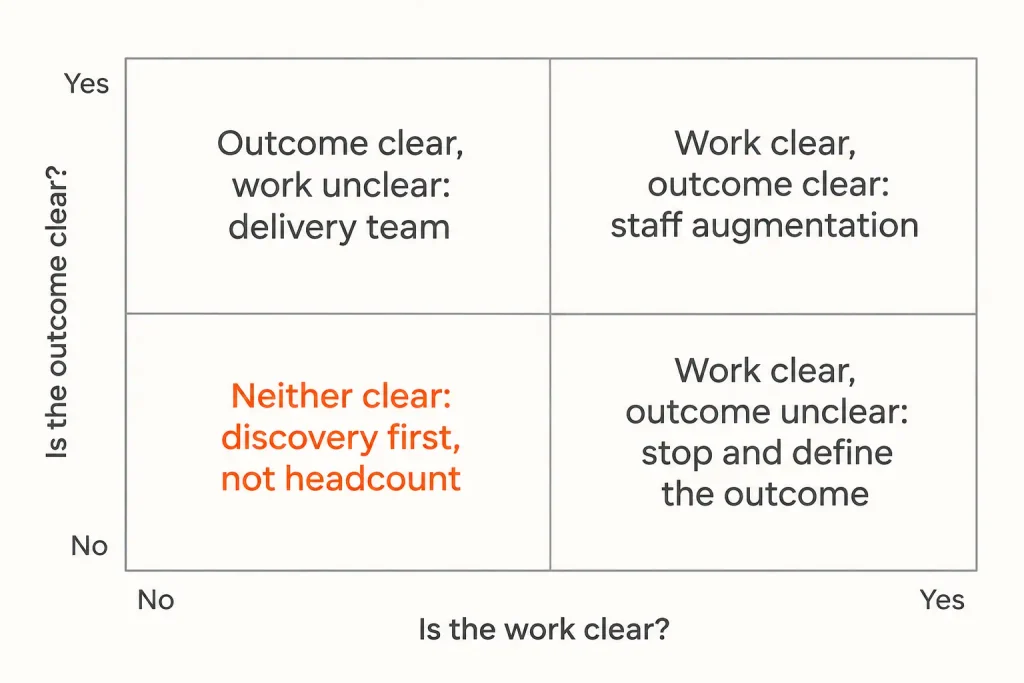
Four situations, four answers.
The work is clear and the outcome is clear. Staff augmentation, because your direction is cheap to supply and you are only short of hands.
The outcome is clear and the path is not. A delivery team, because you are buying the thinking as well as the typing, and you want one party accountable for getting there.
The work is clear but the outcome is not. Stop. Neither model fixes an undefined outcome, and buying either one now converts a product question into a staffing cost.
Neither is clear. Run a short discovery with a small senior group before adding anyone. Headcount applied to an unclear problem produces more work to review, not more progress. That is also the moment to check your delivery schedule against reality rather than against the plan.
Do this: Put your project in one of the four quadrants in writing. If you cannot, you are in the fourth one.
What neither model fixes
Some of this is outside what any engagement model touches, and buying harder makes it worse.
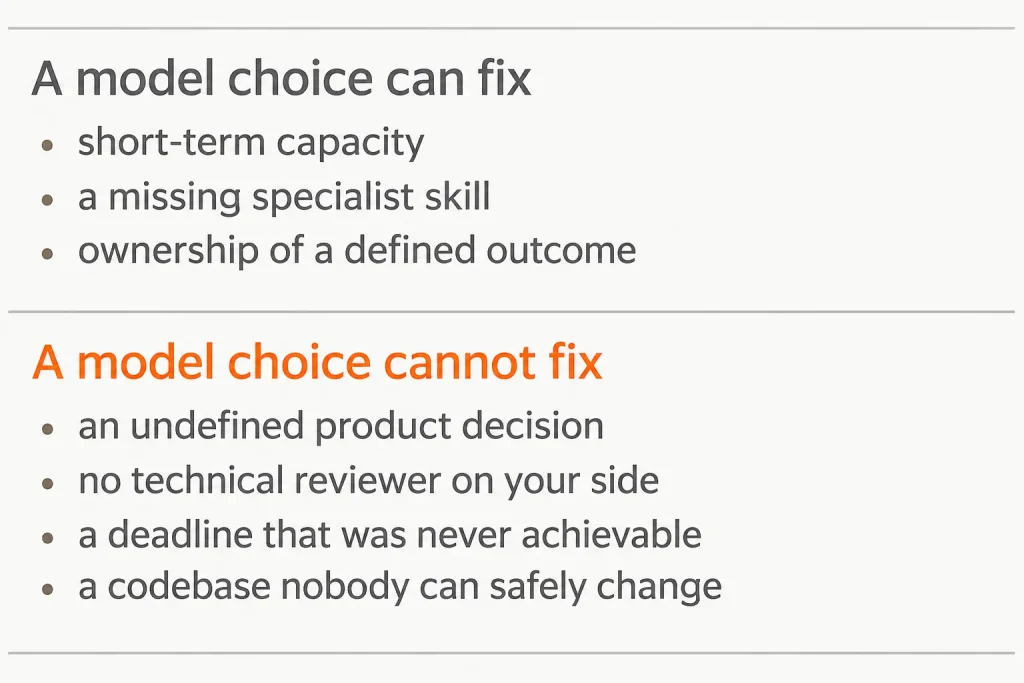
Neither model supplies a technical reviewer you do not have. Augmented engineers need one, and a delivery team still needs someone on your side to accept or reject the result. That row stayed with you in both columns of the table above.
Neither model rescues a date that was never achievable. Adding people to a late project adds coordination before it adds output, and the first weeks of any arrangement are net negative while people learn your system.
I cannot tell you which model fits your situation from here, and I am not going to pretend a framework does that. Nothing here is legal, tax or employment advice. The FAR and the IRS pages above are written for federal procurement and US tax classification respectively, not for your contract. Take the co-employment question to an employment attorney in your jurisdiction.
One honest limit on this piece. Velcod has no original data on outcomes under the two models, so nothing here is a measured result. Everything above is drawn from primary regulation, a federal statute, IRS guidance and GAO’s own audit findings, which is solid for the structure of the decision and silent on how often each model succeeds. If you want that number, nobody credible has published it.
Where we fit: if your outcome is clear and the path is not, that is the delivery-team shape and the first step is Get your build plan. It is complimentary, comes back in two business days, and includes the recommended scope, the stack with reasons, the cut list, a fixed price and a launch date. No sales call. We are the wrong call if you scored five or six yes answers on the six tests, because then you need hands under your own direction and a fixed-scope vendor is the expensive way to buy them. Get your build plan and we will tell you which of those two you are. You can see how we scope and sequence work and read what previous builds produced first.
Do this: Score the six tests, name your reviewer, then choose. In that order.
Frequently Asked Questions
Is staff augmentation cheaper than a delivery team?
Per hour, usually yes. In total, often no. Five of the seven work items in the table above transfer to you under staff augmentation: ticket writing, technical direction, code review, onboarding and coordination. Price those hours against someone’s real calendar and compare the totals rather than the rates.
How do I know which one a vendor is actually selling me?
Score their proposal against the six descriptive elements in FAR 37.104(d). Four or more yes answers means staff augmentation whatever the contract is titled. The FAR is explicit that the relationship arises from the contract’s terms or the manner of its administration, so also check how you intend to run it.
Can I start with staff augmentation and switch to a delivery team later?
Yes, and it is a common path, but the switch is a real renegotiation rather than a settings change. A vendor cannot accept accountability for an outcome you have been directing ticket by ticket until the scope, the acceptance criteria and the review rights are rewritten. Plan it as a new engagement.
What is co-employment risk in plain terms?
It is the risk that a tax or labor authority treats contractor personnel you direct as your employees. The IRS says a worker is an employee under common-law rules if you can control what will be done and how it will be done, and that the right to control is what matters. Contract with the vendor entity, not with individuals.
How is this different from choosing between a freelancer and an agency?
That decision is about who builds a product you do not have yet. This one is about adding capacity to a team you already run. If you have no in-house engineering and no technical reviewer, you are making the first decision and should not be comparing these two models at all.
Resources
- FAR Part 37, Service Contracting, Federal Acquisition Regulation. The 37.101 definitions of a service contract and a nonpersonal services contract, the 37.104 personal services definition and prohibition, the terms-or-administration test at 37.104(c)(1), and the six descriptive elements at 37.104(d).
- 5 U.S.C. 3109, Employment of experts and consultants; temporary or intermittent, Legal Information Institute, Cornell Law School. The statute FAR 37.104(b) names, permitting temporary services not in excess of one year, or intermittent services, of experts or consultants.
- Independent contractor (self-employed) or employee?, Internal Revenue Service, page last reviewed 19 May 2026. The three categories of evidence, the common-law control standard, the right-to-control point, and the employment tax liability consequence of classifying without a reasonable basis.
- DHS Service Contracts: Increased Oversight Needed to Reduce the Risk Associated with Contractors Performing Certain Functions, U.S. Government Accountability Office, GAO-20-417, published 7 May 2020. That oversight levels are not consistently planned, and that officials on six of eight reviewed contracts did not identify specific oversight activities.
- Managing Service Contracts, U.S. Government Accountability Office, report GAO-12-87. That more than half of the 230 statements of work sampled requested services closely supporting inherently governmental functions, and that using such services can inappropriately influence decisionmaking without proper oversight.