Key Takeaways
How to choose between a freelancer and an agency for your MVP, based on real 2026 costs, the risks nobody prices in, and how fast you actually need to ship.
- Cheapest on paper is rarely cheapest in the end. A freelancer’s low rate often hides rework, delays, and a rebuild you pay for twice.
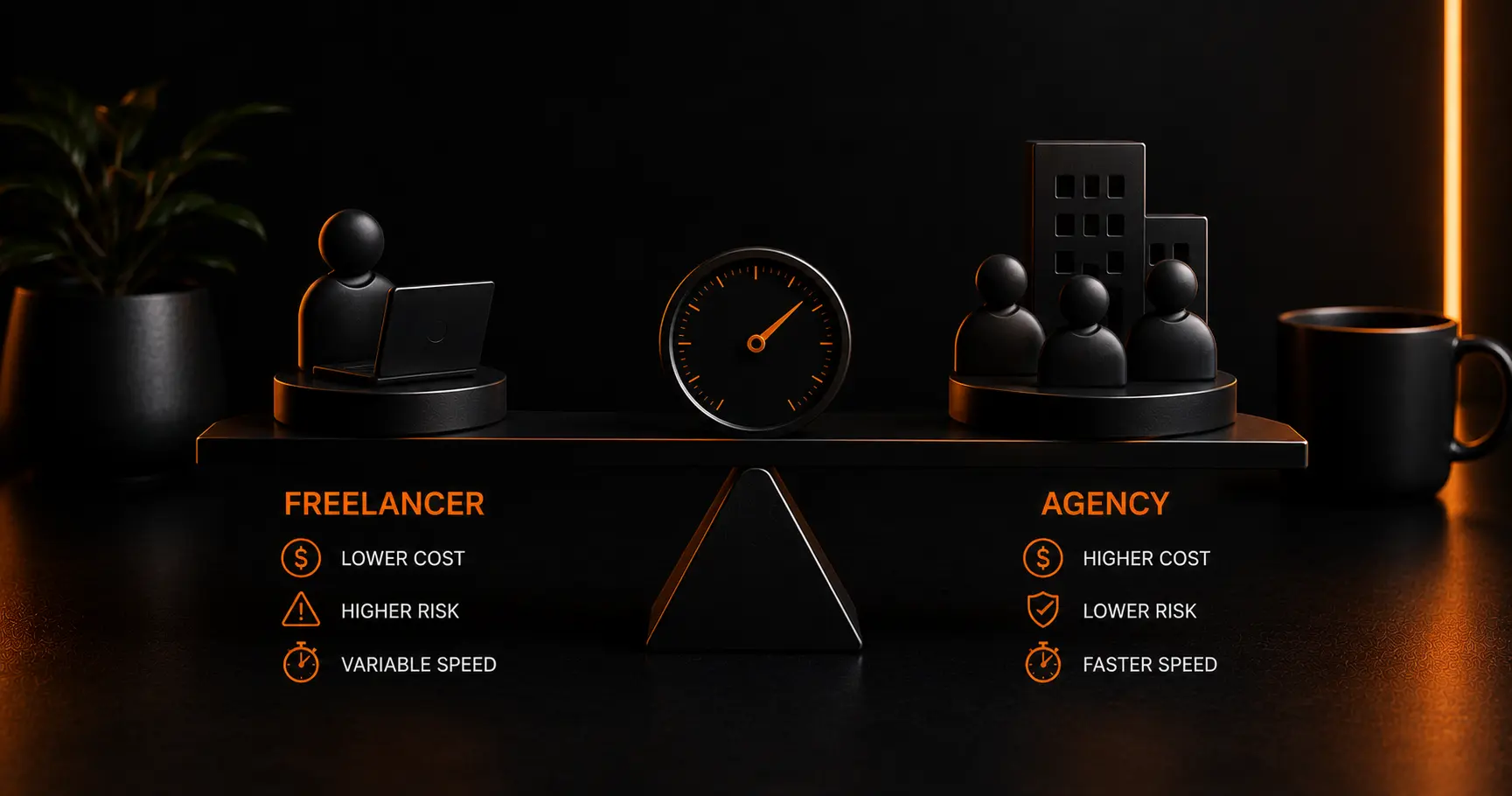
- The real difference is risk, not price. One freelancer is a single point of failure; an agency spreads the risk across a team and a process.
- Freelancers win on tiny, well-defined jobs. For one screen, one integration, or a quick fix, a good freelancer is faster and far cheaper.
- Agencies and studios win on full MVPs. When you need design, build, launch, and a deadline you can trust, the coordinated team is worth the premium.
- A fixed-scope studio is the founder-friendly middle. You get agency reliability with freelancer-like pricing clarity, and you keep the code.
The freelancer vs agency MVP decision looks like a budget question and is really a risk question. A freelancer quotes you a number that feels safe, an agency quotes one that makes you flinch, and most non-technical founders pick on price alone. Then the cheap option quietly becomes the expensive one: the build slips, the code is a mess, and you are hiring someone new to finish, or start over, three months later.
This guide breaks the choice down the way it actually plays out for a startup: what each path really costs in 2026, the risks that never make it into a quote, how each affects your speed to launch, and which option fits your specific budget, timeline, and scope.
What “Freelancer vs Agency” Really Means for Your MVP
Hiring a freelancer means contracting one independent person to build your product, usually paid hourly or per milestone. Hiring an agency means engaging a company with a team, a process, and a project manager who owns delivery. The gap between them is not just size. It is accountability, coverage, and what happens when something goes wrong.
That distinction matters more for an MVP than for almost any other project, because an MVP is a race against your runway. You are not just buying code. You are buying the odds that a working, launchable product exists by a specific date, built well enough that real users and investors take it seriously. Those odds are exactly what a freelancer and an agency price so differently.
Quick Verdict: Hire a freelancer for a small, well-defined piece of work on a tight budget when you can manage the project yourself and a delay would not sink you. Hire an agency or studio for a full MVP you need shipped reliably by a deadline, with design, build, and launch handled end to end. If you want agency reliability with fixed, upfront pricing and full code ownership, talk to Velcod.
Freelancer vs Agency for Your MVP at a Glance
| Factor | Freelancer | Agency / Studio |
| Cost | Lower hourly rate, variable total | Higher, but usually fixed or scoped |
| Speed to a full MVP | Slower (one person, one queue) | Faster (parallel design and build) |
| Risk if they vanish | High, the project stops | Low, the team absorbs it |
| Scope covered | Usually one skill (build or design) | Design, build, QA, launch |
| Project management | You do it | Included |
| Code ownership | Depends on the contract | Should be yours in writing |
| Best for | Small, defined tasks | Full, deadline-driven MVPs |
The pattern is consistent: a freelancer optimizes for a low rate on a narrow task, while an agency optimizes for delivering a whole outcome on time. Neither is universally better. The right pick depends on how big and how urgent your build really is.
What Hiring a Freelancer Actually Looks Like
A freelancer is one person you find on Upwork, Toptal, or a referral, who takes your project on directly. At their best, freelancers are fast, affordable, and personal: you talk to the person doing the work, with no account manager in between and no agency overhead on the invoice.
The trade-off is coverage. Most freelancers are strong in one area, so a “full-stack” MVP with design, backend, payments, and a polished front end often stretches beyond what one person does well. You also become the project manager by default, writing the spec, testing the work, chasing updates, and catching gaps. For a technical founder that can work. For a non-technical one, it is a second job you did not plan to take.
What Hiring an Agency Actually Looks Like
An agency is a company that assigns a team to your build: typically a designer, one or more developers, and a project manager who keeps it moving. You get a process, a timeline, and a single point of contact who is accountable for delivery, not just for writing code.
That structure is what you are paying the premium for. When a developer gets sick, the team covers. When you need design and backend at once, they run in parallel. When something breaks after launch, there is an organization on the hook, not a person who may have moved on to the next gig. The downside is cost and, at larger traditional agencies, slower timelines and more bureaucracy than a lean startup wants.
The True Cost: Freelancer vs Agency in 2026
Sticker price and true cost are not the same thing here, and the gap is where founders get burned. Freelance developer rates on Upwork in 2026 run roughly $25 to $60 an hour for intermediate talent and $60 to $120+ for experts, while vetted senior US freelancers often bill $80 to $150. Traditional agencies bill more, commonly $110 to $230 an hour, and a full agency MVP frequently lands between $30,000 and $150,000 depending on scope.
| Build path | Typical 2026 MVP cost | What drives it |
| Freelancer | 5,000–30,000 | One person, hourly, you manage it |
| Traditional agency | 30,000–150,000+ | Full team, hourly or large fixed bids |
| Fixed-scope studio | 12,000–50,000 | Scoped team build, price agreed upfront |
The number that does not appear in any quote is the cost of failure. Research on software delivery consistently finds that roughly 1 in 4 outsourcing relationships fail, and a large share of software projects miss their scope, budget, or timeline targets. A $12,000 freelancer build that has to be redone by an agency did not cost $12,000. It cost that, plus the rebuild, plus the months of runway you burned learning the lesson.
The Risk Trade-Off
Cost gets the attention, but risk is what actually separates these two paths. This is the part most founders underweight until it bites.
Single Point of Failure
A freelancer is one human with one life. If they get sick, take a better-paying contract, or simply stop replying, your project stops with them, and you may not even own a clean copy of the code. Agencies carry what teams call a low “bus factor”: the work is spread across people, so no single absence halts the build. For a company betting its runway on a launch date, that redundancy is not a luxury.
Quality and Rework
Freelance quality varies enormously, even between two people with similar profiles and ratings, and a bad hire is expensive in time you cannot get back. A meaningful share of startups report needing significant rework after a low-cost build, and rework on an MVP is brutal because it arrives exactly when your runway is thinnest. Agencies are not immune to quality problems, but a review process and more than one set of eyes catch more before it ships.
Code Ownership and Lock-In
With either path, ownership lives in the contract, not in good intentions. A freelancer might hold your repository, accounts, or credentials, and some agencies lock you into proprietary platforms you cannot export. Insist, in writing and before work starts, that you own the full code, designs, data, and accounts from day one. If anyone resists that, treat it as a preview of the whole relationship.
The Speed Trade-Off
Speed is where the math surprises people. A freelancer feels faster to start, because you can hire one in a day, but a full MVP moves at the pace of a single person working one task at a time. Design waits for build, build waits for testing, and every handoff is a queue of one.
An agency or studio runs work in parallel. Design and backend progress at the same time, integrations happen alongside core features, and QA overlaps the build instead of following it. That is why a well-scoped studio can ship a real MVP in about three weeks while a solo freelancer on the same scope needs two to three months. If your deadline is an investor meeting or a market window, the coordinated team usually gets you there first, even though its start feels slower.
Where a Freelancer Wins
A freelancer is genuinely the smarter choice in several situations, and any honest guide has to say so. When the job is small and well defined, a single screen, one API integration, a bug fix, or a landing page, a good freelancer is faster to engage and far cheaper than any agency minimum. If you are a technical founder who can write the spec and review the work yourself, you remove the freelancer’s biggest weakness, which is the missing project management layer. And on a genuinely tight budget where a delay would not be fatal, a freelancer lets you make progress you otherwise could not afford. For focused, low-risk work, paying agency overhead is simply wasteful.
Where an Agency Wins
An agency earns its premium the moment your project stops being a single task and becomes a whole product. When you need design, development, QA, and launch handled together, one team beats stitching three freelancers into a pipeline you have to manage. When the deadline is real and non-negotiable, the team’s redundancy and parallel workflow protect the date. And when the stakes are high, an investor demo, a paying customer, a regulated feature, the accountability of a company on the hook is worth more than a lower hourly rate. For a full, deadline-driven MVP, that reliability is usually the deciding factor.
The Third Option Most Founders Miss
The freelancer versus agency framing hides a better middle for many founders: a lean, fixed-scope product studio. Traditional agencies are built for enterprise budgets and timelines, while freelancers are built for single tasks. A studio sits between them, giving you a small senior team, an agency-grade process, and a price agreed upfront, without the six-figure bill or the six-month calendar.
Modern studios also build on no-code, low-code, and AI-assisted stacks like Bubble, FlutterFlow, and Supabase, which compress a build that once took months into weeks. That is what makes a fixed three-week MVP realistic today. Two other paths exist and deserve honesty: hiring in-house makes sense once the product is your core and you can afford senior salaries, and nearshore teams can lower cost if you can manage the coordination. For most non-technical founders shipping a first MVP, though, a fixed-scope MVP development studio is the lowest-risk way to get a real product fast without becoming a project manager.
Who Should Choose a Freelancer, an Agency, or a Studio
Match the path to your stage, not to the lowest number.
Choose a freelancer if you are technical enough to manage the work, the scope is a small and well-defined piece, and your budget is tight enough that reliability is a fair thing to trade for a lower rate. Choose a traditional agency if you are funded, the project is large or complex, and you need deep specialist capacity with enterprise-grade process. Choose a fixed-scope studio if you are a non-technical, pre-seed to Series A founder who needs a full, investor-ready MVP shipped fast, wants a price you can plan around, and refuses to gamble your runway on a single freelancer’s availability.
How to Vet Whichever You Choose
The same discipline protects you on either path. Ask to see real, recent, live work you can actually open and use, not a slide of logos. Confirm in writing that you own the code, designs, and accounts. Get a fixed scope and a clear timeline, and treat a firm price quoted before any real discovery as a warning sign, not a bargain.
For a freelancer, the red flags are no reviewable portfolio, no clear process, a single point of contact who goes quiet, and vague answers on ownership. For an agency, watch for a 20-page proposal within a day of a first call, proprietary lock-in, and a refusal to name deliverables or price. Cross-check either against verified reviews on Clutch rather than testimonials curated on their own site.
How Velcod Fits
Velcod is a fixed-scope MVP studio built for exactly this decision. You get a senior-only team, design and build and launch handled end to end, a price agreed before we start, and full code ownership handed to you at the end, so there is no single point of failure, no hourly meter, and nothing held hostage. It is agency reliability with the pricing clarity founders wish freelancers offered.
The promise is deliberately simple: an investor-ready MVP in three weeks or it is free, because a fixed, honest scope is what keeps a startup out of the rebuild statistics. You can see real products shipped for non-technical founders in the case studies. If you are weighing a freelancer against an agency and want a straight answer on which fits your build, book a call and get a fixed quote.
The real question was never “freelancer or agency.” It is “what is the cheapest way to get a reliable, owned MVP shipped before my runway runs out.” Answer that honestly, and the right path picks itself.
Frequently Asked Questions
Is it cheaper to hire a freelancer or an agency for an MVP?
A freelancer is cheaper per hour and often cheaper upfront, with MVP builds around $5,000 to $30,000 versus $30,000 or more at a traditional agency. But the true cost includes risk: if a freelance build needs rework or a rebuild, you pay twice. A fixed-scope studio often lands between the two on price with agency-level reliability.
Should a non-technical founder use a freelancer or an agency?
Usually an agency or a fixed-scope studio. A freelancer leaves you managing the project, writing specs, and testing work, which is hard without technical skills. An agency or studio handles design, build, and launch end to end, so a non-technical founder gets a working, owned product without becoming an accidental project manager.
What is the biggest risk of hiring a freelancer for your MVP?
The single point of failure. One freelancer can get sick, take another contract, or stop responding, and the project stops with them, sometimes without you holding clean code. That risk is why teams value the redundancy of an agency, where the work is spread across people and no single absence halts your build or your launch date.
How long does an MVP take with a freelancer vs an agency?
A solo freelancer on a full MVP typically needs two to three months, because one person works one task at a time. An agency or studio runs design, build, and testing in parallel, so a well-scoped MVP can ship in about three weeks. If you have a hard deadline, the coordinated team usually reaches launch faster.
How do I make sure I own my MVP’s code?
Put it in the contract before work begins. State that you own the full source code, designs, data, and all accounts, with everything transferring to you as work is delivered. This applies to freelancers and agencies alike. Anyone who resists clear ownership terms is showing you how the rest of the engagement will go.
Resources & Further Reading
- Upwork: Freelance Hourly Rates: current 2026 freelance developer rate benchmarks by skill and experience.
- CB Insights: Why Startups Fail: the data on product-market fit and running out of cash, the risks a slow build amplifies.
- The Software House: Why Outsourcing Fails: research on outsourcing failure rates and how to avoid them.
- Clutch: verified B2B reviews for vetting freelancers and agencies with real client feedback.
- Y Combinator: How to Build an MVP: YC’s guidance on scoping and shipping a first product fast.
- Toptal: context on vetted senior freelance talent and where higher rates come from.

M. Sabir Junaid
Founder • CEO
M. Sabir Junaid is founder and CEO of Velcod, the senior product studio. He leads product and delivery across MVPs, SaaS platforms, and mobile apps — system architecture, no-code and low-code engineering, and AI integration. An official Bubble partner, Sabir has shipped products across fintech, marketplaces, edtech, and creator platforms. He works with founders raising pre-seed to Series A who need a product built to launch and scale in weeks, not a six-month agency build.
Share
- Previous
- Next
Ready to build?
Your idea, live in 3 weeks.
Book a free strategy call and get a fixed-price roadmap for your MVP, SaaS, or app.